unnamed (1) Courtesy: Ministry of External Affairs, India
7 April 2022

A formal, opportune BIMSTEC

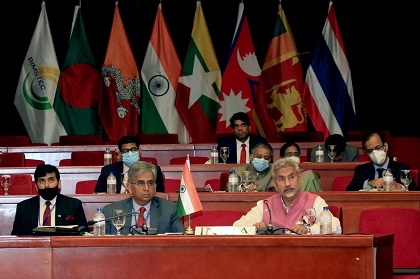
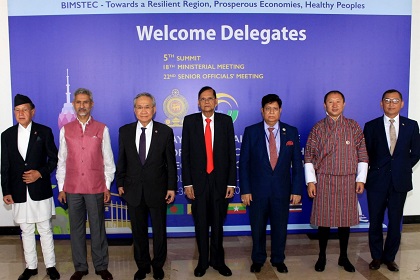
The recently concluded BIMSTEC summit is now a regional intergovernmental organization with a formal charter, giving it a clear mission and legality and a destiny linked to South and South East Asia. It is now better equipped to accelerate economic development for the fifth of the world’s population, which contributes only 4% of global GDP.
bimstec 2022 Courtesy: BIMSTEC
31 March 2022

BIMSTEC steps forward

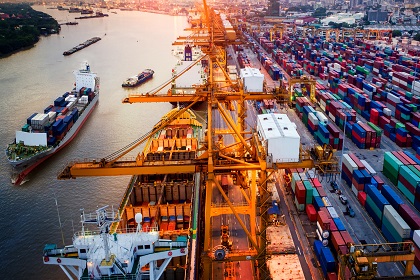
BIMSTEC is of special importance to India as it is a crucial link between the Neighbourhood First and Act East policies. This almost 25 year old multilateral can contribute to the Indo-Pacific region by addressing challenges in strategic areas of regional connectivity, security cooperation, free trade, and geoeconomic ties with external partners.

Logistics,And,Transportation,Of,Container,Cargo,Ship,And,Cargo,Plane Courtesy: Shutterstock
10 March 2022

India in the Resilient Supply Chain Initiative

Concerns of global supply chains being overdependent on China has shifted the focus to India. This became clear in 2021 when Australia, Japan and India together launched the Resilient Supply Chain Initiative. India must now leverage its unique position in the Indo-Pacific region by incorporating well-planned industrial clusters and models.

TDB_car_151021 Courtesy: TDB
24 February 2022

Enhancing Regional Financial Intermediation in the Indo-Pacific

Financial intermediaries are critical lubricants for business, growth and development. The Indo-Pacific countries are industrializing, but smaller nations lag behind economically. The Quad countries can aid the advancement of the financial architecture in the Indo-Pacific by helping to develop an ecosystem, modelled on the examples of Japan and India.

Countering China's Maritime Greyzone activities Courtesy:
22 July 2021

Countering China’s Maritime Grey Zone Activities

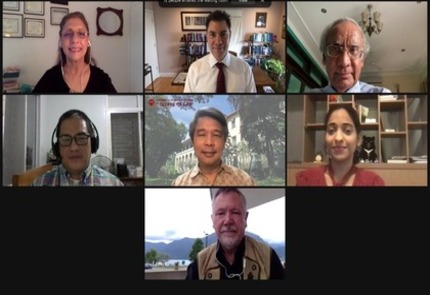
On 15 July, Gateway House co-hosted a webcast with Konrad-Adenauer-Stiftung (KAS) on 'Countering China’s Maritime Grey Zone Activities'. The panel discussed the potential strategies that smaller nations in the region can adopt to overcome the challenges of Chinese maritime grey zone activities, and the role of regional maritime powers in capability-building of maritime law enforcement agencies.

SAARC and BIMSTEC Courtesy: Nepal Institute for International Cooperation and Engagement
1 July 2021

Revitalizing SAARC and BIMSTEC

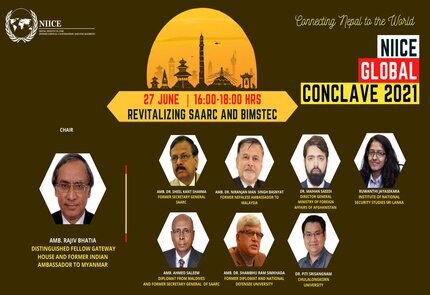
On 27 June 2021, Ambassador Rajiv Bhatia, Distinguished Fellow, Gateway House, chaired a session on Revitalizing SAARC and BIMSTEC. This was part of the Global Conclave 2021, hosted by the Nepal Institute for International Cooperation and Engagement (NIICE), Kathmandu. Bhatia spoke about the present state, past trajectory and future challenges and opportunities for regional and sub-regional cooperation through SAARC and BIMSTEC.

BIMSTEC: Potential and Opportunities Courtesy:
22 February 2021

BIMSTEC: Potential and Opportunities

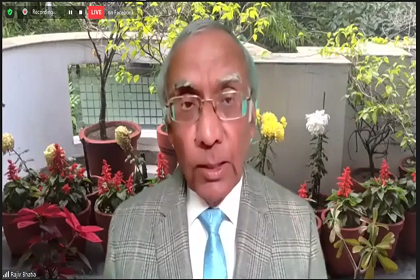
During the Bay of Bengal Economic Dialogue 2021 on, Post-COVID Challenges in the Bay of Bengal Region, Amb. Rajiv Bhatia, Distinguished Fellow, Foreign Policy Studies, Gateway House addresses the staggered growth of BIMSTEC, whilst also highlighting its potential as a regional grouping. He identifies the lack of political commitment, bureaucratic inertia and insufficient engagement of the Third Space and disregard for the region as a community as the chief obstacles to a successful initiative.

Vietnam's effective ASEAN leadership Courtesy: asean.org
13 January 2021

Vietnam’s effective ASEAN leadership

Vietnam had a busy 2020, starting with its chairmanship of ASEAN and ending with the signing of RCEP, and a free trade agreement with the EU. All were completed successfully despite the pandemic, which it also handled well. It has revealed Vietnam’s dexterity and confidence, good management and societal control and raised the country’s global profile.

50636637062_a0e491ec59_c Courtesy: MEA/Flickr
26 November 2020

The ASEAN- India Summit: A new direction emerges

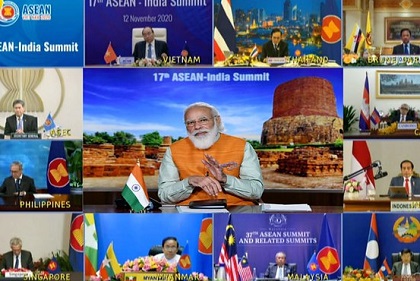
The recently concluded ASEAN and EAS Summit saw Prime Minister Modi highlighting the Indo-Pacific region. That’s because a cohesive, responsive and prosperous ASEAN is seen as vital to India's Indo-Pacific Vision and to Security And Growth for All in the Region (SAGAR). India’s decision to opt out of RCEP, even when all ASEAN member countries are signatories to that agreement, will mark a shift in how India enhances bilateral engagements with ASEAN nations with greater strategic intent.