Book review: Exploring the origins of World War I
In 'The War that ended Peace: The Road to 1914', Margaret Macmillan delves into the decades leading up to 1914, as she explores why Europe abandoned years of peace to plunge into World War I

 Courtesy: Random House
In 'The War that ended Peace: The Road to 1914', Margaret Macmillan delves into the decades leading up to 1914, as she explores why Europe abandoned years of peace to plunge into World War I
 Courtesy: remy steinegger / Flickr
German President Joachim Gauck’s visit to India this week is a reminder of how Germany is addressing inequality, with better wages, benefits for the poorest, and other measures. When the gap between the rich and poor is growing globally, it is time for India’s prime ministerial aspirants to also focus on this issue
 Courtesy: Wikimedia Commons
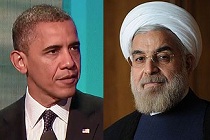
The P5+1 negotiations with Iran, mostly a Washington-Tehran affair, may be a means to a complex and ambitious end: a new strategic and energy equation in Southwest Asia. U.S. President Barack Obama’s recent State of the Union address indicates that to reach this goal, the U.S. is steering away from war to diplomacy
 Courtesy: Press Information Bureau
With intra-regional trade at a low 4.23%, South Asia is the ‘least integrated region in the world.’ At the recent fifth SAARC Conclave in New Delhi, officials spoke about the need for better integration. But this is only possible if problems such as political differences and inadequate connectivity are addressed
 Courtesy: Ministry of External Affairs, India
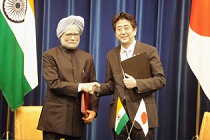
Japan’s reaching out to India, as demonstrated by the upcoming visit of Prime Minister Shinzo Abe, reflects the urgency with which Japan sees the threat of a rising China. India too has experienced Chinese aggression and must work with other democracies towards creating a multi-polar Asia
 Courtesy: Secretary of Defense/Flickr
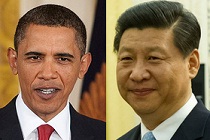
U.S. President Barack Obama’s focus on domestic issues has sidelined his country’s foreign policy at a time when China is ascending as a superpower. With China’s economy set to surpass the U.S.'s by 2017, a recent report presents a ‘grand strategy’ for the U.S. to counter China’s economic and strategic expansion
 Courtesy: The Prime Minister's Office/Flickr
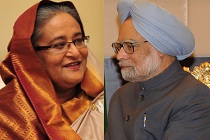
The return of the Awami League to power has generated protests and violence in Bangladesh. India’s support to the January 5 election was aimed at keeping at bay anti-India forces in Bangladesh, but anti-India sentiment in the country is high and fresh elections may throw up a result that does not suit New Delhi
 Courtesy: Press Information Bureau/Wikimedia Commons
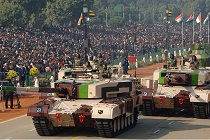
What are the implications for India of the scaling down of U.S. forces from Afghanistan, the continuing tension with China at the border, and the political turmoil in Bangladesh? How should India address these and other upheavals in its neighbourhood, which are potential challenges to the country’s security?
Vivek Katju, former Indian Ambassador to Afghanistan, says about India’s attempts to reintegrate the Afghan economy into the region. In an interview to Gateway House he also talks about why it will take time for Afghanistan to become a bridge for the flow of trade, and how the U.S.-Pakistan equation impacts India
The Afghan Youth Peace Volunteers, an Afghan youth group, say Afghanistan must be self-reliant and not look to foreign powers for aid to rebuild their country. Gateway House’s Rajni Bakshi speaks to the group to find out about their vision for Afghanistan