myanmar Courtesy: Reuters
3 March 2021

Myanmar’s coup, India’s way forward

In principle, India supports democracy everywhere, but is also committed to non-interference in the internal affairs of other countries. But instability in Myanmar could trigger support for insurgency in India's North east, which is now on the path to progress. Accelerating the completion of India’s development cooperation projects in Myanmar will send a positive signal for regional stability.

resized revised 1 Courtesy: Shutterstock
4 February 2021

Myanmar’s military coup

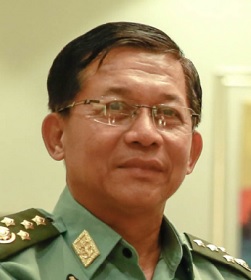
On February 1, the Myanmar army seized power, turning a partial democracy into a full-fledged military rule, once again. Whenever democracy suffers, India feels concerned. However, New Delhi is committed to the policy of non-interference in another state’s internal affairs. It is also guided by its national interest and will astutely balance principles, values, interests, and geopolitical realities.

50636637062_a0e491ec59_c Courtesy: MEA/Flickr
26 November 2020

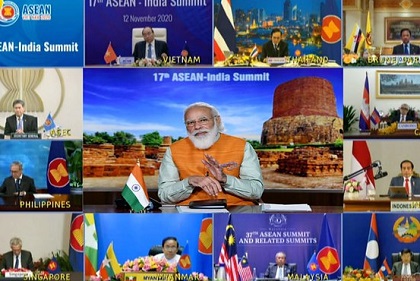
The ASEAN- India Summit: A new direction emerges

The recently concluded ASEAN and EAS Summit saw Prime Minister Modi highlighting the Indo-Pacific region. That’s because a cohesive, responsive and prosperous ASEAN is seen as vital to India's Indo-Pacific Vision and to Security And Growth for All in the Region (SAGAR). India’s decision to opt out of RCEP, even when all ASEAN member countries are signatories to that agreement, will mark a shift in how India enhances bilateral engagements with ASEAN nations with greater strategic intent.

India&MyanmarFinal Courtesy: Ministry of External Affairs
7 October 2020

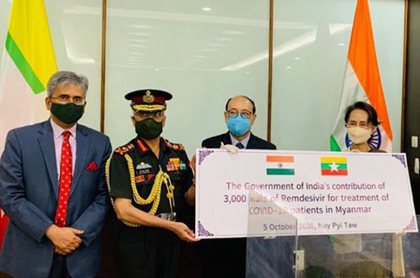
Consolidating the Myanmar partnership

The visit of Foreign Secretary Harsh Vardhan Shringla and COAS Gen. MM Naravane to Myanmar on October 4-5 will advance this vital relationship at a critical time. As the region’s geopolitics change, India’s Neighbourhood First and Act East policy and Myanmar’s deep-seated instinct for a balanced and independent foreign policy, must ensure that the two countries journey together as companion souls.

TH23-RAJIVBHATIA-XISMYANMARVISIT3 Courtesy: The Hindu/Handout
27 January 2020

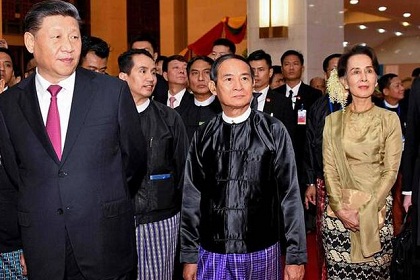
Myanmar’s growing dependence on China

Chinese president Xi Jinping’s visit to Myanmar on January 17 highlighted the economic aspect of the two countries’ bilateral relationship. China has been Myanmar’s top partner for years. But more than the 33 agreements signed, the visit threw light on the region’s changing geopolitics and Myanmar’s own compulsions in growing closer to China

shutterstock_1457421710 (1) Courtesy: Shutterstock
26 September 2019

Quad in the Indo-Pacific

The foreign ministers of the Quad countries meet for the first time in New York today even as the Indo-Pacific has turned into a keenly contested geopolitical arena. Some countries are offering to play a mediatory role while other triangular equations are also undergoing change. An analysis of some of the relationships at work here

30362033555_a558fdf2cd_o Courtesy: Mea/ Flickr
23 August 2018

Boosting BIMSTEC’s visibility

The 21-year-old regional organisation, which will hold its fourth summit on August 30-31, was formed because of the opportunities to make headway in economic and social development through cooperation, but it has achieved modest success. It has a relevance independent of SAARC or ASEAN and goals of its own to pursue

2-8-18 CableMap-02 - Copy Courtesy: Gateway House
2 August 2018

Version 2: Mapping China’s global telecom empire

This version of the Gateway House Map on China’s Expanding Global Telecom Empire identifies some more telecommunication assets -- optic-fibre and satellite ground stations -- that Beijing is working on in South and Central America, Africa, Myanmar, the Indian Ocean Region and mainland China besides the existing ones, such as the Pakistan East Africa Cable Express (PEACE). It shows the direction China’s investment is taking, its diplomatic overtures and the larger geopolitical implications of its growing telecom empire