India’s Strategic Imperative in the South Pacific
This report analyses the significance of expanding India’s engagement with the South Pacific in the backdrop of mounting global interest in the region

 Courtesy: Madhu Amodia
This report analyses the significance of expanding India’s engagement with the South Pacific in the backdrop of mounting global interest in the region
 Courtesy: bfshadow/flickr
This daily column includes Gateway House’s Badi Soch – big thought – of the day’s foreign policy event. This Badi Soch discusses the new Chinese internet censorship laws and analyses how it plays to a larger model of internet censorship.
 Courtesy: WikimediaCommons
Can the world aspire to a future where the use of force is not seen as leadership? Can the U.S. and former colonial powers like France and UK, think differently and reject the use of force as first resort? Can China and India craft alternatives?
 Courtesy: Benison P Baby/WikimediaCommons
Indian companies are pursuing defence offsets and commercial aviation products, but bypassing the global space economy. To build on this market requires New Delhi to overhaul its space policy, ISRO to amend its policy on contracts, and Indian industry to share the risk and investment
 Courtesy: oxfamnovib/Flickr
Elections are meant to be a suitable recourse in democracies if citizens feel that the government does not represent them. However, the recent protests in Brazil, Turkey and India show that people feel political classes are too far removed from their every day realities to address their grievances
 Courtesy: Gateway House
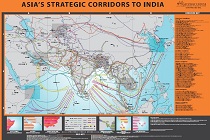
The map – Asia’s Strategic Corridors to India – has emerged from Gateway House’s study of India’s strategic links with other parts of Asia. It highlights the progress India has made in forging multiple links with six strategic regions – Central Asia, West Asia, East Africa, South-East Asia, East Asia, and our immediate neighbourhood
 Courtesy:
This daily column includes Gateway House’s Badi Soch – big thought – of the day’s foreign policy events. Today’s focus is on why the government should take a closer look at the kinds of data discovered by PRISM.
 Courtesy: MEAphotogallery/ Flickr
In 2012, Iraq emerged as India’s second largest crude oil supplier thereby shifting focus back on bilateral relations. However, India’s historical and cultural connection with Iraq, as well as common geopolitical concerns, reveal that relations have the potential to go beyond oil
 Courtesy: NASA's Marshall Space Flight Center/Flickr
An increase in the global demand for rare earth elements, used in high-technology industries, coupled with limited supplies on Earth, has accelerated extra-terrestrial exploration. International cooperation and competition for these space-based resources will determine the next human footprint and race in space.

This daily column includes Gateway House’s Badi Soch – big thought – of the day’s foreign policy events. Today’s focus is on how Latin America is a natural choice to seek asylum for the whistleblower Edward Snowden.