India in a changing global order
This speech was delivered at ‘Industry Meet 2018’, organised by the Indian Institute of Management, Indore, in collaboration with the Ministry of External Affairs, Government of India, on 7 July 2018

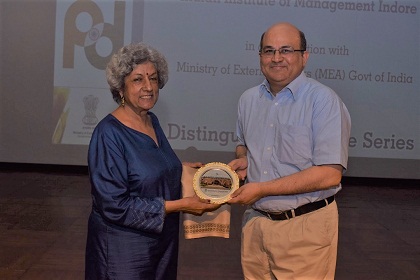 Courtesy: IIM, Indore
This speech was delivered at ‘Industry Meet 2018’, organised by the Indian Institute of Management, Indore, in collaboration with the Ministry of External Affairs, Government of India, on 7 July 2018
 Courtesy: Caixin Global
China’s foreign direct investment is shifting away from natural resources to high-tech areas, such as Artificial Intelligence and robotics. The scale of these acquisitions, along with questions about intellectual property and national security, are causing widespread concern in the West
 Courtesy: U.S. Department of State/ Flickr
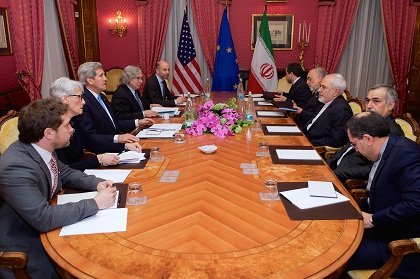
Scrapping the JCPOA will badly bruise Iran’s economy, citizens and foreign relations; it will have an impact on the U.S.’ allies too
 Courtesy: Gateway House
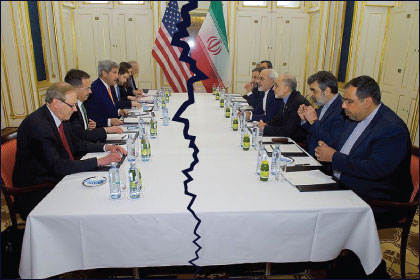
India may end up being the unintended victim of renewed U.S. sanctions on Iran. It will push up the price of oil and cost India billions of dollars annually
 Courtesy: Gateway House
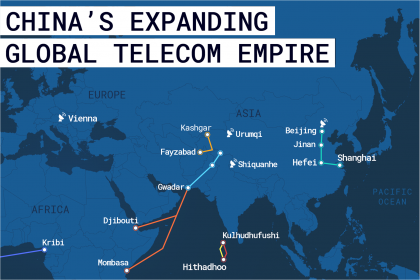
China is steadily deploying state-of-the-art communications systems to connect its strategic and economic assets in Asia. It is then linkingthe Asian mainland to Africa, and Africa to South America. The investment spree is rapidly making Beijing a major player in global telecommunications – and ‘informationisation warfare’.
 Courtesy: Government of South Africa/ Flickr
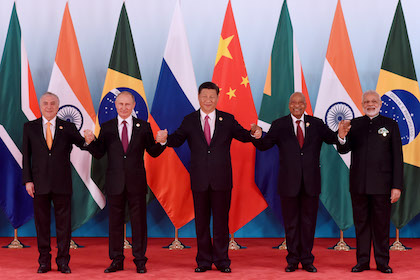
Internal political constraints dog it currently, but if overcome, South Africa can be a good chairman to BRICS and IORA in 2018. It also has a tough balancing act to perform between two great Asian powers, China and India
 Courtesy:
Indian President Ram Nath Kovind leaves for Africa on his first foreign visit as president on October 3. His first port of call will be Djibouti, which occupies a strategic location in the Horn of Africa. The country has assumed significance for hosting multiple foreign military bases on its territory, the latest entrant being China. This infographic illustrates Djibouti’s ‘military base’ diplomacy.
 Courtesy: Gateway House
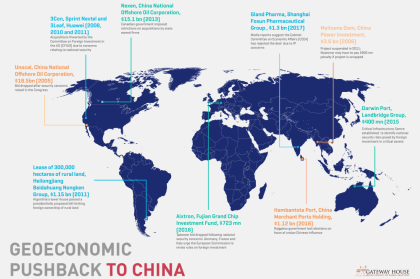
The Indian government may block the acquisition of Gland Pharma by Shanghai Fosun Pharmaceuticals, a move that offers further confirmation of how China’s opaque business model is causing concern worldwide. This infographic shows some high-profile cases of acquisitions by Chinese companies that ran into local opposition
 Courtesy: MEA/ Flickr
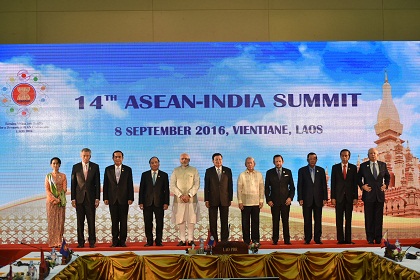
The Indo-Pacific region is home to some of the largest and most rapidly growing economies as also powerful military forces. Nuclear threats, international terrorism and climate change are some of the issues that define the region. Uncertainty dogs relations among the four nations in the top league—U.S., China, India and Japan—but what is emerging is a hawkish, policy stance from the U.S. as opposed to an isolationist outlook apprehended earlier
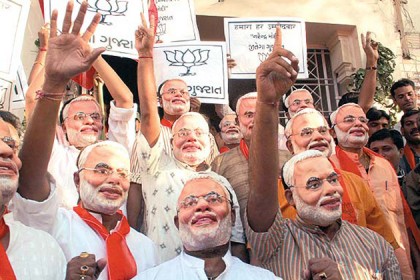 Courtesy: Narendramodi.in
Narendra Modi’s landslide victory in India's 2014 general elections, despite his hardline nationalist image, was viewed as a localised phenomenon. But two years later, voters across the world from Europe to Philippines seem to be tilting towards leaders with the same nationalist tag.