Bhatia article image Courtesy: Gateway House
17 February 2022

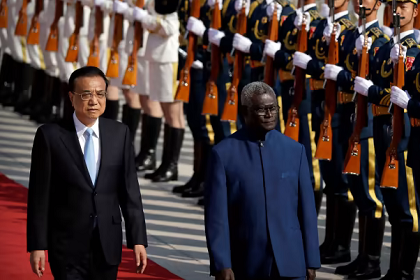
Has global geopolitics turned multipolar?

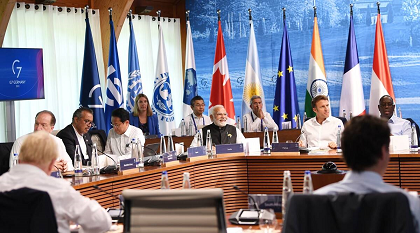
The Quad Foreign Ministers' meeting held on February 11 is the latest example of growing geopolitical cooperation. Several loci of power have emerged, indicating the end of the post-Cold War western hegemony. China's rise and alliance with Russia hints at a bipolar tendency in this nascent global multipolarity. India must ensure power distribution in Asia by sharpening its diplomacy to achieve its own interest - true multipolarity in Asia.

Untitled design (6) Courtesy: Gateway House
10 February 2022

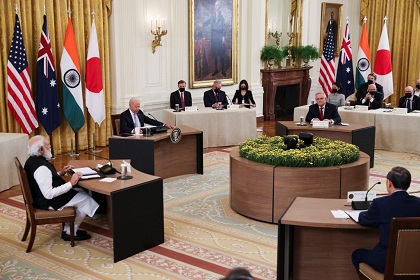
Panel Discussion on India in the Indo-Pacific

On 1 February 2022, Gateway House and the U.S. Embassy, New Delhi, co-hosted a panel discussion on India in the Indo-Pacific: Pursuing Prosperity and Security. The panelists explored the comprehensive role that India can play in the Indo-Pacific from the perspective of business, think tanks, academia and diplomacy.

New,Delhi,,India-aug,24,2021:,Group,Of,Afghan,Women,Sitting Courtesy: Shutterstock
27 January 2022

Developing a balanced Indian refugee policy

India has seen a recent influx of refugees from Afghanistan and Myanmar. This has highlighted the absence of a concrete refugee policy in India. India must formalise its approach towards refugees. The Citizen Amendment Act of 2019, is a start. India can move this forward by learning from the examples of other democracies like the U.S., Kenya and South Korea, on how to balance international law with its national security interests.

Indian,Ocean,Military,Boat,Reunion,Island Courtesy: Shutterstock
20 January 2022

The Indo-Pacific opportunity in 2022

Nine great powers and a number of important multilaterals have vested interests in the Indo-Pacific. Given the U.S.-China standoff in the region, the role of new groupings like the Quad and AUKUS is significant. The time is ripe for India to use its position in the region, and convert its humanitarian duties into economic and strategic opportunities in 2022.

chaitanya cover Courtesy: Routledge India
5 January 2022

India in the Second Space Age

The concept of astropolitical blocs as an extension of geopolitical blocs remains unexplored, especially from an Indian perspective. As the scope of international cooperation in space expands into soft science diplomacy, the advent of the second space age creates opportunities for India to step up its space program, according to this book. This particular excerpt discusses the second space age, the changing nature of space enterprises, and the involvement thereof, of developing nations.

Geopolitical contestations in cyberspace
27 December 2021

Geopolitical contestations in cyberspace

On 20 December 2021, the Gateway House-FLAME Policy Lab organised a webcast on geopolitical contestations in cyberspace. Gateway House’s Sameer Patil moderated the discussion with former deputy National Security Advisor Latha Reddy, National Law University’s Gunjan Chawla and cybersecurity expert Atul Khatavkar.

Omicron, India-Africa ties and a fresh look Courtesy: Gateway House
2 December 2021

India-Africa through a new lens

The new Omicron variant of COVID-19 has caused concern across the globe, especially in Africa. India has shown solidarity with the continent, extending supplies of Made in India vaccines, drugs and medical equipment. Despite some setbacks, there is vast potential for Indo-African collaboration based on strategic advantages and mutual goals.

AUKUS spurs EU's Indo-Pacific ambitions Courtesy: EuroNews
25 November 2021

AUKUS spurs EU’s Indo-Pacific ambitions

The news of the EU's much-awaited Indo-Pacific strategy was overshadowed by the Australia-UK-U.S. military alliance, AUKUS. Eight weeks later, tempers are cooling off as the U.S and EU signed agreements at COP26. So, are transatlantic good times back on track? Has AUKUS put a permanent spanner in the wheel of the EU’s Indo-Pacific outreach?

Europe - IP Courtesy: Club of Three
18 November 2021

Indo-Pacific through the European prism

The EU's Indo-Pacific strategy, released in September, set the tone for a renewed focus on the region. Europe's Asia connect is rich, strong and multi-layered, laying the foundation for an advantageous position for the EU in the Indo-Pacific. This can be achieved if the EU is more candid with itself, more assertive with China, and more cooperative with India.

bcim corridor Courtesy: Institute of Peace and Conflict Studies
9 November 2021

Physical connectivity in the Bay of Bengal

China is a clear winner in the physical connectivity stakes in the Bay of Bengal, and there's a reason a why: Its projects are connected to one another, from rail to road to port. While India also has some successful cross-border road and rail infrastructure projects, they are often an extension of an existing railway line or highway, not specific to the connectivity needs of the region. India can win by focussing instead on building infrastructure to maximise the vast maritime potential of the Bay of Bengal, especially the Andaman and Nicobar Islands that give India access to critical sea channels and trade routes.