Latin America Update, September 2013
In 'Latin America Update' Gateway House lists some of the important events in Latin America over the past month

 Courtesy:
In 'Latin America Update' Gateway House lists some of the important events in Latin America over the past month
 Courtesy: Alain Bachellier & WEF/Flickr
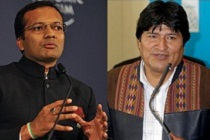
Jindal’s integrated mining and steel project in Bolivia was the largest contract secured by an Indian company in Latin America. The project, which ultimately became a victim of the country's domestic politics, has lessons for Indian companies venturing into Latin America
 Courtesy: oxfamnovib/Flickr
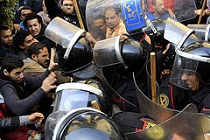
Elections are meant to be a suitable recourse in democracies if citizens feel that the government does not represent them. However, the recent protests in Brazil, Turkey and India show that people feel political classes are too far removed from their every day realities to address their grievances
 Courtesy: Jacques Delarue/Wikimedia Commons
The leaderless protests are upending traditional definitions of leadership and forms of hierarchy. Instead, the protestors are seeking some form of direct democracy and dignity.
 Courtesy: NASA's Marshall Space Flight Center/Flickr
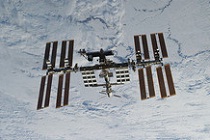
An increase in the global demand for rare earth elements, used in high-technology industries, coupled with limited supplies on Earth, has accelerated extra-terrestrial exploration. International cooperation and competition for these space-based resources will determine the next human footprint and race in space.
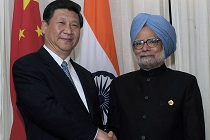 Courtesy: Ministry Of External Affairs, India
Indian foreign policy has not yet addressed the ramifications of Chinese economic dominance in BRICS. Nor have we matched China’s engagement within the group to ensure that the BRICS vision of a new international order for emerging economies actually works in their favour.
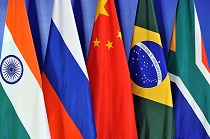 Courtesy: Government/ZA/Flickr
At the 5th BRICS Summit that begins in South Africa today, the heads of state of Brazil, Russia, India, China and South Africa are expected to ratify the creation of the BRICS Bank. After discussion and study for over a year by the respective governments, the bank will be launched with seed money estimated at between $50 billion to $100 billion, and most likely an equal share of voting rights for the management of the bank. What remains
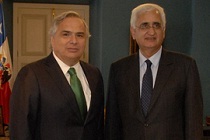 Courtesy: Ministry Of External Affairs, India
Indian Foreign Minister Salman Khurshid’s February 5 visit to Chile and Argentina is emblematic of the new era in Indo-Latin America relations. What does this increased engagement mean for India and Chile, two rapidly growing economies of the Global South?
 Courtesy: Shwkyn231/Flickr
The year 2012 has been a busy one for foreign policy: from escalating disputes in the South China Sea to alternate financial instruments from the emerging world. India’s foreign policy too has its shown strengths and weaknesses. We present our top foreign policy Hotspots, Sweet spots and Blind spots for 2012.
 Courtesy: trendscout::/Flickr
All the major economic forces in the world have come together in Africa in a new version of the Great Game. The competition for the continent’s resources will ultimately harm Africa unless Africa uses this opportunity to its advantage and to address its own serious problems.