Courtesy: Government of Tonga
29 May 2012

India-Tonga: Old friends, new engagements

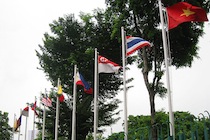
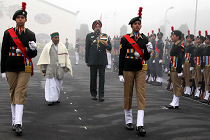
After the passing of Tonga's revered King, Tupou V, all eyes are on the new establishment for signs of change in Tonga's foreign policy. How will India, an old friend to the Pacific island-nation, fit into this increasingly important region? Can it build on traditional ties with Tonga?

seema nato summit obama Courtesy: Secretary of Defense/Flickr
23 May 2012

NATO-Pakistan: Frigid in Chicago

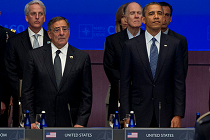
Pakistan’s refusal to re-open NATO supply routes into Afghanistan has made the country an instant pariah in the U.S. at the NATO Summit. The communiqué released confirms a withdrawal of 130,000 troops by as early as mid-2013. Can the remaining soldiers help maintain peace when a force much larger could not?

hillary clinton articles Courtesy: Ministry of External Affairs, India
18 May 2012

Hillary Clinton’s ‘Pivotal’ Moment

U.S. Secretary of State Hillary Clinton's recent visit to China, India, and Bangladesh is keeping with the U.S. pivot to Asia. The choice of countries has strategic significance for the U.S., where India is flagged as balancing the rise of China, and Bangladesh as a strategic base in the Bay of Bengal.

Myanmar and the ASEAN Matrix copy Courtesy: Wikimedia Commons/Gunkarta
18 May 2012

Myanmar in the ASEAN Matrix: An opportunity for India?

As India and the world welcome the recent democratization of Myanmar, this presents India an opportunity to increase its access to South East Asian countries as well, especially with members of ASEAN which still have catching up to do – particularly Cambodia, Laos, Myanmar and Vietnam.

Courtesy: Flickr/ccqatar
3 May 2012

Qatar: Geopolitical Cosmopolitanism

Over the last few years Qatar has actively participated in world affairs by holding the Presidency of multilateral organizations, hosting international institutions and investing significantly in foreign markets. What does Qatar hope to achieve from its rising profile and its growing role in international affairs?

Myanmar Sanctions Courtesy: Wikimedia Commons/Htoo Tay Zar
1 May 2012

Sanctions on Myanmar: Have they worked?

The West is quick to claim that their sanctions against Myanmar have forced the government to implement political and economic reforms in the country. However, such bans do not usually achieve their stated purpose of forcing regimes to change their behavior.

U.S.-Afghanistan agreement: A welcome start Courtesy: U.S. Department of Defense
27 April 2012

U.S.-Afghanistan agreement: A welcome start

An important take-away from the preliminary pact reached by Kabul and Washington is that unlike the 1990s, the Americans are not just packing their bags and leaving. This is good news in terms of regional stability, and the upcoming NATO summit may answer some questions this draft agreement raises.

bahrain piece neelam Courtesy: LGEPR
24 April 2012

The Bahrain formula

With turmoil in the Middle East, a drawdown in Iraq and Afghanistan, the Iran-Israel-U.S. conflict, the international community has paid little attention to the democracy of a small group of people - the Bahrainis. More worrisome, however, is that politics now responds to the elite.

5825395379_5d725a53f4_z Courtesy: Flickr/freeedomania
21 April 2012

UN: a return to ‘mandated colonialism’

By forcing regime change in Libya, and attempting the same in Syria, and by promiscuously arming disparate groups of Wahabbis and Salafists to achieve this aim, NATO is creating more room for instability in the region. What Syria needs is engagement, not isolation; it needs dialogue and not the arming of rebels.

xerxes piece defence2 Courtesy: Ministry of Defence, India
10 April 2012

India: A unified defence command?

India must revisit the need for a unified command structure, to effectively use the enormous combat power it is developing at such astronomical cost. A balanced force-restructuring based on operational needs can enable the armed forces to project itself as a single, viable, effective war machine.