shutterstock_777026497 Courtesy: Shutterstock
13 August 2020

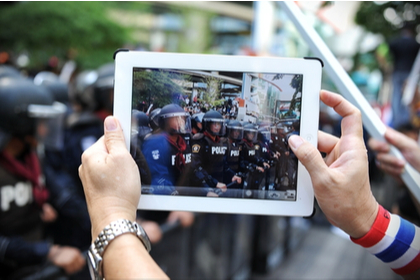
We own your Face!

Facial recognition technology has emerged as an important identification tool. Big tech, social media companies and governments around the world use it and hold an unprecedented power over individuals and communities. Its use for surveillance purposes has brought it under public scrutiny. The technology has still not been perfected. Is it really ready for adoption?


shutterstock_1659219964 Courtesy: Shutterstock
21 May 2020

Digital services across verticals: Jio, Alibaba and Amazon

Recent investments by Facebook, Silver Lake, Vista Equity Partners, General Atlantic, KKR, Mubadala, ADIA, TPG, L Catterton and Intel Capital could well be the infusion of capital and expertise Jio needs to compete with Alibaba and Amazon. The infographic compares the number of services offered by these companies across different technology domains

GH Courtesy: Gateway House
20 May 2020

Gateway House Webcast: Alibaba, Amazon…… Jio?

Blaise Fernandes, Director, Gateway House was in discussion with Dexter Roberts, Non resident Senior Fellow, Asia Security Initiative, Atlantic Council and author of ‘The Myth of Chinese Capitalism,’ Lauri Rechardt, Chief Legal Officer, IFPI and B.K. Syngal, Sr Principal, Dua Consulting and Former Chairman and Managing Director, VSNL.

shutterstock_1164513586 Courtesy: Shutterstock
12 May 2020

Artemis Accords propel India’s space ambitions

Under the ‘Artemis Accords’ the U.S. is planning an international coalition to extract natural resources from the Moon. China is concurrently planning an Earth-Moon Special Economic Zone. India’s antiquated endorsement of the 1979 Moon Agreement is shackling its true potential for economics-driven space exploration. India must immediately do away with Cold-War era, vintage whims of global commons.

shutterstock_1682301697 Courtesy: Shutterstock
7 May 2020

Global spread of remote working solutions

COVID19 has forced a sharp increase in the adoption of remote working solutions across the world. Zoom’s daily participants have risen from 10 million in December 2019 to 300 million in April 2020. Microsoft Teams’ daily active users have risen by 70% in the two months since March 2020. ‘Work from home’ may well be the norm for the foreseeable future. A look at the global proliferation of the top 26 online apps to date.

shutterstock_730156222 Courtesy: Shutterstock
16 January 2020

NEST-ling new tech in foreign policy

The recently announced New and Emerging Strategic Technologies (NEST) Division of India’s Ministry of External Affairs is timely. It can become vital for India’s national technosecurity in the imminent Fourth Industrial Age if a new Cabinet Committee on Futuristic Science and Technologies is established along with it

shutterstock_167012954 Courtesy: Shutterstock
9 January 2020

Digital Natives’ protest goes offline

The current wave of protests sweeping India and the government’s suspension of internet services to impede communication has led to innovation. Protesters have taken recourse to offline messaging applications to escape detection while executing their plans. This infographic tracks the evolution of online media – from the basic to the more discreet

Cryptocurrency-Bitcoin-Blockchian Courtesy: exit.al
2 May 2019

Chronicling strikes on digital black markets

Digital black markets or “dark net marketplaces” which facilitate the transaction of contraband and illegal services, pose a silent, relatively unnoticed threat to the economy. Hackers, organised criminal networks and terrorist groups use these sites, their advanced security features enabling anonymity when executing cybercrimes. This infographic looks at some of the security crackdowns that have eliminated only some of these sites as they have proved to be resilient

ClimateEngineering_GH_CIGI_Cover Courtesy: Gateway House & CIGI
28 February 2019

Making Terrestrial Geoengineering Technologies Viable: An Opportunity for India-Canada Climate Leadership

The use of terrestrial geoengineering techniques, such as carbon capture, is necessary to keep the rise in global temperatures below 1.5 degrees Celsius, as per the Paris Agreement’s targets. Terrestrial geoengineering is different from atmospheric climate engineering: the latter does not remove the very source of the increased greenhouse effect, which are anthropogenic greenhouse gases. India and Canada must collaborate on carbon capture and propose multilateral regulations for unethical atmospheric climate engineering

so18_cover_large_0 Courtesy: Foreign Affairs
1 October 2018

Battlefield Internet

The immediate threat is more corrosive than explosive. States are using the tools of cyberwarfare to undermine the very foundation of the Internet: trust. The result is that an arena that the world relies on for economic and informational exchange has turned into an active battlefield.