Gateway House launches first Quad Economy and Technology Task Force
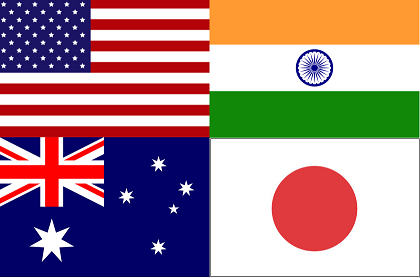
The Task Force led by Gateway House will study economic and technological cooperation between the four like-minded democracies in the Indo-Pacific.

 Courtesy: Gateway House
The Task Force led by Gateway House will study economic and technological cooperation between the four like-minded democracies in the Indo-Pacific.
 Courtesy: Shutterstock
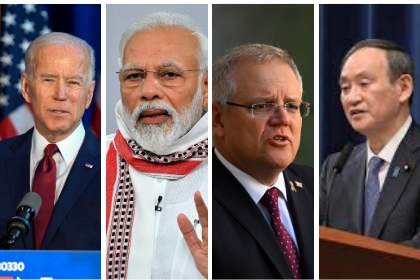
In its recent itineration, the Quad (or the Quadrilateral Security Dialogue) has been toiling since 2017, through deliberations among mid-level and senior officials, to develop a common vision for the challenges facing the Indo-Pacific region, challenges caused by China's menacing rise and aggressive behaviour.
 Courtesy: Twitter
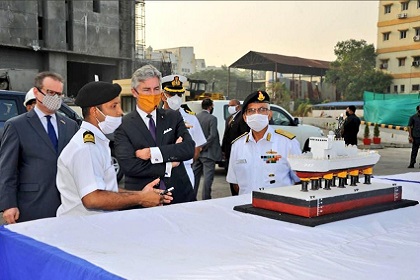
The U.S. Navy Secretary, Kenneth Braithwaite, visited India on 17 Dec 2020. Will this year-end visit culminate in the reactivation of the First Fleet under the U.S. Indo-Pacific Command? The First Fleet, is likely to be an expeditionary fleet - one without a shore-based headquarters and assigned primary responsibility for the Indian Ocean and parts of Pacific Ocean bordering South Asia. Its reactivation will emphasise the strategic importance of this region. It will also relieve the burden of the U.S. Navy's 7th Fleet headquartered in Japan, that is deployed for operations in this vast oceanic space.
 Courtesy: US Navy/Twitter
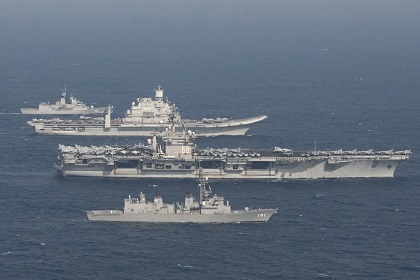
Australia's much-awaited inclusion at the Malabar Exercise-2020 reflects a hard reset in India's foreign policy that was traditionally accommodative to Chinese concerns on the militarisation of the Quad. In the backdrop of the on-going stand-off with China at the Ladakh border, the Indian Navy has maintained a high operational tempo and deployed the highest numbers of frontline assets during this edition of the Malabar Exercise. India must build on this strategic vision and work towards including France at the next edition of Malabar in 2021.
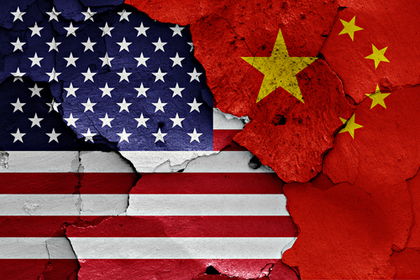
The global world order is witnessing a substantial shift. Part of the greater tussle for strategic and geopolitical dominance is the military rivalry between the U.S. and China. The two countries together now account for over one-half of the world’s defense spending.
 Courtesy: Shutterstock
On 21 October, Gateway House and the Institute of Chinese Studies, Delhi jointly hosted a webcast with Ambassador (Lt. Gen.) Karl Eikenberry, Sinologist, Deputy Chairman, NATO Military Committee; former Director of the U.S.-Asia Security Initiative at the Shorenstein Asia-Pacific Research Center, Stanford University on the Growing Sino-American Military Rivalry
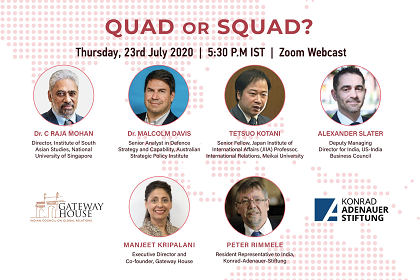
The Quad, a grouping of Indo-Pacific democracies, is more relevant than ever. It must now operationalise not just the military exchanges but also formalise economic and technology partnerships that will undergird a meaningful new multilateral, provide it with resilience and appeal in the Indo-Pacific region. In this Webcast, co-hosted by Gateway House and Konrad-Adenauer-Stiftung, the panelists discuss the need to reform Quad, which hosts the four leading global voices, in order for it to become the magnet that attracts like-minded nations, small and big cutting across continents and oceans to converge on the new world order realities.
 Courtesy: USGS/Wikimedia
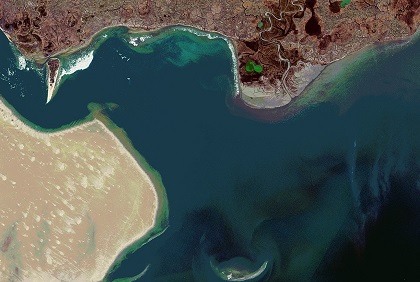
The recent use of geospatial analyses by Indian social and mainstream media for near real-time defence and military intelligence in Ladakh has been made possible because of the lower cost of earth-observation satellite construction, and thereby, easy access to satellite imagery on the internet. While independent analysis is useful, the same intelligence can be also used against the interests of a sovereign nation by an adversary, especially border imagery. India must find innovative methods to reduce this vulnerability of commercial satellite imagery.
 Courtesy: Gateway House
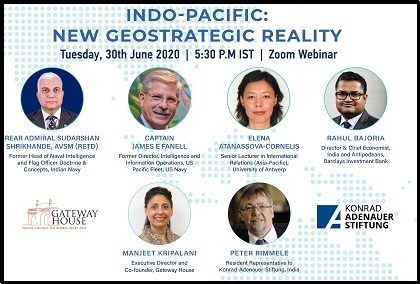
On 30th June, 2020 Gateway House in association with Konrad-Adeneur-Stiftung (KAS) co-hosted a webinar on Indo-Pacific: New Geo strategic reality.
 Courtesy: Shutterstock/Gateway House
China’s escalating actions in the wake of the COVID-19 catastrophe is a calculated strategic diversion and risk. In the Indo-Pacific, tensions between China and the U.S., Australia, India and others are building momentum. As a geopolitical partnership, the relevance of the Quad is now proven. There are clear ways to empower it immediately, and make it a resilient grouping.