India’s Corona-diplomacy
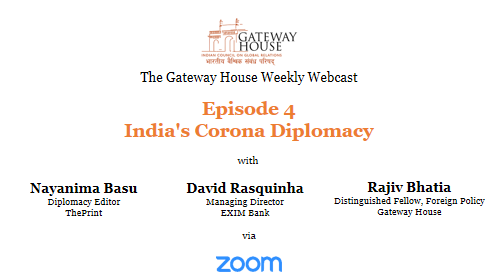
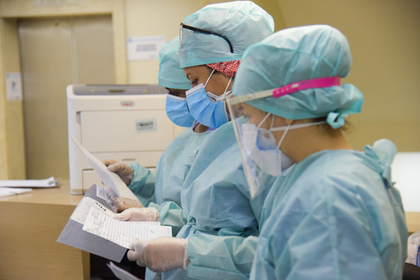
Over the last month, India’s Corona-diplomacy has been evident. The government’s two-point plan is to protect its citizens and help its neighbours and friends.
Courtesy: Shutterstock
Over the last month, India’s Corona-diplomacy has been evident. The government’s two-point plan is to protect its citizens and help its neighbours and friends.
Courtesy: MEA/Flickr
The first-ever virtual summit of leaders from member-states of the South Asian Association for Regional Cooperation on March 15 was an innovative exercise in showing solidarity in containing a pandemic. Here is an assessment of its tangible outcomes – and longer-term ways to prepare for SAARC’s revival
Courtesy: Shutterstock
Iran is reeling from the Coronavirus Disease (COVID-19), with no access to medicine or equipment due to severe sanctions, the continuing uncompromising position of world powers, and an ill-advised regime
Courtesy: Lovneet Bhatt
The 25 March 2020 attack on a Sikh gurudwara in Kabul focused world attention on the plight of Afghanistan’s indigenous Sikh and Hindu minorities, the target of both local lawless elements and religious fundamentalists. They once were a significant part of Afghanistan’s principally Muslim population and a mark of its cultural syncretism and religious pluralism
Courtesy: Shutterstock
The COVID-19 pandemic has exposed the deficiencies of India’s precision instrument import-dependency and the global supply-chain vulnerabilities of international high-tech manufacturing giants. New Delhi can incentivise such companies to manufacture under the Make in India and Assemble for the World in India programmes
Courtesy: Shutterstock
The U.S.-Taliban deal of 29 Feb favours some and disadvantages others in the region. This infographic shows how regional geopolitics will change
Courtesy: Sage Publishing
This book offers a bird’s-eye view of India’s strivings to forge close relations with the East, but covering a vast region and swathe of history has inherent drawbacks. The result is a haphazard narrative, focusing more on the contemporary period and lacking in insight or analysis
Courtesy: Shutterstock
As part of our weekly series of podcasts in the run-up to the U.S. elections, in this episode on the first month of the Democratic Party’s primaries, Ambassador Neelam Deo, Director and Co-founder of Gateway House, on Biden’s candidature, how the U.S. appears still unready for a woman president and why the Indian American community, which has traditionally voted Democrat, may be ambivalent this time
Courtesy: Gateway House
Over the last five years, China has quietly created a significant place for itself in India – in the technology domain. While India has refused to sign on to China's Belt and Road Initiative (BRI), this report shows India's positioning in the virtual BRI to be strategically invaluable for China. Nearly $4 billion in venture investments in start-ups, the online ecosystem and apps have been made by Chinese entities. This is just the beginning; there is more to come.
Courtesy: Shutterstock
Kenya’s Mombasa port, the gateway to East and Central Africa, has enabled the Chinese to gain better access to resources in the region and export destinations within Africa through the Belt and Road Initiative. A recent visit offered insights into some of the shortcomings of increasing Chinese investments in the region – and the scope for other countries to step in