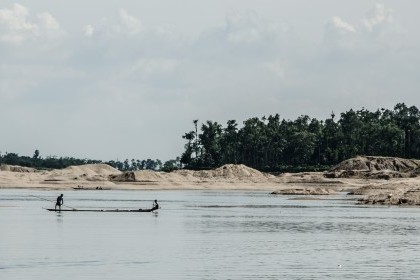
Wah_Umngot_River_Dawki_Meghalaya_Border_Crossing_Bangladesh_India Courtesy:
27 July 2016

Listening to the Rivers

India's North Eastern States are part of one of the largest fluvial regions, they share this region with five other nations. At a recent conference, held on the sidelines of the the Nadi Festival in Shillong, the message of 'Listen to the dignity of the river' struck a chord with all present, and is a message which should be carried across the region.
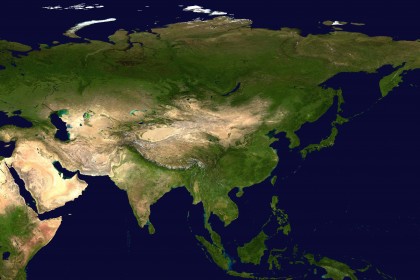
Asia_topic_image_Satellite_image Courtesy: Wikipedia
26 May 2016

Bioregions: India’s strategic imperative

Prime Minister Modi’s term has been marked by a resolve to improve cooperation among South Asian nations. These proactive efforts can bear rich fruit if the Modi government promotes the concept of geoeconomic and geopolitical equations being seen through the lens of bioregions. There are significant precedents which the Modi government can build upon

Jaishnkar Courtesy: Saddahaq.com
26 February 2015

SAARC sojourn: surmounting the entropy

The SAARC Yatra to be undertaken by foreign secretary S. Jaishankar from March 1 is an opportunity for India to improve relations, resurrect stalled projects and create new synergies with its neighbourhood. An initiative like this could hold the key to India shedding the ‘hegemon’ tag and pursuing mutually beneficial policies with its neighbours

SAARC Courtesy: pmindia.nic.in
21 November 2014

Will SAARC embark on a new path?

The 18th SAARC Summit in Kathmandu next week is an opportunity for member countries to start shaking off the shackles of distrust. Instead, SAARC must robustly move forward on such issues as regional connectivity, SAFTA, climate change, and security—and India can be the prime mover in building this renewed cooperation

SAARCsummit1 Courtesy: Wikimedia commons
21 November 2014

A primer on SAARC

The 18th SAARC Summit will cover a wide range of issues, including connectivity, climate change, and SAFTA. A number of similar issues were discussed at the last summit—what’s been the progress since then? Given its constraints, does the association have a future? Gateway House asks and answers five questions on SAARC

Modi departure_Bhutan Courtesy: MEA/Indian Embassy Thimphu
18 June 2014

Modi: charting a new foreign policy course

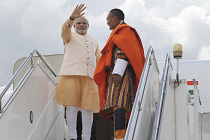
Narendra Modi’s first month in office has seen him deftly handle India’s neighbours, accept an invitation to visit Washington, enhance relations with Bhutan and accord due importance to China. In the same manner, Modi will also have to move quickly and firmly to reassure foreign investors of the dependability of India’s fiscal environment

Modi with Jigme Wangchuk Courtesy: MEA/Government of India
13 June 2014

India-Bhutan: a unique bond

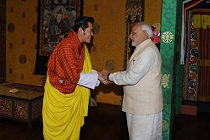
Narendra Modi has picked Bhutan for his first foreign visit after taking charge, a sign that the neighbourhood is a foreign policy priority for the new government. Bhutan’s economy is closely linked to that of India’s, and despite pressures from powerful countries, Bhutan has always kept Indian interests paramount.

MapsofIndia Courtesy: Chaipau/WikimediaCommons
30 May 2014

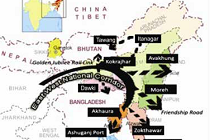
Policy Catalyst: Seven Sisters’ Corridor

The Narendra Modi government has made the North East a developmental and foreign policy priority. Gateway House has conceived a robust regional economic plan called the “Seven Sisters’ Corridor” that can be the template for a new North East.

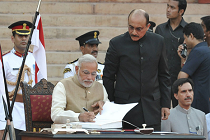
Modi signing register Courtesy: PMO/Government of India
28 May 2014

Narendra Modi: global perspectives

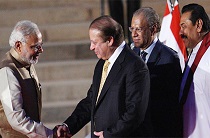
By inviting SAARC leaders to his swearing-in ceremony India’s new prime minister Narendra Modi has signaled a major shift in India’s foreign policy. Gateway House presents perspectives from experts from seven countries on the changes they expect to see in India’s foreign policy in the Modi era