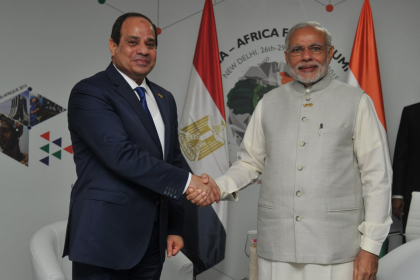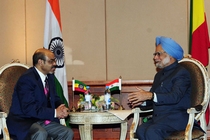
Modi and Sisi Courtesy: Ministry of External Affairs / Flickr
31 August 2016

India-Egypt: renewing old ties

Egyptian president, Abdul al-Fattah al-Sisi, is set to arrive in New Delhi on 1 September 2016 with a delegation of important ministers and business leaders. This marks an important opportunity for the two countries to connect on a much wider range of regional and international issues than earlier.

indiaAfricalLogo Courtesy: India Africa Forum Summit 2015
7 July 2016

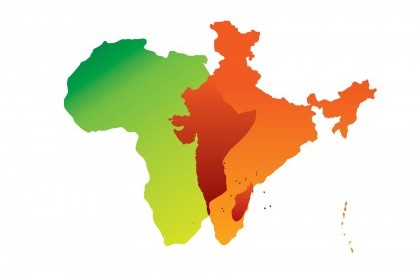
India-Africa ties: pitching higher

Prime Minister Modi’s tour of four African countries will seek to build upon recent high-level visits to the continent, providing fresh impetus for the reinforcement of India-Africa relations in matters of diplomacy, business, security, and energy while putting to rest criticism of India’s visibility deficit in Africa. However, the onus to harness this momentum now lies with other stakeholders.

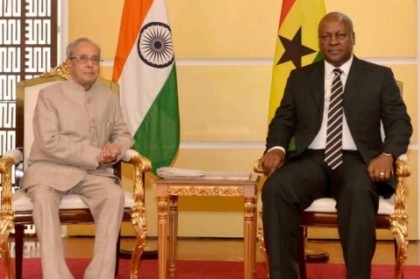
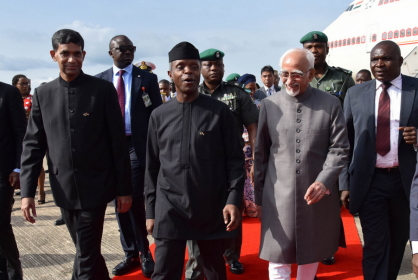
Pranab Mukherjee meeting the President of the Republic of Ghana_122907 Courtesy: The First Mail
30 June 2016

A new trajectory for India-Africa ties

India now sees Africa as a promising market for Indian goods, services, and investments. This is evident in the government’s recent concerted focus on the India-Africa relationship—high profile visits by top leaders to African countries, a recasting of India’s development diplomacy, and an attempt to match action to past promises

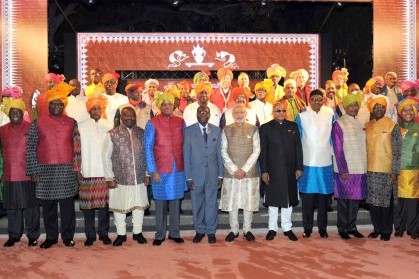
The Prime Minister, Shri Narendra Modi with the African leaders during the special dinner hosted, on the sidelines of the 3rd India Africa Forum Summit, in New Delhi on October 28, 2015. Courtesy: MEA / Flickr
31 March 2016

Africa: diplomatic flavour of 2016?

India has hosted a plethora of India-Africa conferences, expressing commitment to deepen mutual cooperation. It is further expected that the president, vice president, and prime minister may visit Africa this year, to follow up actively. Indeed, a senior official predicts Africa will even become “the diplomatic flavour in 2016”. An analysis.

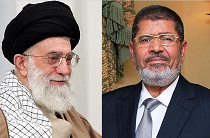
khameini Courtesy: Dragonfire and Georgethewriter/WikimediaCommons
29 November 2012

Iran-Egypt: old foes, new competitors

Rivals Iran and Egypt have become the two most important powers in today’s West Asia. Yet, Iran is looking for neither a smooth victory nor a quick failure for Egypt’s rise. Tehran will remain the key regional player, while it’s too early to tell if Cairo is capable of overcoming Iran’s influence.

Courtesy: Gigi Ibrahim/WikimediaCommons
27 November 2012

Israel-Hamas: Only an intermission

The series of Israeli offensives against Gaza, which began on November 4, ended when Egypt's new President Mohamed Morsi brokered a ceasefire between Hamas and the Israeli government on November 13. The possibility of this ceasefire holding up, however, seems remote.

chris stevens casket Courtesy: Secretary of Defense/Flickr
20 September 2012

Death of an Ambassador

Ambassador Christopher Stevens, the U.S. envoy to Libya, was killed, following protests against a controvertial movie, titled 'Innocence of Muslims.' Is an anti-U.S. sentiment to be blamed for this violence? What consequences will this incident have on the U.S. policies towards Libya and Syria?

debnath shaw Courtesy: Gateway House
5 July 2012

“Russia still dominates Central Asia”

Though some countries like Russia gained a strong foothold in Central Asia and the Caucasus post-1991, India has been a late-comer. Gateway House interviews former Ambassador to Azerbaijan Debnath Shaw to discuss India’s energy interests in the region, the Shanghai Cooperation Organization and the TAPI pipeline.