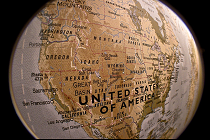
US2 Courtesy: Owlpacino
14 August 2014

Indian union and American federalism

Although the histories, levels of economic development, and critical issues of India and the U.S. are different, the confrontational party politics in their political systems pose similar challenges. Both countries can learn from the experience of federalism of the other to take their national agendas forward

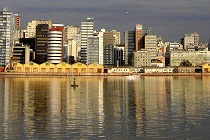
porto alegre Courtesy: wikimedia\commons
14 August 2014

Federalism, swaraj and Brazil

Brazil follows a more decentralised form of federalism and gives special importance to the municipalities. Porto Alegre’s successful 'participatory budgeting' is a role model for the world. India can learn from both the positive and negative aspects of the Brazilian system

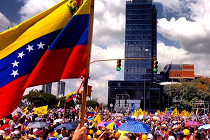
VenProtests-2014 Courtesy: durdaneta/Wikimedia
8 August 2014

Latin America slowdown

Latin America’s economic growth has slowed down in 2014. But the region’s fundamentals are relatively strong, and have the resilience to absorb external shocks and increase growth in the coming years. However, Argentina and Venezuela face continuing uncertainty and deterioration.

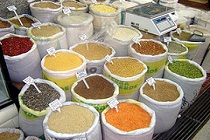
food-sedurity Courtesy: Rigues/Flickr
25 July 2014

Food security, WTO and India

Recent developments at the WTO's two-day General Council Meeting that started on July 24 suggest that India will agree to sign the trade facilitation agreement only if the deal comes bundled with a permanent solution that will allow unhindered roll-out of welfare schemes such as the food security programme.

Ceren Courtesy: BBC
27 June 2014

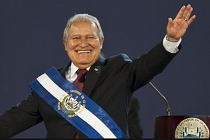
El Salvador’s new president

The election of Salvador Sanchez Ceren, a leftist ex-guerilla fighter, as president of El Salvador, is a reflection of the maturity and inclusiveness of the Latin American democracies. With his compassionate and pro-poor policies, Ceren has the vision and compassion needed to reduce poverty and break the vicious cycle of crime and violence which has paralysed El Salvador

Dilma_e_Lula_210x140 Courtesy: Government of Brazil/Wikimedia Commons
15 May 2014

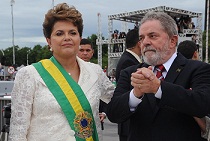
Brazil: time to be a global power?

Brazil’s advantages – including resources of oil and gas, no historical baggage, an absence of terrorism and military conflicts – and regional leadership, make it a potential global power. But it also has to tackle many challenges in the medium-term, such as poverty, poor infrastructure, healthcare and education

Modi with Lat-Am delegation Courtesy: www.narendramodi.in
12 May 2014

Gujarat-Latin America: friends & benefits

The burgeoning trade between the state of Gujarat and Latin America has ensured that Narendra Modi’s campaign is closely followed in Latin America. The new government in India must build on this engagement, which will help address India’s energy, food and investment needs

gendergap Courtesy: Narendra Modi/Wikimedia Commons
24 April 2014

The missing women of Parliament

Fewer than 10% of the candidates in the ongoing elections in India are women. A law to reserve seats for women in Parliament, which will increase this number, is in abeyance. Our next government can take lessons from Latin America, where 16 countries have successfully implemented reservations and other enabling measures