ANI Courtesy: ANI
11 September 2025

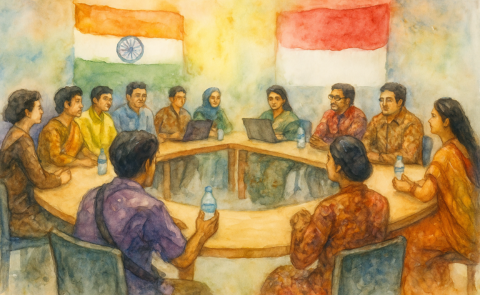
India and Indonesia reconnect 

India and Indonesia are two Asian leaders and democracies which are reconnecting after decades, even centuries – in a world rife with new volatility and uncertainty. Both countries can collaborate and learn: Indonesia is an adept trading nation and India is a powerful tech player. The two governments are on a mission to deepen and diversify their relationship, stepping out of their past, and bringing fresh thinking.

61mEzQVAteL (1) Courtesy: Amazon India
4 September 2025

The New World: 21st Century Global Order and India

In this book, author Ram Madhav refers to “order” not simply in terms of politics and power, but as the outcome of inventions, industries, and ideologies that have shaped human civilisation. He blends the lens of an Indian scholar with that of a seasoned politician, tracing turning points in history and highlighting the roles of non-state actors, technological revolutions, and the moral and ethical dimensions of order.

X  @Narendra Modi Courtesy: X / @narendramodi
4 September 2025

Modi in Japan: a larger Asia mission

Prime Minister Narendra Modi’s visit to Japan is significant for India domestically and its extended Asian influence. His visit, just prior to the SCO Summit in China, represents a shrewd endeavour at balancing the several priorities of Indian foreign policy

G20.Org Courtesy: G20.org
28 August 2025

Appraising Brazil’s G20 Presidency

The G20’s current cycle is unique, with four Global South nations presiding consecutively: Indonesia, India, Brazil, and now South Africa. Brazil’s 2023-24 presidency exhibited both achievements and struggles, prioritising social inclusion, hunger, energy transition, and governance reform. The handover to South Africa marks a significant milestone in G20 history. Will the momentum be followed by the U.S., the next G20 president but also a G20 sceptic?

Agence France-PresseGetty Images Courtesy: Getty Images
21 August 2025

Posturing over a Palestinian State

America’s allies say they will recognise a Palestinian state by September unless Israel agrees to a ceasefire and a two-state solution. Apart from rewarding Hamas, creating a new state has multiple legal, cartographic, social and military implications that have not been considered. Better to provide much-needed food and medical aid for now, than posture for a solution.

Damon Coulter  SOPA Images  Alamy Courtesy: Damon Coulter / Alamy
21 August 2025

Rise of the Japanese Right

The recent election for Japan’s Upper House of Councillors is a pivotal moment for Japanese politics, revealing fractures within the ruling coalition and a simultaneous rise of the political right. Economic discontent, cultural anxieties, and effective digital mobilisation are converging. Is this a fleeting moment for Japan, or the start of a deeper, more profound change in its political landscape?

Website articles  (5) Courtesy: Gateway House
21 August 2025

Unfolding Geopolitics Episode 22 | Analysing Alaska: The Russian View

On August 15, President Donald Trump and President Vladimir Putin met in Alaska to discuss the Russia-Ukraine peace deal. Ivan Timofeev analyses the stakes for Russia, the U.S., Europe, and Ukraine, noting that Washington and Moscow remain decisive players while Europe and Ukraine play secondary roles. Could this meeting pave the way for peace? For India, the talks matter, as it faces an additional 25% tariff for buying Russian oil.

DD news Courtesy: DD News
18 August 2025

Alaska, the Summit of Summits

There was much at stake for the U.S.-Russia summit at Alaska – more than just the future of Ukraine. It will put the world back on economic track, and ease East-West relations, under stress for an on-going tariff war. For now, diplomacy has played a successful hand.

ANI Courtesy: ANI
14 August 2025

Is Russia a Red Line for India?

U.S. President Trump will meet Russian President Putin on August 15. A positive outcome may mean removal of punitive U.S. tariffs on India for buying Russian oil and resolving its dilemma of placating a partner country with growing commercial, geopolitical and defence ties, or pursuing strategic autonomy, keeping its old friends and take an economic hit? Is Russia the red line for India?

U.S. Implementation of tariffs Explained1 Courtesy: Gateway House
13 August 2025

The path of U.S. tariff policies

Who makes, imposes, administers and collects U.S. tariffs? The U.S. Congress, but for the last several decades, it has been at the discretion of the U.S. President, who has been given tariff-setting authority. Under the International Emergency Economic Powers Act, 1977, U.S. President Donald Trump has imposed reciprocal and universal tariffs on over 60 countries.