India-Canada Relations – Post-Trudeau Visit: the Road Ahead
Rajiv Bhatia, Distinguished Fellow, Foreign Policy Studies, Gateway House wrote an article for the Indian Foreign Affairs Journal on India-Canada relations

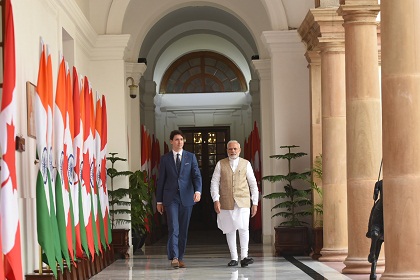 Courtesy: MEA/ Flickr
Rajiv Bhatia, Distinguished Fellow, Foreign Policy Studies, Gateway House wrote an article for the Indian Foreign Affairs Journal on India-Canada relations
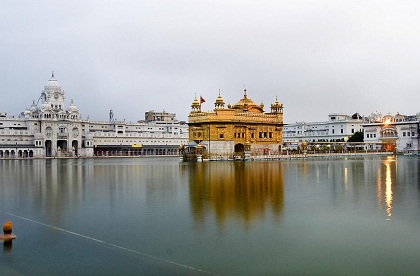 Courtesy: Flickr
Radical Sikh elements within the Indian diaspora have found the permissive political climate in Canada, North America and Europe conducive to building a support base in their respective countries, while donations from gurdwaras abroad and social media propaganda have fuelled separatist efforts in Punjab. India may have to step with care, containing the hostile propaganda, yet not appearing too stern in its response
 Courtesy:
The Centre for International Governance Innovation (CIGI) and Gateway House, along with the Honourable Harjit Sajjan, Minister of National Defence of the Government of Canada, announced the launch of the Canada-India Dialogue on Innovation, Growth and Prosperity,
 Courtesy: Gateway House
Canadian Minister for National Defence, Hon'ble Harjit S Sajjan, discusses contemporary security issues, international peacekeeping, bilateral defence ties, and geopolitical arenas, relevant to India, Canada, and the world. More specifically, he converses about prospects of peace in Afghanistan, the geopolitics of and Canadian sovereignty over the Arctic, UN peacekeeping programs initiated by Canada, focus areas for India and Canada defence relations, and the Quad initiative.
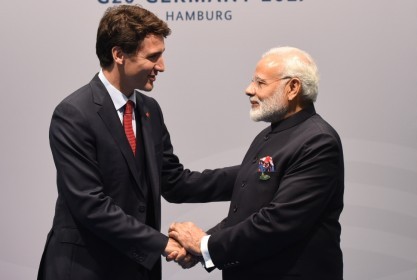 Courtesy: MEA / Flickr
Canada’s commercial relationship with India needs to go beyond lentils, uranium and other resources to explore the scope of greater cooperation on renewable energy and cutting-edge technology. There are strong reasons for the two countries to draw closer—even if other countries always loom larger. Prime Minister Trudeau visits India this week
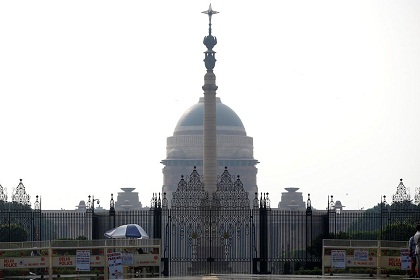 Courtesy: Open Canada
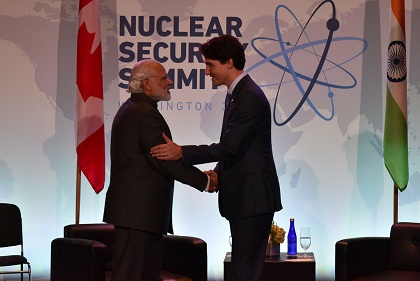
From trade to counter terrorism to civil society partnerships, here are the areas in need of greater collaboration between the two countries.
 Courtesy: MEA/ Flickr
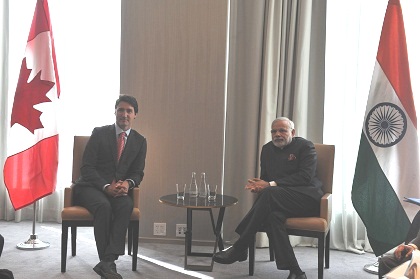
India hardly figures in current discourse on Canadian foreign policy. Yet, the two countries are important to each other: one, a source of investment, technology and energy, the other an attractive market. The current challenge is to conclude negotiations on long-pending trade and investment agreements
 Courtesy: MEA/ Flickr
One is an advanced economy, the other an emerging one, and yet they share a striking complementarity of interests—from democracy and liberal values to a history of cordial relations. But two important economic agreements remain as chasms to be bridged
 Courtesy: Gateway House
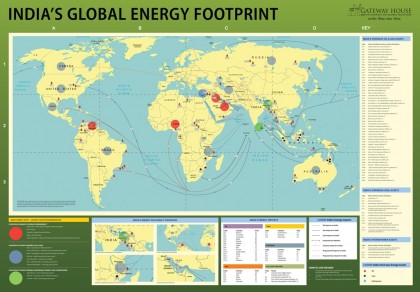
Trends in technology, geopolitics and geoeconomics have dramatically transformed the global energy scenario in the last two years. This means favourable conditions for import-dependent India, which must use the opportunities available to reduce its vulnerability to high energy prices. The jump in oil prices past the $60 mark suggests that India must act with alacrity. India’s Energy Footprint Map offers a profile of India’s global trade and investment in energy, and indicates what India can do to access cheap and reliable supplies
 Courtesy: Reuters
The long march to implement the long-awaited Good and Services Tax in India has just begun. It is instructive to understand how other countries introduced this tax and cherry-pick lessons from their experiences