Indo-Pacific: New Geostrategic Reality
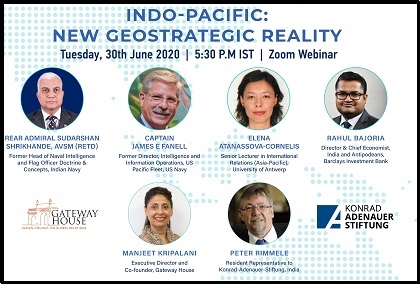
On 30th June, 2020 Gateway House in association with Konrad-Adeneur-Stiftung (KAS) co-hosted a webinar on Indo-Pacific: New Geo strategic reality.

 Courtesy: Gateway House
On 30th June, 2020 Gateway House in association with Konrad-Adeneur-Stiftung (KAS) co-hosted a webinar on Indo-Pacific: New Geo strategic reality.
 Courtesy: Uday Deb/Times of India
After the strategic digital pushback against Chinese investments and apps, India should turn its attention to the biggest Chinese domination tool – 5G. This is the mother lode that enables the efficient gathering of data, which when mined, results in product enhancement and pricing benefits to products listed in China 2025 and helps China set global standards. There is an urgency for alternate suppliers of 5G equipment and other technologies to avoid relying on China.
 Courtesy: Gateway House
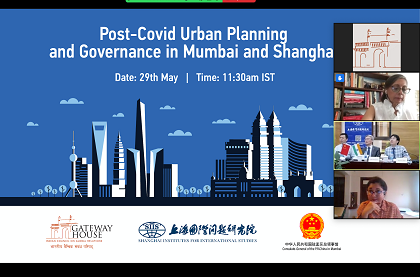
The sister cities of Mumbai and Shanghai have a shared history, population size, and economic significance. On 29 May, a roundtable between the Shanghai Institute of International Studies and Gateway House encouraged discussion on strategies to battle COVID-19, and kick-start city economies after a lockdown. Here are some workable solutions.
 Courtesy: Tasnim News Agency
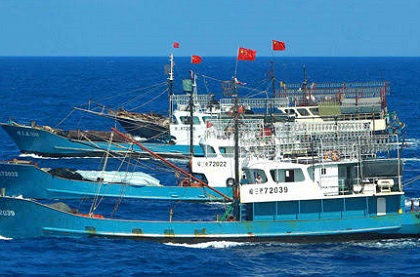
The Quad is set to launch a satellite-based maritime security initiative to monitor illegal fishing by the Chinese maritime militia. This is long overdue. China’s ‘little blue men’ are recruited from its fishing communities but are in fact official members of a well networked and controlled defense force engaged in regional grey zone warfare.
 Courtesy: Shutterstock/Gateway House
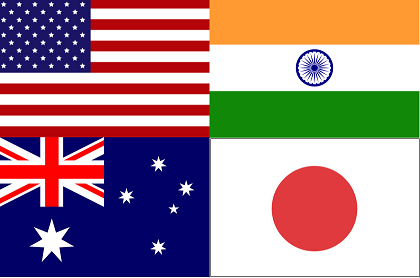
China’s escalating actions in the wake of the COVID-19 catastrophe is a calculated strategic diversion and risk. In the Indo-Pacific, tensions between China and the U.S., Australia, India and others are building momentum. As a geopolitical partnership, the relevance of the Quad is now proven. There are clear ways to empower it immediately, and make it a resilient grouping.
 Courtesy: MEA/Flickr
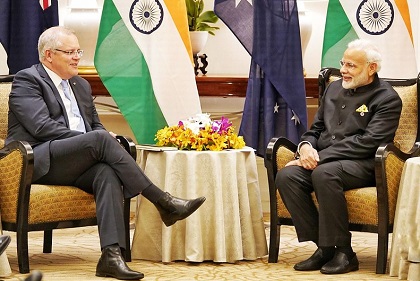
At the 4 June, India-Australia, virtual summit, one of the most critical, among several agreements signed, was the Mutual Logistics Support Agreement (MLSA). India has logistics support agreements with many countries. How is the MLSA with Australia any different? Given the geo-strategic maritime competition with China, this agreement is uniquely significant and could be especially beneficial for the Indian Navy.
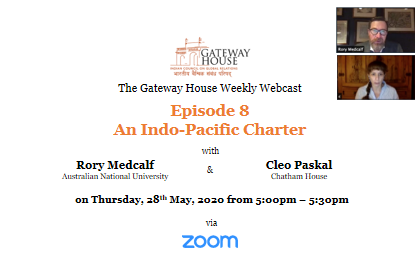
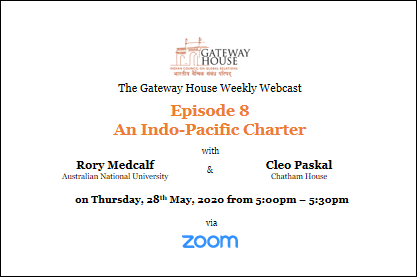
Manjeet Kriplani, Executive Director, Gateway House, in discussion with Prof. Rory Medcalf, Head, National Security College, Australian National University, and author of Indo-Pacific Empire: China, America and the Contest for the World's Pivotal Region; and Cleo Paskal, Associate Fellow, Energy, Environment and Resources, and Asia-Pacific, Chatham House; on the possibility of an Indo-Pacific Charter for the region.
 Courtesy: Gateway House
Manjeet Kripalani, Executive Director, Gateway House, in discussion with Prof. Rory Medcalf, Head, National Security College, Australian National University, and author of Indo-Pacific Empire: China, America and the Contest for the World's Pivotal Region; and Cleo Paskal, Associate Fellow, Energy, Environment and Resources, and Asia-Pacific, Chatham House; on the possibility of an Indo-Pacific Charter for the region.
 Courtesy: Shutterstock
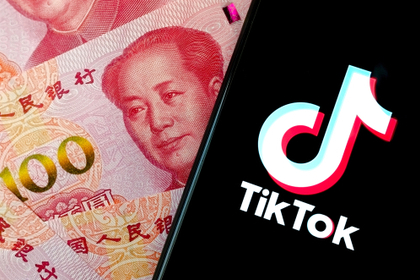
With more than 130 and 119 million users respectively, Chinese apps such as UC Browser and TikTok are not merely internet products, but serious content aggregators in India. But the final control of data collected by these apps resides in China, and this creates a grave risk to national security.
 Courtesy: Shutterstock
Globalisation has resulted in the interdependence of nations through the largely unimpeded transmission of investment capital and information, and integrated business operations. The leading beneficiaries have been the global 1%, and China. While it is too late and not possible to roll back an interconnected world order, globalization as we know it will recede, as will China’s standing in the world.