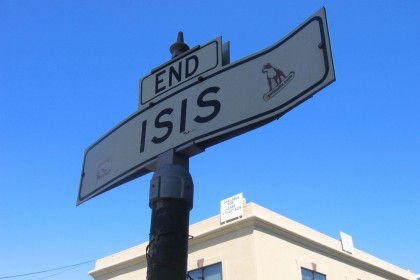
EndISISFlickrDawn Endico Courtesy: Dawn Endico
3 December 2015

Can ISIS be defeated?

Today ISIS is the gravest international security threat. To defeat ISIS, the world should pay heed to India’s experience of the need to isolate state sponsors of terrorism. Ultimately, only when Saudi Arabia acknowledges the danger to its own survival from past policies of alleged support to extremist groups, can it be a reliable partner in the fight against ISIS.
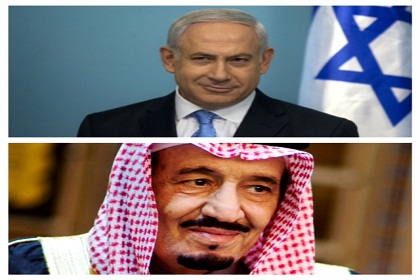
Israel-Saudi Courtesy: Wikipedia
13 July 2015

Reassessing our Israel, Arab engagement

The announcement in June of a Saudi-Israeli alliance against Iran has to be seen in the context of the strategic dimensions of India’s relations with Saudi Arabia, Israel, Iran, and the U.S. And it has far-reaching implications for India’s policy towards West Asia

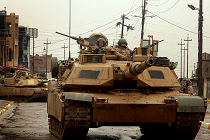
IS Courtesy: U.S. Staff Sergeant Aaron Allmon
16 September 2014

Modi, Obama and the Islamic State

Obama’s strategy to target the IS in Syria within the framework of a U.S.-led international coalition has met with a tepid response. There are reports that the U.S may offer India a non-NATO ally status during Modi’s upcoming visit in a bid to seek greater support – a gesture that India will do well to disregard.

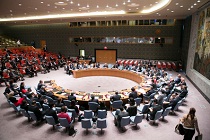
UNSC Syria UNSC Courtesy: United Nations
4 October 2013

Decoding the UNSC Resolution on Syria

The recent UNSC Resolution, which mandates the complete destruction of Syria’s chemical weapons, demonstrates that after more than a year, a degree of international agreement on the Syrian issue has been possible. In the evolving situation, Russia will now emerge as a major player

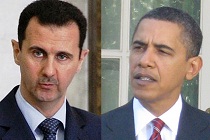
assadobama Courtesy: Freedom House/Flickr
6 September 2013

Syria: An unwarranted intervention

Despite rising international opposition, U.S. President Barack Obama is ready to penalise the Syrian regime for an alleged chemical attack in Ghouta, Syria, last month. The justifications given by the U.S. for an armed attack are questionable, and such retaliatory action will destabilise the entire region

West Asia Courtesy: takver/WikimediaCommons
3 December 2012

Prioritizing West Asia

India is tied to West Asia by economic, religious and political threads. The ongoing social and political flux in the region can have adverse consequences for India and requires a serious rethink of its foreign policy priorities. How can India insert itself usefully into this geopolitical cauldron?

obama second term_0 Courtesy: U.S. Navy
10 November 2012

The second term

U.S. President Barack Obama will certainly have the benefit of continuity in his second term, but he has a range of impending crises to address immediately - be it to avert the so-called fiscal cliff before the end of the year when automatic cuts kick in or plan for the military drawdown from Afghanistan.

Courtesy: FREEDOM HOUSE2/FLICKR
24 August 2012

Syria: What next?

With the Free Syrian Army being supplied aid by the West and the Gulf Cooperation Council countries, the endgame for the Syrian regime has begun. Does Assad's exit guarantee the replacement of autocracy with democracy? What implications will it have on regional politics?

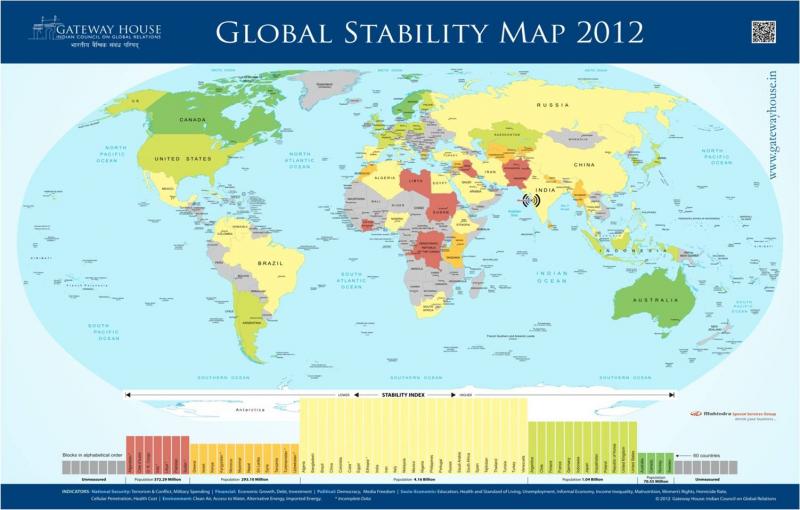
Global Stability Map Courtesy: Gateway House
1 August 2012

Global Stability Map 2012

Gateway House prepared a Global Stability Map, using 20 differing indicators, to analyze the stability of 60 countries around the world. Using criteria that are important to the emerging economies of the world, the map provides an Indian perspective of the world today.

anna hazare 2 Courtesy: nazeah/Wikimediacommons - Ramesh Lalwani/Flickr
30 December 2011

2011’s Top Foreign Policy Cheers and Jeers

The year 2011 saw various events - the Arab Spring, anti- corruption protests, Europe's sovereign debt crisis - transform countries and reshape the world order. Gateway House takes a look at what these events mean for India, and presents India's top foreign policy cheers and jeers for the year.