BRICS inching towards complementarity
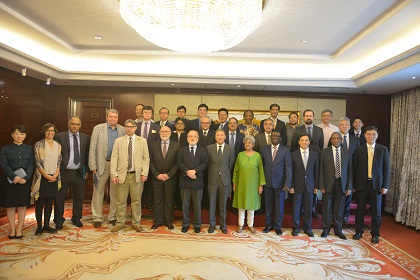
A conference of the BRICS 2017 Think Tank Forum, held in Beijing recently, showed that the grouping had progressed in influencing global governance despite some persistent intra-member differences
Courtesy: Gateway House
A conference of the BRICS 2017 Think Tank Forum, held in Beijing recently, showed that the grouping had progressed in influencing global governance despite some persistent intra-member differences
Courtesy: Igor Peraza
Speakers at the ‘1st BRICS Think Tank Forum on Pragmatic Cooperation’, held in Shanghai last month, discussed ways to tackle new challenges as globalisation moves into the next phase where the BRICS countries will take the lead
Courtesy: MEA/ Flickr
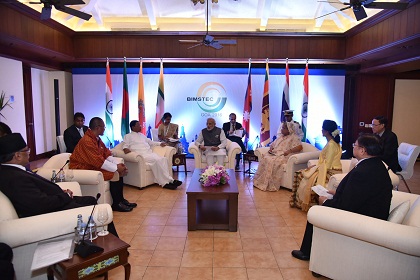
This regional grouping, which was envisioned as a potential bridge between SAARC and ASEAN, turns 20 on June 6. It achieved very little until last year, when efforts to revive its original mission began quite by accident. It has the potential to make greater strides if member states adhere to their commitments.
Courtesy: IMF/ Flickr
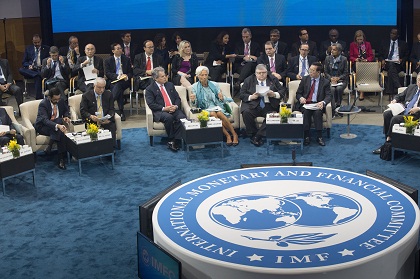
The IMF spring meetings on April 21-23 will take place amidst good news of the global economy moving into a better position. But the underlying fundamentals are still weak both in advanced countries and emerging markets, with the risks considerable. Economic policy makers must recognise and address the challenges with global consensus and multilateral actions
Courtesy: Gateway House
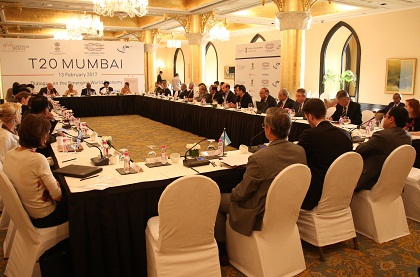
Gateway House hosted a T20 meeting in Mumbai on February 14, 2017 in collaboration with the Kiel Institute for the World Economy and the Ministry of External Affairs, Government of India, with support from GIZ and Siemens India. This was the third time Gateway House hosted a T20 meeting; previous editions were held in 2015 under the Turkish Presidency with the leading Turkish think tank TEPAV, and in 2016 under the Chinese Presidency with the leading Chinese think tanks — Institute for World Economics and Politics, Shanghai Institute for International Studies, and Chongyang Institute for Financial Studies.

Courtesy: Wikipedia
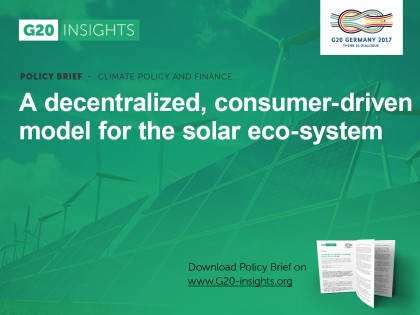
The transition to renewable energy is hampered by the lack of suitable, affordable products and specialised financing for its infrastructure. This infographic, as part of a policy brief put forth by Gateway House, set to be tabled at the 2017 Hamburg G20 conference, outlines an ecosystem to overcome these hurdles
Courtesy: G20 Insights
In a policy brief for the G20, Akshay Mathur and Purvaja Modak discuss the challenge of data classification when it comes to cross-border trade in services
Courtesy: The Telegraph
President Trump’s “America First” rhetoric has eroded support for the commitments that leaders made at previous G20 summits regarding trade: rejecting protectionism and strengthening the multilateral trading system. What implications does this have for global trade? Will the more moderate voices in the administration get heard?
The past decade has witnessed an evolution of India-Africa relations especially since the implementation of Modi's Act East policy. There is also a growing realisation of the strategic and geopolitical value of the Indian Ocean region. This speech highlights the policies needed to strengthen India-Kenya relations and tap the wealth of resources in this Blue Economy.
Britain will begin its formal exit process from the European Union on March 29. Signs that the European Union will survive are clear: public opinion is turning finally in its favour. The European economy has resumed creating jobs, and the unemployment rate, although still high, is steadily declining. Yet, what remains of the project is likely to have a different animus