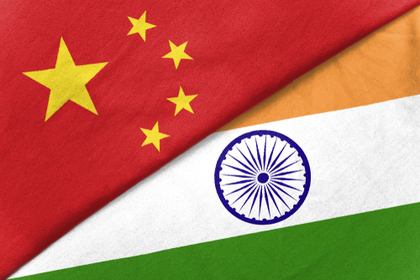
Interests over values
With the West losing its ability to set the rules of global order, what matters to nations is the dominance of interests over values, argue foreign policy experts

 Courtesy: The Hindu
With the West losing its ability to set the rules of global order, what matters to nations is the dominance of interests over values, argue foreign policy experts
 Courtesy: Sameer Patil
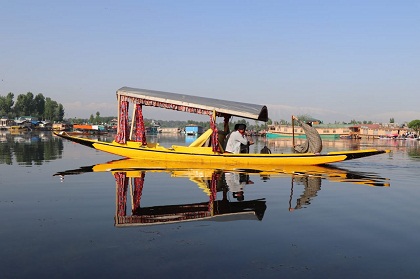
On a week-long October visit to Jammu and Kashmir, the author found both clarity and complexity among the citizens about their new status, and that the practicalities of daily life are more compelling than ideology
 Courtesy: @narendramodi/twitter
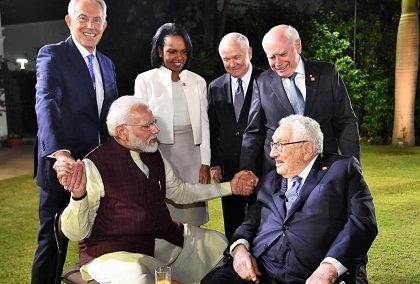
Dr Condoleezza Rice and Dr Henry Kissinger, speakers at the annual meeting of the U.S-India Strategic Partnership Forum, in Delhi in October 2019, kept the audience riveted. The topics covered included China as competitor, the earlier disharmony in India-U.S. relations, and tips from a veteran on the art of negotiation
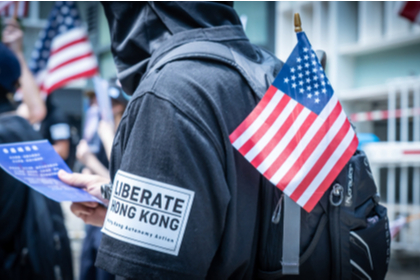 Courtesy: Shutterstock
Partisan media coverage of the anti-government protests in Hong Kong points to a new Cold War between the United States and China. The author examines the divergent approaches of the Chinese and international media and the biases they betray
 Courtesy: Government Law College, Mumbai
The world has changed – and so has India in the last 70 years since independence. Its foreign policy has evolved from non-alignment to multipolarity and to proactive participation in various multilateral organisations. Building on the work of its predecessors, the Modi government’s diplomacy articulates India’s interests more forthrightly and pursues them more energetically
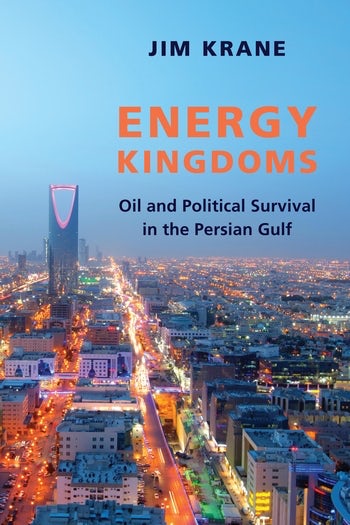 Courtesy: Columbia University Press
This book examines concisely and readably how the discovery of oil and natural gas transformed the six oil kingdoms of the Gulf, but profligate energy consumption at home challenged the basis of this very prosperity. It goes on to look at how these countries dealt with the economic crises that struck them
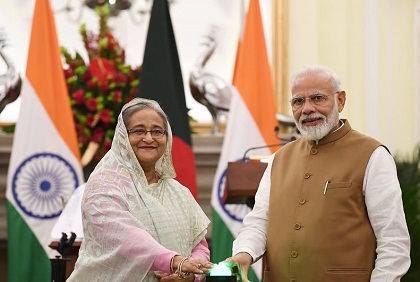 Courtesy: MEA/Flickr
Bangladesh prime minister Sheikh Hasina’s visit to India earlier this month, resulting in seven new agreements, showed the strength of the mutual relationship. But both governments need to address some rankling issues: the sharing of the Teesta waters, the Rohingya problem and repatriation of the illegal people from Assam
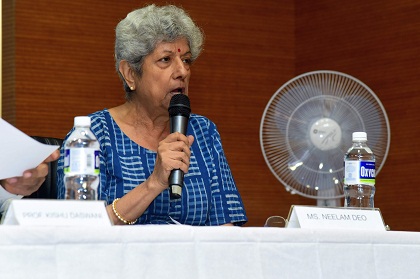
The second informal summit between Prime Minister Modi and President Xi Jinping in Mamallapuram on October 11 is likely to be more a holding operation than an occasion for increasing convergence of perspectives on regional and global issues. Neelam Deo, Director of Gateway House, answers a few questions on the eve of the Chinese president’s visit
 Courtesy: MEA/Flickr
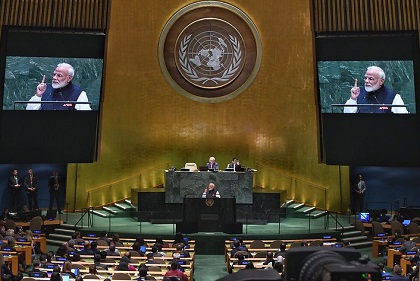
Prime Minister Modi’s tour of the U.S. last month was centred around the UN General Assembly’s 74th session and discussions on environmental challenges, but questions regarding the Indian government’s action in Kashmir persisted
 Courtesy: Princess Nora bint Abdul Rahman University
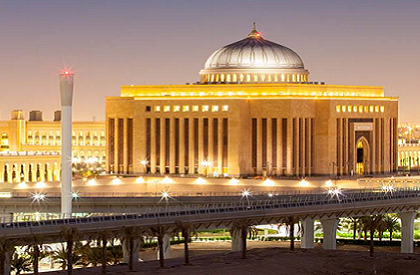
The immediate panic in the aftermath of the missile attack on Saudi Aramco’s facility at Abqaiq underlines the still-critical role of the Kingdom to the world economy. The subsequent recovery of oil production – with no disruption – showed that Saudi Arabia is a reliable partner/guarantor of energy supplies. Our Energy and Environment fellow Amit Bhandari was in Riyadh recently for a conference, and describes a post-Abqaiq Saudi Arabia