unnamed (1) Courtesy: Ministry of External Affairs, India
7 April 2022

A formal, opportune BIMSTEC

The recently concluded BIMSTEC summit is now a regional intergovernmental organization with a formal charter, giving it a clear mission and legality and a destiny linked to South and South East Asia. It is now better equipped to accelerate economic development for the fifth of the world’s population, which contributes only 4% of global GDP.

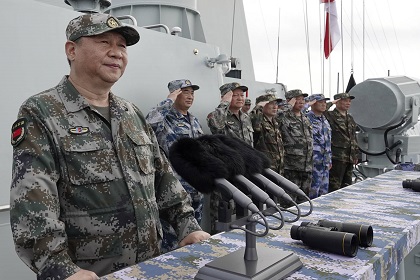
FILE - In this April 12, 2018, file photo released by Xinhua News Agency, Chinese President Xi Jinping, left, speaks after he reviewed the Chinese People's Liberation Army (PLA) Navy fleet in the South China Sea. From Asia to Africa, London to Berlin, Chinese envoys have set off diplomatic firestorms with a combative defense whenever their country is accused of not acting quickly enough to stem the spread of the coronavirus pandemic. (Li Gang/Xinhua via AP, File) Courtesy: The Japan Times
31 March 2022

China’s military modernisation

China's 2022 defence budget reflects the seriousness of the Communist Party aims to fully modernise the People’s Liberation Army by 2027. Given the on-going border competition, it is crucial for India too, to optimise budgetary resources, intensify restructuring and enhance indigenous defence production, thereby improve power projection capability.

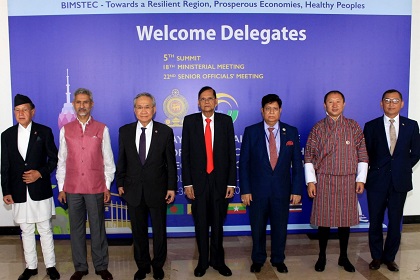
bimstec 2022 Courtesy: BIMSTEC
31 March 2022

BIMSTEC steps forward

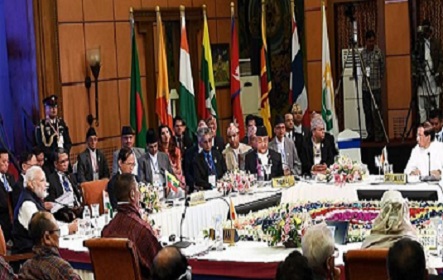
BIMSTEC is of special importance to India as it is a crucial link between the Neighbourhood First and Act East policies. This almost 25 year old multilateral can contribute to the Indo-Pacific region by addressing challenges in strategic areas of regional connectivity, security cooperation, free trade, and geoeconomic ties with external partners.

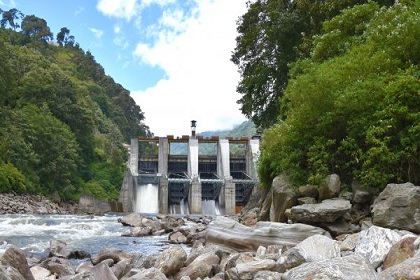
DRUK HYDRO DAM Courtesy: Druk Green Power Ltd
18 November 2021

Bay of Bengal connectivity

The Bay of Bengal is gaining relevance as a significant sub-region within the Indo-Pacific. Despite its importance to regional security, there is inadequate financial, physical, and energy connectivity. India must use its strategic and political pre-eminence and influence in the sub-region to pursue deeper connectivity with Bangladesh, Myanmar, Thailand, Nepal, and Sri Lanka and to block China's growing influence.

SAARC and BIMSTEC Courtesy: Nepal Institute for International Cooperation and Engagement
1 July 2021

Revitalizing SAARC and BIMSTEC

On 27 June 2021, Ambassador Rajiv Bhatia, Distinguished Fellow, Gateway House, chaired a session on Revitalizing SAARC and BIMSTEC. This was part of the Global Conclave 2021, hosted by the Nepal Institute for International Cooperation and Engagement (NIICE), Kathmandu. Bhatia spoke about the present state, past trajectory and future challenges and opportunities for regional and sub-regional cooperation through SAARC and BIMSTEC.

bimstec needs to reinvent itself Courtesy: @MEAIndia | Twitter
14 April 2021

BIMSTEC needs to reinvent itself

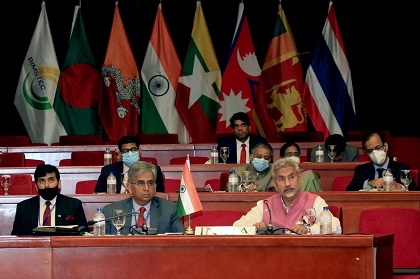
The 17th Bay of Bengal Initiative for Multi-sectoral Technical and Economic Cooperation (BIMSTEC) ministerial meeting was held on 1 April 2021. Though the grouping is ready to move forward, a number of obstacles stand in the way of this, including regional tensions, uncertainties surrounding SAARC and China's involvement in the multilateral. As BIMSTEC is to celebrate the silver jubilee of its formation next year, can it achieve its goal, to effect “a paradigm-shift in raising the level of cooperation and regional integration"?

BIMSTEC: Potential and Opportunities Courtesy:
22 February 2021

BIMSTEC: Potential and Opportunities

During the Bay of Bengal Economic Dialogue 2021 on, Post-COVID Challenges in the Bay of Bengal Region, Amb. Rajiv Bhatia, Distinguished Fellow, Foreign Policy Studies, Gateway House addresses the staggered growth of BIMSTEC, whilst also highlighting its potential as a regional grouping. He identifies the lack of political commitment, bureaucratic inertia and insufficient engagement of the Third Space and disregard for the region as a community as the chief obstacles to a successful initiative.

shutterstock_1787861693 Courtesy: Shutterstock
21 October 2020

Riparian Governance in South Asia

The record of regional cooperation on rivers since India's independence in 1947 is one of several successes, with some contestations. In contrast to the past when governments strove to divide and share river waters, the endeavor has now shifted to thinking about comprehensive river basin development which makes the process even more complex. India’s policy on transboundary river governance must now also be aware of the increasing importance of Indo-Pacific in the global geopolitics.