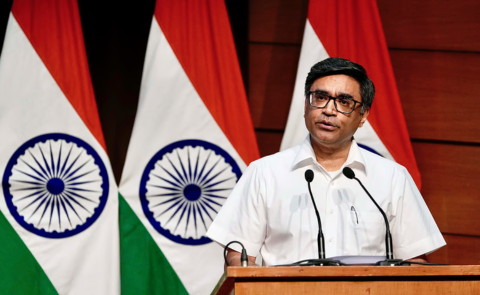
Joint Statement from the Quad Foreign Ministers’ Meeting in Washington Courtesy: U.S. Embassy & Consulates in India
19 June 2025

Reappraising QUAD post Pahalgam

The July 2 meeting of the QUAD foreign ministers in Washington, D.C., restated all the commitments of the grouping, including a condemnation of the April 22 terrorist attacks on Pahalgam. Yet, none of the QUAD countries actually came to the aid of India, despite China being a present player in the fight, in full support of its partner Pakistan.

Website articles  (21) Courtesy: News Arena India
12 June 2025

G7 Summit: Plethora of opportunities

Canadian Prime Minister Carney can use the upcoming G7 summit he is hosting to advance the North-South dialogue and cooperation and also to discuss the strained bilateral with India. India can articulate the viewpoint of the Global South, stressing its conviction that the G7 is better served by constructively working with developing and emerging economies.

IMEC map with source Courtesy: Gateway House
11 June 2025

IMEC: more than just a corridor

The proposed IMEC corridor connecting India to Europe through the Gulf can be transformative, helping to reduce risks to the global movement of goods and data. It’s early days yet, and there are gaps to be filled in terms of missing infrastructure and overcoming a diplomatic rift.

Myanmar article Courtesy: X /@antonioguterres
28 May 2025

Quid pro quo for Myanmar’s humanitarian corridor

A proposed humanitarian corridor from Bangladesh to Myanmar’s suffering Rakhine state is the need of the hour. But Chief Advisor Yunus has linked it with repatriation of the Rohingya refugees in Bangladesh, mixing up unrelated issues. This is a classic ploy to distract the public from his own shortcomings, and his single-minded focus to extend and legitimise his regime.

The New Indian Express Courtesy: The New Indian Express
19 May 2025

Post-Pahalgam diplomacy

Studying the reaction of key stakeholders to the India-Pakistan conflict, and how India’s diplomatic machine coped with it, is revealing. Some of the major powers like the U.S., raised the temperature, China expectedly stood by Pakistan while Russia once again proved a dependable friend. Unsurprisingly, South Asia had a consistently neutral stance toward the conflict.

Getty (1) Courtesy: Gateway House
15 May 2025

The New Geopolitics and South Asia’s Trade Architecture – What Next?

Geopolitics is increasingly intertwined with the economic destiny of South Asia. Even before the U.S. tariffs were rolled out, growing polycrises had hit the global economy, which has been struggling since the pandemic. South Asia seems a relatively bright spark of regional trade and growth. This paper analyses South Asia’s trade architecture in the backdrop of a sluggish world economy in the 2020s, and makes recommendations for closer regional economic integration.

Mark Carney Win Courtesy: AFP
30 April 2025

Canada’s challenges ahead

The victory of Mark Carney and the Liberals in the Canadian elections is a turnaround from the party's diminished position just four months ago. The former banker's campaign ran on a strong, independent Canada able to stand up to the new U.S. administration’s tariff provocations. Now come the challenges. The Carney government has much work to do in rebuilding ties abroad and bridging Canada's internal divisions.

Agnipath Courtesy: India Today
10 April 2025

Assessing India’s Agnipath Scheme

India’s new Agnipath scheme was launched in 2022, which offered young Indians a chance to qualify for four-year military service with 25% possibly being retained for a full service job. How have the ‘Agniveers’ fared now? In this time of multiple wars, how does the Agnipath scheme compare to ones offered globally?

Myanmar Earthquake Courtesy: Associated Press (AP)
3 April 2025

Myanmar’s multiple stakeholders for aid

The March 28 earthquake in Myanmar has devastated a country already in civil war. Multiple groupings and militias now occupy different parts of Myanmar, leaving its neighbours and the international community concerned about which stakeholder to engage with for provision of humanitarian relief, particularly those areas beyond the writ of the ruling military. What can India do to help?