Cheap oil is costing West Asia
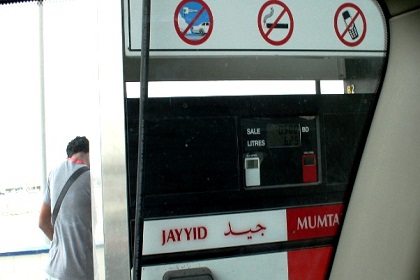
The oil-rich GCC countries are starting to show signs of financial stress maintaining high defense and social spending while the price of oil remains low

 Courtesy:
The oil-rich GCC countries are starting to show signs of financial stress maintaining high defense and social spending while the price of oil remains low
 Courtesy: Wikipedia
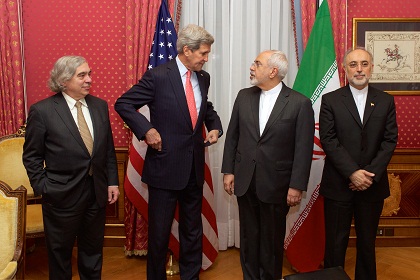
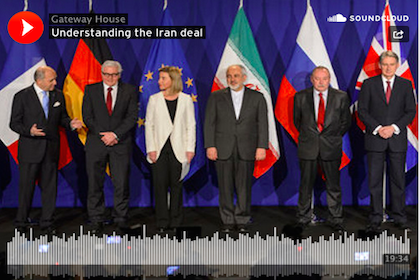
A journey which began in Istanbul in 2012 ended in triumph in Vienna in July 2014, as the P5+1 countries and Iran announced a Joint Plan of Comprehensive action that would see Iran free of all economic sanctions while upholding the right to a civil nuclear programme. While this journey, fraught with challenges, technically is over, the ratification battle in the U.S. congress commences now
 Courtesy:
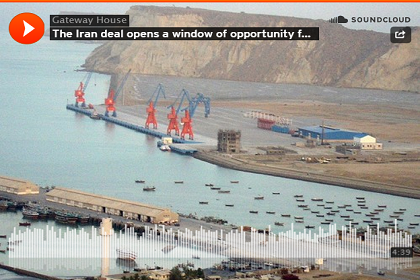
Amit Bhandari, energy and environment fellow, speaks to Dev Lewis, Gateway House, on the impact of the Iran deal on global energy markets. He also outlines why this is a window of opportunity for Indian business
 Courtesy: Wikipedia
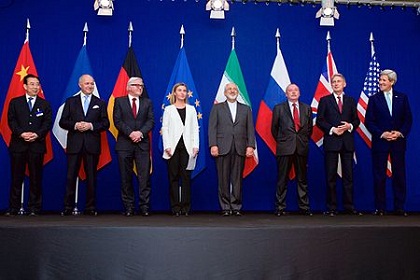
The landmark deal between Iran and the P5+1 countries will gradually phase out all international sanctions on Iran and pave the way for Iran's re-entry into the global economy. How will this affect the chaos in the middle-east and what are the opportunities for India?
 Courtesy:
After 12 years of negotiations on Iran's civilian nuclear program between Iran and the P5+1 countries, a Joint Comprehensive Plan of Action (JCPOA) was announced on July 14. Neelam Deo, Director, Gateway House, sits down with Dev Lewis, Gateway House, to discuss the agreement, how the sanctions will be lifted, and what a re-emerged Iran means for India and the middle-east
 Courtesy: Wikipedia
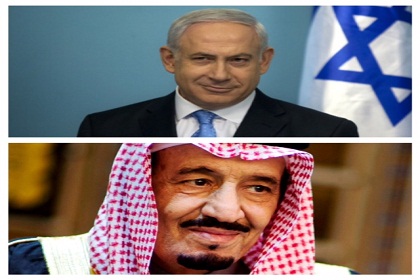
The announcement in June of a Saudi-Israeli alliance against Iran has to be seen in the context of the strategic dimensions of India’s relations with Saudi Arabia, Israel, Iran, and the U.S. And it has far-reaching implications for India’s policy towards West Asia
 Courtesy: Wikipedia
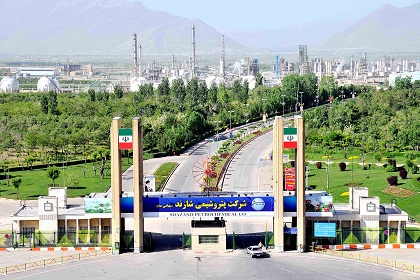
A possible Iran nuclear deal means a longer window of lower oil prices. But the glut of oil supplies is already resulting in cutbacks to oil exploration and production spending, and will eventually lead to higher energy prices. Before that happens, India must use this opportunity to lock in prices
 Courtesy: U.S. Senate/Wikimedia Commons
Hardliners in the U.S. argue that the Obama administration’s eagerness to declare success has given Iran an advantage in the negotiations on its nuclear programme. Even if the agreement between the U.S., its partners, and Iran is finalised in the coming days, Obama has the tough task of convincing the U.S. Congress to lift sanctions
 Courtesy: Marzieh Soleimani, Islamic Republic News Agency
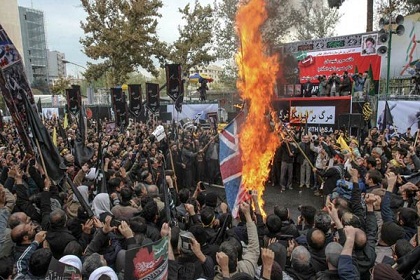
Iran's nuclear deal deadline is looming large, and sparks are already flying. While there is opposition to the deal from Israel, within Iran there are powerful interest groups driven by ideology and business interests, who are doing as much as possible to prevent a deal from being reached
 Courtesy: Wikipedia
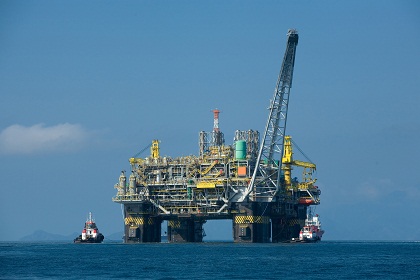
The price of petroleum has risen by almost 40% since February 2015 because of geopolitical tensions. This spike underlines the need for India to hedge its energy imports using a mix of financial markets and asset purchases