What our anthems say
South Asia’s national anthems are patriotic rather than nationalistic.

 Courtesy: Indian Express
South Asia’s national anthems are patriotic rather than nationalistic.
 Courtesy: Homen Biswas/Wikimedia
As India celebrates its Independence Day, security situation on eastern borders is gradually moving towards stability with experiments in peace making focused on resolving insurgencies and border management. These experiments coupled with the sub-regional economic initiatives potentially put eastern region on the path of prosperity.
 Courtesy: Ministry of External Affair, Flickr
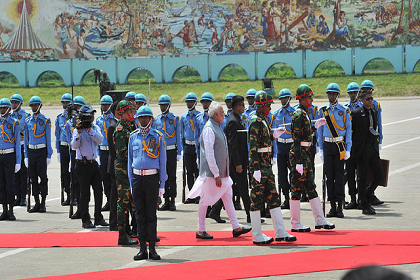
Prime Minister Narendra Modi’s completion of the South Asia circuit demonstrates the importance of the neighbourhood in his government’s foreign policy. The improved perception of India in the neighbourhood, especially in Bangladesh and Sri Lanka, is a positive, but the neighbours must recognise that India’s federal structure makes decision-making slower and more difficult on issues that affect neighbouring Indian states like West Bengal and Tamil Nadu.
 Courtesy:
Indian foreign secretary S. Jaishankar’s visit to SAARC countries from March 1 is an opportunity to examine the political trajectories in the region. While democracy in some countries like Sri Lanka is on an upswing, in others, like Bangladesh, it is in decline. With China’s growing economic influence in South Asia, can Indian democracy be an effective counterpoint?
 Courtesy: Saddahaq.com
The SAARC Yatra to be undertaken by foreign secretary S. Jaishankar from March 1 is an opportunity for India to improve relations, resurrect stalled projects and create new synergies with its neighbourhood. An initiative like this could hold the key to India shedding the ‘hegemon’ tag and pursuing mutually beneficial policies with its neighbours
The 18th SAARC Summit held in Nepal concluded on November 27 with the release of the Kathmandu Declaration. Did the summit live up to its expectations? Was concrete progress made, and if so in which areas? Where is SAARC heading now? Gateway House asks and answers five questions on the outcome of the summit
 Courtesy: wikimedia
Despite an early regional consensus on counter-terror, SAARC’s record in tackling terrorism remains dismal. With the widening network of terrorist groups in the subcontinent, it is imperative that India takes the lead in forging substantial counter-terrorism cooperation, particularly on the issue of financing

Rajni Bakshi, Senior Gandhi Fellow, Gateway House reports from People’s SAARC, a motley gathering of NGO workers and members of the village communities they work with. PSAARC will compile a memorandum – a wish-list of demands and aspirations – on November 24 and present it to the heads of SAARC nations
 Courtesy: pmindia.nic.in
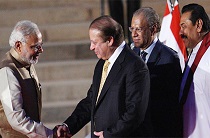
The 18th SAARC Summit in Kathmandu next week is an opportunity for member countries to start shaking off the shackles of distrust. Instead, SAARC must robustly move forward on such issues as regional connectivity, SAFTA, climate change, and security—and India can be the prime mover in building this renewed cooperation
 Courtesy: Wikimedia commons
The 18th SAARC Summit will cover a wide range of issues, including connectivity, climate change, and SAFTA. A number of similar issues were discussed at the last summit—what’s been the progress since then? Given its constraints, does the association have a future? Gateway House asks and answers five questions on SAARC