Indo-Pacific: New Geostrategic Reality
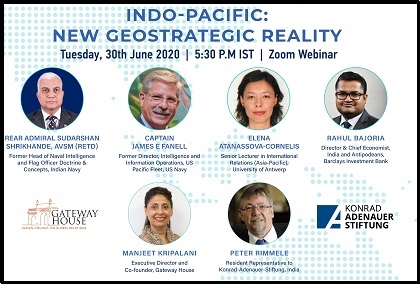
On 30th June, 2020 Gateway House in association with Konrad-Adeneur-Stiftung (KAS) co-hosted a webinar on Indo-Pacific: New Geo strategic reality.
Courtesy: Gateway House
On 30th June, 2020 Gateway House in association with Konrad-Adeneur-Stiftung (KAS) co-hosted a webinar on Indo-Pacific: New Geo strategic reality.
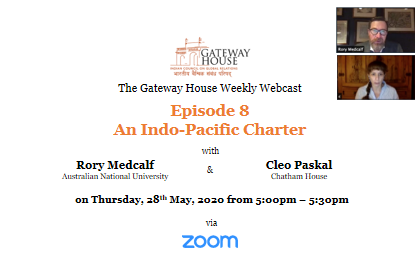
Manjeet Kriplani, Executive Director, Gateway House, in discussion with Prof. Rory Medcalf, Head, National Security College, Australian National University, and author of Indo-Pacific Empire: China, America and the Contest for the World's Pivotal Region; and Cleo Paskal, Associate Fellow, Energy, Environment and Resources, and Asia-Pacific, Chatham House; on the possibility of an Indo-Pacific Charter for the region.
Courtesy: Gateway House
Manjeet Kripalani, Executive Director, Gateway House, in discussion with Prof. Rory Medcalf, Head, National Security College, Australian National University, and author of Indo-Pacific Empire: China, America and the Contest for the World's Pivotal Region; and Cleo Paskal, Associate Fellow, Energy, Environment and Resources, and Asia-Pacific, Chatham House; on the possibility of an Indo-Pacific Charter for the region.
Courtesy: Shutterstock
The OPEC’s proposed cut in oil production earlier this week may not enable the energy market to recover. Recovery is likely only after COVID-19 is brought under control, but there are ways India can capitalise on the current low oil prices for its own energy security
Courtesy: Ministry of External Affairs
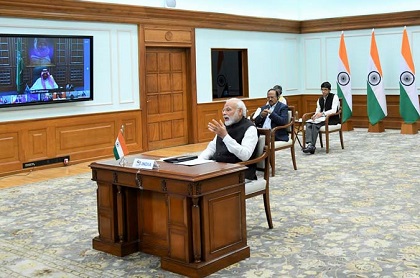
COVID-19 unified G20 leaders at an extraordinary summit last week. An idea given a nudge by Prime Minister Narendra Modi, here was an opportunity for all participants to put together a plan and make a pledge for international cooperation, focusing on four main themes. Next, will they be able to turn words into action?
Courtesy: Flickr/MEA
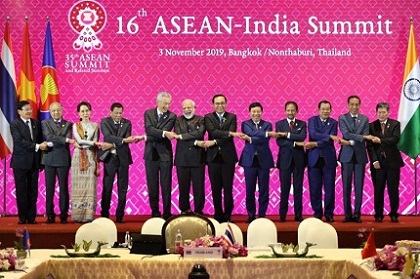
The 35th summit of the Association of South East Asian Nations, held in Bangkok early in November, showed that a shifting geostrategic landscape notwithstanding, “ASEAN centrality” in the region is a top priority with members. It also served as a backdrop for three summits that ASEAN held on November 4 with China, U.S. and India
Courtesy: Shutterstock
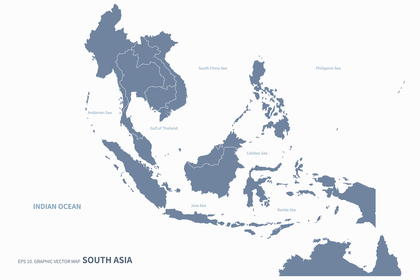
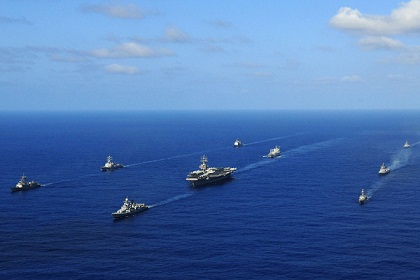
The foreign ministers of the Quad countries meet for the first time in New York today even as the Indo-Pacific has turned into a keenly contested geopolitical arena. Some countries are offering to play a mediatory role while other triangular equations are also undergoing change. An analysis of some of the relationships at work here
Courtesy: Pacom
Canada, which has been slow to respond to a changing trans-Pacific neighbourhood, can join India and the ASEAN member states to embark on a trilateral dialogue on the Indo-Pacific’s importance in terms of political, strategic and other domains. An alignment in outlook can strengthen the security and prosperity of a region, currently mired in U.S.-China rivalries
Courtesy: Zee News
Indonesia and Malaysia appreciate India’s leadership role in the Indo-Pacific, but are also aware of all that keeps it from delivering on its commitments. A policy visit to the two countries enabled a closer look at some key issues, such as ASEAN’s centrality, the Quad and India’s stand on the Regional Comprehensive Economic Partnership
Courtesy: MEA Flickr
Prime Minister Modi’s visits to South East Asia last week were major steps in furthering the goals of India’s Act East Policy even as major power rivalries unfolded in the region. Most significant was the visit to Indonesia, a low key Asian power but one that India can partner to enhance its regional stature.