America’s Energy Edge
The U.S.'s energy boom will fuel the country’s economic revival and give it greater diplomatic freedom and influence. But it has geopolitical implications for countries across the world

 Courtesy: Foreign Affairs
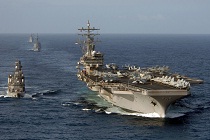
The U.S.'s energy boom will fuel the country’s economic revival and give it greater diplomatic freedom and influence. But it has geopolitical implications for countries across the world
 Courtesy: Spike Call U.S Navy/Wikimedia Commons
The Indian Navy, through multi-lateral exercises, is increasing its sphere of influence and becoming a regional force. Yet, it needs to be supported by policy decisions that enable it to achieve its potential as a state-of-the-art establishment and a powerful tool in India’s diplomatic repertoire
Marshall Bouton, an expert on the India-U.S. bilateral, talks about how ties between the two countries can be repaired. In an interview to Gateway House, he also discusses the steps India must take to integrate with the global economy, and the U.S.’s plans in Afghanistan
 Courtesy: Wikimedia Commons
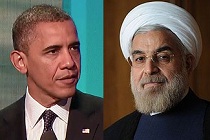
The P5+1 negotiations with Iran, mostly a Washington-Tehran affair, may be a means to a complex and ambitious end: a new strategic and energy equation in Southwest Asia. U.S. President Barack Obama’s recent State of the Union address indicates that to reach this goal, the U.S. is steering away from war to diplomacy
 Courtesy: Pete Souza/Flickr
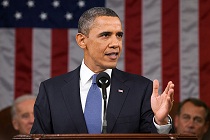
U.S. President Barack Obama's fifth State of the Union address where he set out America's social and economic agenda fails to take into account certain realities. Hal Bergold blogs
 Courtesy: Gobierno de Chile/Wikimedia Commons
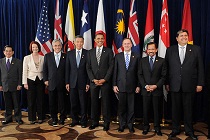
Can India integrate more fully into the global economy and energise its trade by joining the Trans-Pacific Partnership? Or will negotiating an entry require significant concessions, not necessarily in India’s interests? These outcomes will depend on how TPP framework itself develops – inclusively or exclusively
 Courtesy: Secretary of Defense/Flickr
U.S. President Barack Obama’s focus on domestic issues has sidelined his country’s foreign policy at a time when China is ascending as a superpower. With China’s economy set to surpass the U.S.'s by 2017, a recent report presents a ‘grand strategy’ for the U.S. to counter China’s economic and strategic expansion
 Courtesy: Press Information Bureau/Wikimedia Commons
What are the implications for India of the scaling down of U.S. forces from Afghanistan, the continuing tension with China at the border, and the political turmoil in Bangladesh? How should India address these and other upheavals in its neighbourhood, which are potential challenges to the country’s security?
Vivek Katju, former Indian Ambassador to Afghanistan, says about India’s attempts to reintegrate the Afghan economy into the region. In an interview to Gateway House he also talks about why it will take time for Afghanistan to become a bridge for the flow of trade, and how the U.S.-Pakistan equation impacts India
 Courtesy: monotrilho|/Flickr
With elections scheduled in seven Latin American countries, 2014 will be a year of significant political developments in the region. As we enter 2014, Gateway House examines the important events that defined Latin American politics and economy in 2013