Bahrain Activist/WikimediaCommons Courtesy:
8 February 2013

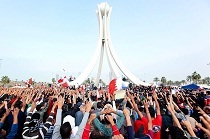
India navigates the Arab Uprisings

The Arab uprisings show no sign of closure, and have become amorphous. While New Delhi has so far been immunised from the political and religious dimensions of the uprisings, the rise of political Islam, Islamic governance, and continuing instability will impact India.
Www.Oic-Oci.Org Courtesy:
23 January 2013

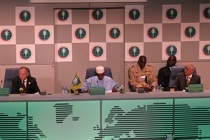
India and the OIC: To join or not to join?

India’s relations with Islamic nations, many of which are members of the Organisation of Islamic Cooperation (OIC), have become even more prolific over the last decade. While India does not visualise becoming a member of a religious international body, many reasons militate against our formally joining the OIC.

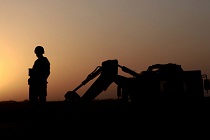
U.S. Department of Defense Courtesy: U.S. Department of Defense
11 January 2013

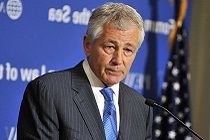
Chuck Hagel: Revising U.S. strategic postures?

The nomination of Chuck Hagel for the post of the U.S. Defense Secretary has garnered severe criticism from Israel and the Jewish lobby. Given the geopolitical changes unfolding in the Middle East and the rest of Asia, what will Hagel’s assumption of office mean for Israel, India and the rest of the world?

Courtesy: Gigi Ibrahim/WikimediaCommons
27 November 2012

Israel-Hamas: Only an intermission

The series of Israeli offensives against Gaza, which began on November 4, ended when Egypt's new President Mohamed Morsi brokered a ceasefire between Hamas and the Israeli government on November 13. The possibility of this ceasefire holding up, however, seems remote.

afghanistan route 606 Courtesy: Isafmedia/Flickr
25 October 2012

Afghanistan: Strategic depth to strategic peace

As the NATO troops prepare to pull out of Afghanistan in 2014, India is already positioned to take on a larger, pro-active role, which can radically alter the balance of power in South Asia. However, what will determine the future of security in the region, is how India and Afghanistan deal with Pakistan.

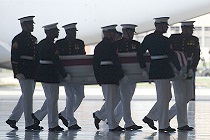
chris stevens casket Courtesy: Secretary of Defense/Flickr
20 September 2012

Death of an Ambassador

Ambassador Christopher Stevens, the U.S. envoy to Libya, was killed, following protests against a controvertial movie, titled 'Innocence of Muslims.' Is an anti-U.S. sentiment to be blamed for this violence? What consequences will this incident have on the U.S. policies towards Libya and Syria?

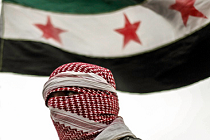
Courtesy: FREEDOM HOUSE2/FLICKR
24 August 2012

Syria: What next?

With the Free Syrian Army being supplied aid by the West and the Gulf Cooperation Council countries, the endgame for the Syrian regime has begun. Does Assad's exit guarantee the replacement of autocracy with democracy? What implications will it have on regional politics?

Neelam on Syria Courtesy: FreedomHouse2/Flickr
6 July 2012

The unique tragedy of Syria

Simultaneous efforts to resolve the problem in Syria remain stymied even as more and more high level meetings and consultations take place. The more countries treat the situation as a proxy for political differences, the more it creates the conditions for a wider conflagration with an unpredictable outcome.

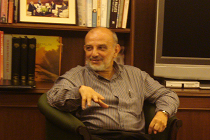
ambassador abhyankar interview Courtesy: Gateway House
8 June 2012

“We are not in the business of ‘civilizing’ nations”

Over the past year, there has been a drastic change in the political scenario in Syria, which is now engulfed with violent sectarian conflict. Gateway House speaks to former Indian Ambassador to Syria, Rajendra Abhyankar, about the changing political scenario and the implications of the ongoing conflict in Syria.