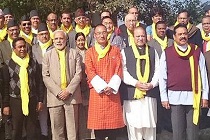
The PSAARC declaration
The People's SAARC (PSAARC) declaration,which called for the governments to address a number of issues from food security to climate justice, established the network as advocates for a progressive humanitarian agenda


The People's SAARC (PSAARC) declaration,which called for the governments to address a number of issues from food security to climate justice, established the network as advocates for a progressive humanitarian agenda
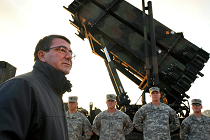 Courtesy: defence.gov
Chuck Hagel’s unremarkable stint as the U.S. Defence Secretary should soon be forgotten if Ashton Carter’s nomination is confirmed. Even though Carter’s nomination bodes well for the India-U.S. bilateral due to his work on furthering the defence partnership he will be faced with more immediate concerns and the onus will then be on India to strategically enhance the relationship
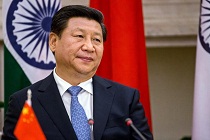 Courtesy: Livemint
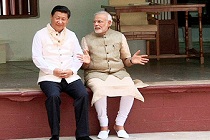
The shifting geopolitics in Asia presented an opportunity for China to rebalance its relations with India during the visit of President Xi Jinping to New Delhi in September. However, the meeting proved to be another missed opportunity for the two countries.
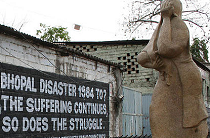 Courtesy: Luca Frediani/Wikimedia Commons
A tragic ‘anniversary’ this week drew attention to what it would take to ensure that the current excitement about ‘make in India’ becomes a boon and not a curse
2014 was celebrated as the year of India-China friendship with many joint high level diplomatic, defence and cultural events to strengthen relations. The cities of New Delhi and Mumbai will see the debut of the Chinese Kunqu Opera to mark the close of the year
 Courtesy: MEA/Government of India
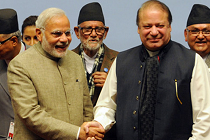
The recent SAARC Summit was once again derailed by India-Pakistan dissonances. Is it time for India to look beyond this collective? Or are there ways to overcome the distrust and address border issues, build institutions to implement common goals, and create an economic union of confident democracies?
The 18th SAARC Summit held in Nepal concluded on November 27 with the release of the Kathmandu Declaration. Did the summit live up to its expectations? Was concrete progress made, and if so in which areas? Where is SAARC heading now? Gateway House asks and answers five questions on the outcome of the summit
 Courtesy: Narendra Modi (wikimedia.org)
A major theme at the multilateral summits this month was connectivity, with China at the forefront. India is trailing behind due to a shortfall in investment and political will, among other factors. Prime Minister Modi must follow up on his meetings at the SAARC Summit by robustly taking forward India’s connectivity agenda
 Courtesy: PSAARC
Parallel to the official SAARC meeting was the People's SAARC in Kathmandu. Comprising NGOs, civil society leaders, and activists, the PSAARC is a platform that rejects narrow nationalism and religion in favour of a transcendent South Asian identity
 Courtesy: pmindia.nic.in
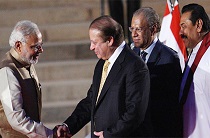
The 18th SAARC Summit in Kathmandu next week is an opportunity for member countries to start shaking off the shackles of distrust. Instead, SAARC must robustly move forward on such issues as regional connectivity, SAFTA, climate change, and security—and India can be the prime mover in building this renewed cooperation