modiobama Courtesy: Wikipedia
29 May 2016

Modi in the U.S.: a changed landscape

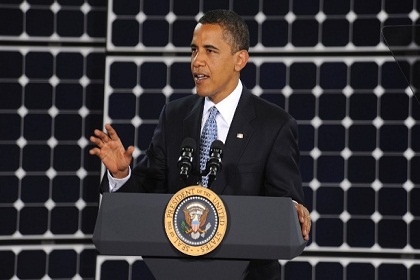
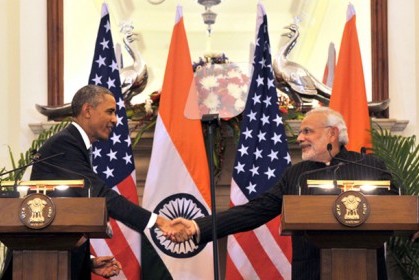
Prime Minister Modi’s skills will be tested on his upcoming visit to the United States. The challenge comes in light of recent anti-India sentiments voiced at a U.S. Senate Foreign Relations Committee hearing. With Modi set to address a joint session of the U.S. Congress, this is an opportunity to address all concerns, be it on policy or polity.
800px-thumbnail Courtesy: Wikipedia
12 May 2016

India: openly-allied with the U.S.

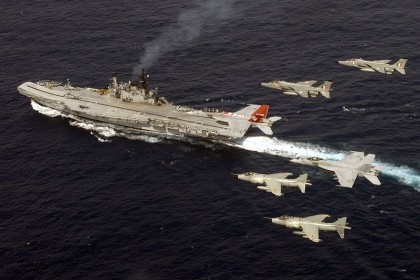
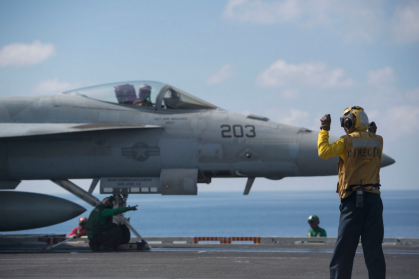
After nearly a decade of moving slowly towards the U.S. on critical matters including nuclear power, the recent bilateral agreement to share military facilities and have anti-submarine warfare talks, suggest that Prime Minister Narendra Modi will have India sail the oceans with the American eagle.

US India Navy Courtesy: Ash Carter / Flickr
16 April 2016

India-U.S.: convergence and divergence

The success of the U.S. Defense Secretary's recent visit to India is indicative of the deepening India-U.S. defence relationship. It has become clear that Indo-U.S. maritime cooperation in the Indian Ocean is steaming ahead; while other geopolitical differences, like the sale of aircraft to Pakistan, seem unlikely to disappear anytime soon.

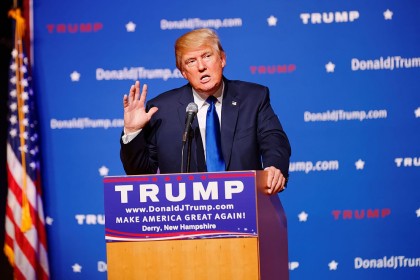
Mr_Donald_Trump_New_Hampshire_Town_Hall_on_August_19th,_2015_at_Pinkerton_Academy,_Derry,_NH_by_Michael_Vadon_02 Courtesy: Wikipedia
31 March 2016

Dismantling the geopolitical Bretton Woods

Statements by Donald Trump, the business magnate turned serious contender for the Oval Office, assert that he wants “good” political and economic deals for the U.S. - even if it means dismantling alliances, i.e. the geopolitical equivalents of Bretton Woods that underwrote the U.S .domination in Europe, Asia and Middle East for more than six decades. A new era could dawn.

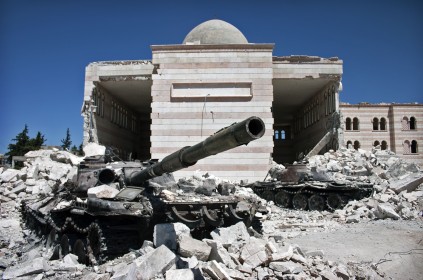
Azaz,_Syria Courtesy: Wikipedia
9 March 2016

India and the Syrian quagmire

With a cessation of hostilities been brokered by Russia and the United States, the conflict in Syria has entered a tense pause. India has had a bystander attitude to the conflict in Syria. However, with the truce expected to be short, does India have the incentive or the option to depart from its current position, and deepen its engagement in Syria?

maxresdefault Courtesy: Youtube
4 February 2016

The world in 2016

The world has witnessed a number of upheavals in the past few years, precipitating widespread global political turbulence stemming from geo-economic instability. Over the next couple of months, Gateway House experts will attempt to deconstruct these events and how India and its foreign policy can work to take advantage of these trends.

DSC_0211[1] Courtesy: Gateway House
14 January 2016

U.S.-Iran: overcoming brief setbacks?

Former United States Ambassador Frank Wisner talks to Gateway House about the progress of U.S.-Iran relations in the aftermath of the P5+1 nuclear deal with Iran, including the U.S. response to Iran’s testing of a missile. He also discusses the U.S. perspective on India’s prospective APEC membership.

Ecuador Dhruv Courtesy: Presidencia Ecuador / Flickr
26 November 2015

India-Ecuador: growing past defence

The Ecuadorian president’s first-ever state visit to India this month was cancelled, possibly because four of seven helicopters supplied by HAL to Ecuador have crashed. But this hurdle can be overcome, and ties between the two countries can expand beyond defence and oil to sectors such as pharma, IT, and agribusiness.