VOA Courtesy: Gateway House
3 October 2025

No tears over H-1B visas

The September announcement from the White House that H-1B petitions would carry a fee of $100,000 per employee, hit India hard. India’s IT services companies are heavy users, capturing 71% of the 65,000 H1B visas issued annually. This shock move is a chance for Indian IT services companies to update their outsourcing model and invest at home, where their R&D-to-sales ratio remains abysmal.

U.S. Tariffs on Brics+ countries Courtesy: Gateway House
25 September 2025

U.S. Reciprocal Tariffs on BRICS+ countries

Under U.S. President Donald Trump’s reciprocal trade policy, the original five BRICS member countries account for the highest U.S. tariffs globally. India and Brazil are facing the highest tariffs of 50%, while China follows with a tariff of 34%, down from 145% earlier in the year. This infographic details the U.S. reciprocal tariff rates for each BRICS+ member and the sectors that are impacted.

gateway house (1) Courtesy:
25 August 2025

Immediate answer to Trump’s tariffs

India has been hit by the imposition of 50% tariffs on Indian exports to the U.S. It will break India’s exports and many businesses, especially MSMEs. There are ways to mitigate the effects, one being to grant a 5% subsidy to affected exporters. This can be swiftly executed by the EXIM Bank of India.

AFP Courtesy: AFP
14 August 2025

India-U.S. trade: geopolitics or geoeconomics?

India-U.S. trade negotiations have faltered. India stepped outside its comfort zone to offer zero tariffs on industrial goods that form 40% of U.S. exports to India, but the additional 25% tariffs have rendered most Indian exports noncompetitive. Only a carefully balanced, incremental negotiating framework blending economic pragmatism with protection of core domestic interests backed by political will, stands a realistic chance of bridging the current impasse.

U.S. Implementation of tariffs Explained1 Courtesy: Gateway House
13 August 2025

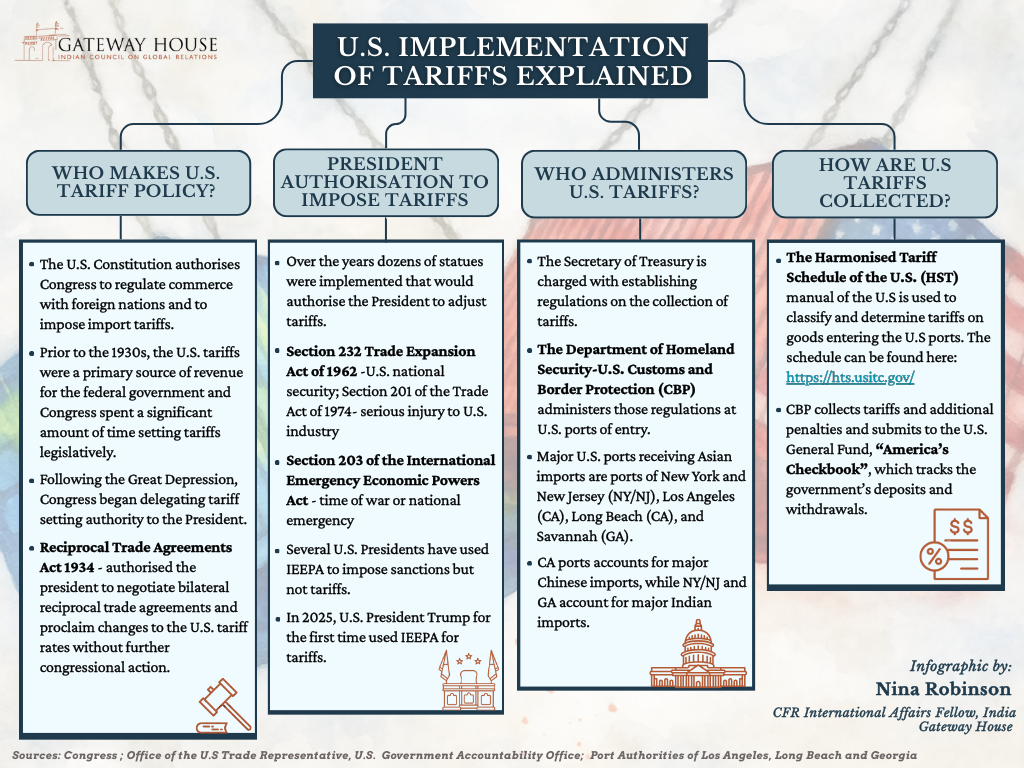
The path of U.S. tariff policies

Who makes, imposes, administers and collects U.S. tariffs? The U.S. Congress, but for the last several decades, it has been at the discretion of the U.S. President, who has been given tariff-setting authority. Under the International Emergency Economic Powers Act, 1977, U.S. President Donald Trump has imposed reciprocal and universal tariffs on over 60 countries.

NarendraModi_JD-Vance Courtesy: Narendra Modi on X
17 April 2025

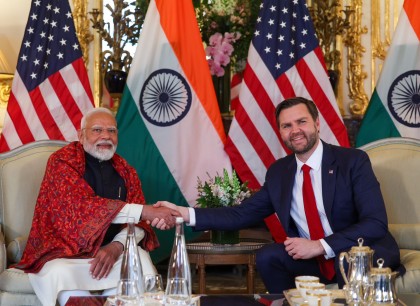
Stepping up the trade talk with Vance

U.S. President Donald Trump is determined that India lower tariffs on American imports. He is sending his top representatives to communicate with officials in New Delhi before his own arrival in the Indian capital, aiming to finalize the proposed bilateral trade agreement.

Modi trump - Newsweek Courtesy: Newsweek
30 January 2025

What Trump 2.0 means for India

U.S. President Donald Trump is back for a second term, and India and the U.S. together have much to gain from it. The bilateral has grown tremendously over the decades, with technology, scientific and trade ties deepening and expanding. Also, both countries have a common interest in addressing the ascent and bullying tactics of China.

shutterstock_1443401150 Courtesy: Shutterstock
6 February 2020

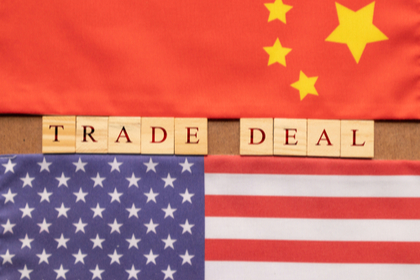
U.S.-China: trade war for trade pact

The U.S.-China Trade Agreement, concluded on 15 January 2020, was the result of a trade war. It is limited to agriculture, mainly, and select service sectors of American interest, with provisions designed to prevent imbalances and distortions