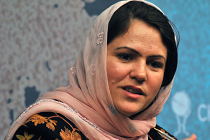
Gunmen attack Indian Consulate in Afghanistan
The Associated Press carried a quote by Gateway House's Sameer Patil, Associate Fellow, National Security, Ethnic Conflict and Terrorism analysing the attacks on the Indian Consulate in Afghanistan

 Courtesy: Associated Press
The Associated Press carried a quote by Gateway House's Sameer Patil, Associate Fellow, National Security, Ethnic Conflict and Terrorism analysing the attacks on the Indian Consulate in Afghanistan
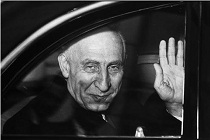 Courtesy: Harry S. Truman Library and Museum/ Wikimedia Commons
This daily column includes Gateway House’s Badi Soch – big thought – of the day’s foreign policy events. This Badi Soch deliberates on the timing of the CIA’s admission of involvement in overthrowing Iran’s Prime Minister Mohammed Mossadegh in 1953 and the implications of this disclosure
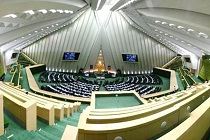 Courtesy: Parliament of Iran (Majlis)
As the 11th Presidential election of Iran draws closer, the atmosphere in Tehran has been abuzz with hope as well as deep cynicism. Why is Iran at a crossroads again? Why will the outcome of this election indicate the foundation of the next chapter in this civilization’s history?
The withdrawal of NATO troops in 2014 and the Presidential elections in Afghanistan continue to spark interest the world over. Gateway House interviews Fawzia Koofi, a Presidential candidate in Afghanistan who provides an overview of the upcoming elections and the changing dynamics in the country.
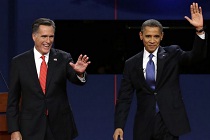 Courtesy: VOA/WikimediaCommons
Domestic issues like jobs and the housing market were front-and-centre during the third round of the U.S. presidential debates. Though the positions taken bears limited resemblance to what will happen in the real, post-election world, the outcome of the elections is bound to affect the world in big and small ways.
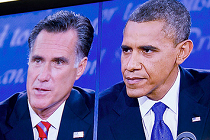 Courtesy: Neon Tommy/Flickr
During the final weeks leading up to the U.S. Presidential elections, moderate views don't seems to count. Though foreign policy was included in the debate, it was confined mostly to China and the Middle East. Both candidates are looking to be one step ahead to win the last of the undecided voters.
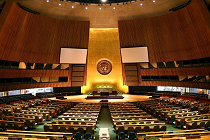 Courtesy: Patrick Gruban/WikimediaCommons
Is a focus on a nuclear Iran in international forums such as the UN General Assembly necessary and appropriate? At a time when other crises – including Syria and Palestine – require the world’s undivided attention, this inordinate focus raises major concerns.
 Courtesy: Embassy of India, Washinton D.C.
The third India-U.S. Strategic Dialogue saw more talk of ‘mutual capabilities’ than of a mere alliance. The larger endeavour in the bilateral is to find the right fit as partners, where both countries can preserve their strategic autonomy and benefit from their unique positions in the international community.
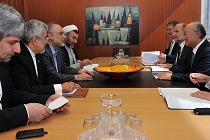 Courtesy: IAEA Imagebank/Flickr
Ahead of nuclear talks between Iran and the P5+1 in Moscow, the West seems confident that sanctions will induce Iran to settle on its uranium enrichment. But rather than arriving at a negotiated settlement by applying the principle of reciprocity, the West may look to anaesthetize oil markets.
The scope for any process on nuclear talks with Iran to founder on distrust, misunderstanding and political in-fighting in both Tehran and Washington remains formidable. Equally disturbing are the wider political realities. Can the upcoming talks in Istanbul launch a process that can, over time, lead to agreement?