West Asia Courtesy: takver/WikimediaCommons
3 December 2012

Prioritizing West Asia

India is tied to West Asia by economic, religious and political threads. The ongoing social and political flux in the region can have adverse consequences for India and requires a serious rethink of its foreign policy priorities. How can India insert itself usefully into this geopolitical cauldron?

The Problem With the Pivot Courtesy: Foreign Affairs
30 November 2012

The Problem With the Pivot

The Obama administration plans to restrain Chinese belligerence by reinforcing U.S. military and diplomatic links to the Asia-Pacific. However, in order to avoid further Chinese resistance to its policies, the U.S. must look for possible avenues of cooperation with the country.

green africa Courtesy: trendscout::/Flickr
4 October 2012

A Green Agenda for Africa

All the major economic forces in the world have come together in Africa in a new version of the Great Game. The competition for the continent’s resources will ultimately harm Africa unless Africa uses this opportunity to its advantage and to address its own serious problems.

pacific islands2 Courtesy: mpeacey/Flickr
27 September 2012

The geo-strategic Pacific Islands

Traditionally, the South Pacific islands have been considered strategically insignificant. However, the need for resources, and the geopolitical shift towards Asia-Pacific have prompted nations to realize that these small island states control large resource-rich ocean areas and are increasingly geostrategic.

Bucking Beijing: An Alternative U.S. China Policy Courtesy: Foreign Affairs
27 August 2012

Bucking Beijing: An Alternative U.S. China Policy

Until now, the U.S.-China policy has been driven by a blend of engagement and balancing. The Obama administration’s concentration on ‘engagement’ has done nothing to halt Beijing’s military build-up. The next administration should work towards bolstering the ‘balancing’ half of Washington’s strategic equation.

Global Stability Map Courtesy: Gateway House
1 August 2012

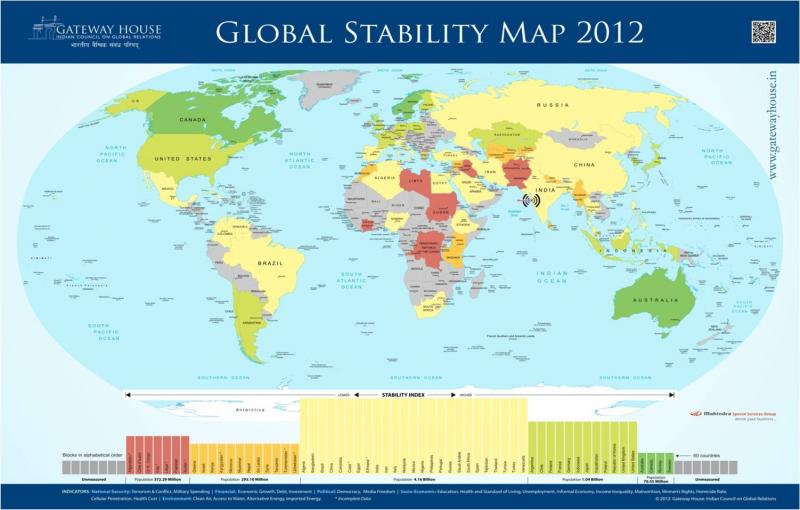
Global Stability Map 2012

Gateway House prepared a Global Stability Map, using 20 differing indicators, to analyze the stability of 60 countries around the world. Using criteria that are important to the emerging economies of the world, the map provides an Indian perspective of the world today.

xerxes china Courtesy: Ministry of Defence, India
12 July 2012

The spectre of China

Though India may seem to be mirroring or competing with China’s military build-up, it doesn't seem to be doing so in consonance with a long-term plan. New Delhi would be better served by avoiding an arms race; staying away from the U.S.-China rivalry and fostering stronger relations with its immediate neighbours.

debnath shaw Courtesy: Gateway House
5 July 2012

“Russia still dominates Central Asia”

Though some countries like Russia gained a strong foothold in Central Asia and the Caucasus post-1991, India has been a late-comer. Gateway House interviews former Ambassador to Azerbaijan Debnath Shaw to discuss India’s energy interests in the region, the Shanghai Cooperation Organization and the TAPI pipeline.

indo us strategic dialogue Courtesy: U.S. State Department
12 June 2012

India-U.S.: More equal partners

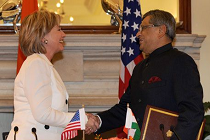
The setting for the third Indo-U.S. Strategic Dialogue is promising: a global shift of economic weight to Asia, U.S. military exhaustion and indebtedness to China and other factors call for a greater convergence in Indo-U.S. interests than ever before. It is essential then, to take bold decisions at the dialogue.