Iran looms large on Indo-U.S. relations
Iran may become a litmus test for India's relationship with the U.S., where New Delhi must deftly balance its strategic relationship with the U.S. along with its energy interests in Iran.

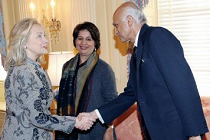 Courtesy: Indian Embassy
Iran may become a litmus test for India's relationship with the U.S., where New Delhi must deftly balance its strategic relationship with the U.S. along with its energy interests in Iran.
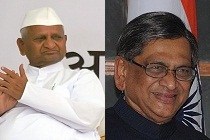 Courtesy: nazeah/Wikimediacommons - Ramesh Lalwani/Flickr
The year 2011 saw various events - the Arab Spring, anti- corruption protests, Europe's sovereign debt crisis - transform countries and reshape the world order. Gateway House takes a look at what these events mean for India, and presents India's top foreign policy cheers and jeers for the year.
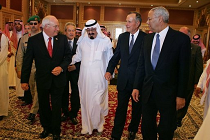 Courtesy: White House photo/WikimediaCommons
The Wahhabis, who now merit NATO backing, continue on their global mission of converting the Muslim Ummah to its relatively harsh and antediluvian ways of thinking and living. For NATO, this is a geopolitical miscalculation that will have tragic security consequences for the alliance within a decade.
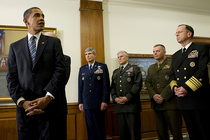 Courtesy: US Army/ Flickr
President Barack Obama is receiving pressure from domestic politics and Israel to maintain his stance on a nuclear free Iran. Will the United States go so far as to attack Iran, and if so, can it deal with the consequences?
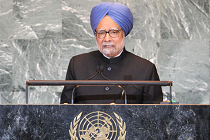 Courtesy: PMO
Indian Prime Minister Manmohan Singh’s speech at the UN General Assembly has put Indian perceptions on the record and clearly outlined India’s independent foreign policy. India came out unequivocally in support of the Palestinian struggle & reiterated its traditional stance of respecting countries’ sovereignty.
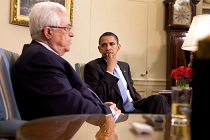 Courtesy: www.whitehouse.gov/WikimediaCommons
Repeated applause greeted Palestinian Authority President Mahmoud Abbas' speech to the UN General Assembly, asking for support for the “establishment of Palestine.” But with the U.S. backing Israel, under almost all circumstances, will Abbas' proposal be able to bring about any change?
Corruption has become a galling global phenomenon: structured, vertically-integrated networks, whose objective is the extraction of resources, are forming in countries around the globe. And strikingly, these structures are masquerading as democratically-elected, seemingly-open governments.
 Courtesy: WTCTributeinLight/WikimediaCommons
A change has come about after 9/11: the ideologies grouped as “Al Qaeda” has morphed, from a group directed by a few individuals, it is now disaggregated. Due to this change, NATO is empowering it's future foes in the Arab world by its continued belief in the camouflaged jihadis.
Former Indian Ambassador to Syria, Rajendra Abhyankar, speaks to Gateway House’s Samyukta Lakshman about the developments in Syria, the impact on India-Syria relations and the future of the region.
 Courtesy:
A decade after 9/11, the U.S. has prevented further terrorist attacks - a major achievement. But with a $1.3 trillion budget deficit, a debt downgrade, and 24 million Americans searching for jobs, the U.S. needs to attend to matters at home rather than intervening in the world's affairs.


