Duke and Duchess of Cambridge praised for the type of clothes that earned Trudeau ridicule
Our Distinguished Fellow, Foreign Policy Studies, Ambassador Rajiv Bhatia was quoted in the National Post. Read the article here

 Courtesy:
Our Distinguished Fellow, Foreign Policy Studies, Ambassador Rajiv Bhatia was quoted in the National Post. Read the article here
 Courtesy: Shutterstock
A recent seminar on cyberspace stability in Shanghai showed a global preoccupation by nations to acquire capabilities and devise protective mechanisms against attacks. A reflection on two themes emerging from the discussions
 Courtesy: MEA/Flickr
Bangladesh prime minister Sheikh Hasina’s visit to India earlier this month, resulting in seven new agreements, showed the strength of the mutual relationship. But both governments need to address some rankling issues: the sharing of the Teesta waters, the Rohingya problem and repatriation of the illegal people from Assam
 Courtesy: Shutterstock
Decarbonising the transportation sector is an environmental priority globally, and hydrogen, the cleanest and most plentiful of fuels, is central to achieving this goal. If hydrogen mobility is actively pursued, India’s large reserves of gas hydrates and shale gas can be tapped for commercial use. Such a shift in choice of fuel will also ensure India’s energy security
 Courtesy:
Our Executive Director and Co-Founder, Manjeet Kripalani, featured on WION. Watch the interview here
Courtesy:
Our Director and Co-Founder, Neelam Deo, featured on WION. Watch the interview here
The second informal summit between Prime Minister Modi and President Xi Jinping in Mamallapuram on October 11 is likely to be more a holding operation than an occasion for increasing convergence of perspectives on regional and global issues. Neelam Deo, Director of Gateway House, answers a few questions on the eve of the Chinese president’s visit
 Courtesy: Shutterstock
The United Nations’ Paris Agreement of 2015 had nations committing to reduce emissions of greenhouse gases to slow the rise in global temperatures. But terrestrial geoengineering – or the use of “carbon capture” technologies and developing carbon sinks to remove gases already in the atmosphere – and atmospheric climate engineering are technologies which also seek to slow global warming
 Courtesy: MEA/Flickr
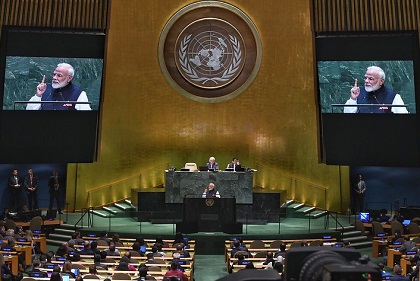
Prime Minister Modi’s tour of the U.S. last month was centred around the UN General Assembly’s 74th session and discussions on environmental challenges, but questions regarding the Indian government’s action in Kashmir persisted
 Courtesy: Princess Nora bint Abdul Rahman University
The immediate panic in the aftermath of the missile attack on Saudi Aramco’s facility at Abqaiq underlines the still-critical role of the Kingdom to the world economy. The subsequent recovery of oil production – with no disruption – showed that Saudi Arabia is a reliable partner/guarantor of energy supplies. Our Energy and Environment fellow Amit Bhandari was in Riyadh recently for a conference, and describes a post-Abqaiq Saudi Arabia