U.S.-Afghanistan agreement: A welcome start Courtesy: U.S. Department of Defense
27 April 2012

U.S.-Afghanistan agreement: A welcome start

An important take-away from the preliminary pact reached by Kabul and Washington is that unlike the 1990s, the Americans are not just packing their bags and leaving. This is good news in terms of regional stability, and the upcoming NATO summit may answer some questions this draft agreement raises.


bahrain piece neelam Courtesy: LGEPR
24 April 2012

The Bahrain formula

With turmoil in the Middle East, a drawdown in Iraq and Afghanistan, the Iran-Israel-U.S. conflict, the international community has paid little attention to the democracy of a small group of people - the Bahrainis. More worrisome, however, is that politics now responds to the elite.

5825395379_5d725a53f4_z Courtesy: Flickr/freeedomania
21 April 2012

UN: a return to ‘mandated colonialism’

By forcing regime change in Libya, and attempting the same in Syria, and by promiscuously arming disparate groups of Wahabbis and Salafists to achieve this aim, NATO is creating more room for instability in the region. What Syria needs is engagement, not isolation; it needs dialogue and not the arming of rebels.

Courtesy: IAEA Imagebank
9 April 2012

Iran: An opportunity for BRICS

The scope for any process on nuclear talks with Iran to founder on distrust, misunderstanding and political in-fighting in both Tehran and Washington remains formidable. Equally disturbing are the wider political realities. Can the upcoming talks in Istanbul launch a process that can, over time, lead to agreement?

China, What Nixon wrought Courtesy: White House Photographer/Wikimedia Commons
23 February 2012

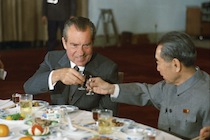
China: What Nixon wrought

Forty years ago, former President of the United States Richard Nixon made a visit to China that has perhaps changed the whole gamut of U.S.-China relations. In the following years, China witnessed the rise of a significant middle class and became the world's second largest economy.

Courtesy: PMO
3 January 2012

India-Japan: An Asian Partnership

India and Japan have designed their collaborations over the years to be a win-win for both sides. Now, they are willing to collaborate on long-term initiatives, based on intrinsic factors of inter-dependent competencies – rather than on the defence of an extrinsic threat of a common enemy.

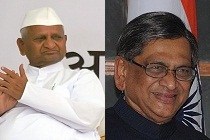
anna hazare 2 Courtesy: nazeah/Wikimediacommons - Ramesh Lalwani/Flickr
30 December 2011

2011’s Top Foreign Policy Cheers and Jeers

The year 2011 saw various events - the Arab Spring, anti- corruption protests, Europe's sovereign debt crisis - transform countries and reshape the world order. Gateway House takes a look at what these events mean for India, and presents India's top foreign policy cheers and jeers for the year.