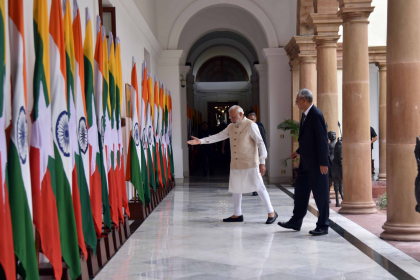
Modi in Vietnam Courtesy: Ministry of External Affairs/Flickr
12 September 2016

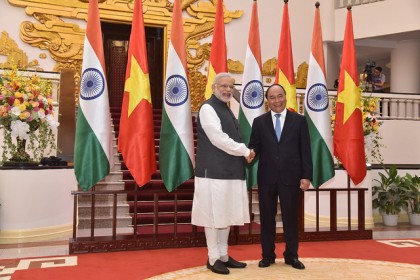
India-Vietnam: setting a new benchmark

Prime Minister Narendra Modi’s recent trip to Vietnam had both heads of state announcing an upgrade of their ‘Strategic Partnership’ into a ‘Comprehensive Strategic Partnership’. This added term captures the importance both sides have vested in the need to deepen the relationship and the prospect for future cooperation.

INS_Vikramaditya_in_Baltic_Sea Courtesy: Wikipedia
6 September 2016

India’s ocean strategy crystallises

India's policy towards the Indian Ocean has begun to take a clear, coherent form with the signing of the Logistics Exchange Memorandum of Agreement with the United States, an important bilateral visit to Vietnam by Prime Minister Modi, and an ambitious future being laid out by Foreign Secretary Jaishankar

Modi Kyaw2 Courtesy: Ministry of External Affairs / Flickr
1 September 2016

Stepping up the Myanmar bilateral

The visit of the Myanmar president was a landmark visit, the first in five decades. It raises the fundamental question as to whether the visit will bring forth major strategic and economic gains in the India-Myanmar relationship.

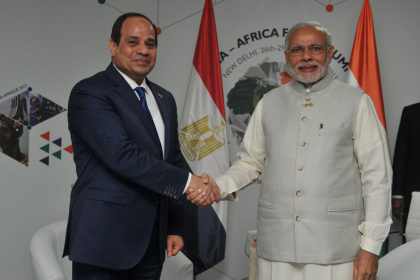
Modi and Sisi Courtesy: Ministry of External Affairs / Flickr
31 August 2016

India-Egypt: renewing old ties

Egyptian president, Abdul al-Fattah al-Sisi, is set to arrive in New Delhi on 1 September 2016 with a delegation of important ministers and business leaders. This marks an important opportunity for the two countries to connect on a much wider range of regional and international issues than earlier.

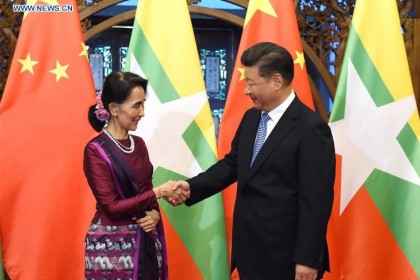
135618503_14717392190131n Courtesy: Xinhua News Agency
21 August 2016

Suu Kyi in China: Asian balancing act

Aung San Suu Kyi’s recent visit to China heralds the return of Myanmar into the geo-strategic fold. The visit has demonstrated the Chinese willingness to woo its neighbour, and is an indicator that India needs to step up its relations with Myanmar.

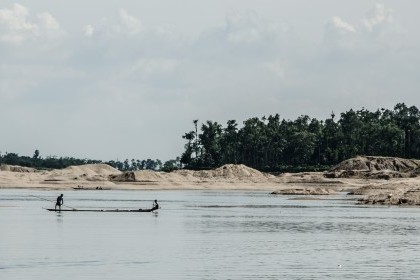
Wah_Umngot_River_Dawki_Meghalaya_Border_Crossing_Bangladesh_India Courtesy:
27 July 2016

Listening to the Rivers

India's North Eastern States are part of one of the largest fluvial regions, they share this region with five other nations. At a recent conference, held on the sidelines of the the Nadi Festival in Shillong, the message of 'Listen to the dignity of the river' struck a chord with all present, and is a message which should be carried across the region.

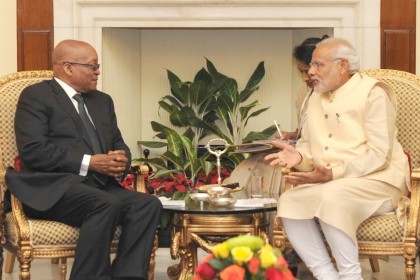
Modi_Zuma Courtesy: India Africa Forum Summit 2015
21 July 2016

Immediate outcomes of Modi in Africa

Prime Minister Modi has just returned from his five-day tour (7-11 July) of eastern and southern Africa. The visits to Mozambique, South Africa, Tanzania and Kenya, were productive and saw the signing of 19 different agreements, all which highlight the India-Africa connection. The long term benefits, however, are yet to be seen.

indiaAfricalLogo Courtesy: India Africa Forum Summit 2015
7 July 2016

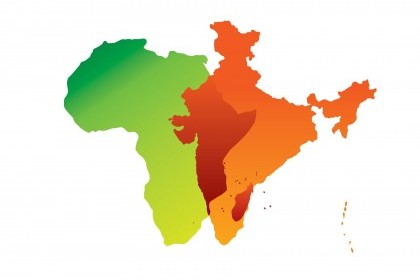
India-Africa ties: pitching higher

Prime Minister Modi’s tour of four African countries will seek to build upon recent high-level visits to the continent, providing fresh impetus for the reinforcement of India-Africa relations in matters of diplomacy, business, security, and energy while putting to rest criticism of India’s visibility deficit in Africa. However, the onus to harness this momentum now lies with other stakeholders.

1042327973 Courtesy: Sputnik News
6 July 2016

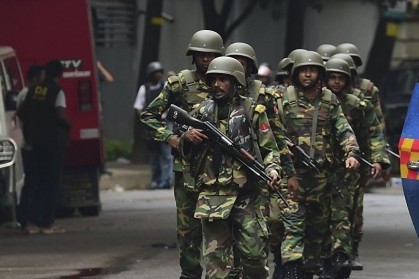
Terrorism in Bangladesh

The recent terror attacks in Dhaka, the capital of Bangladesh, turned the spotlight on the country’s increasingly violent and volatile political situation. The interplay of deep political divisions, the rise of radicalised student politics, religious extremism, which the government has failed to rein in, and the spread of trans-national terror networks has created a toxic cocktail in Bangladesh with dangerous implications for India.

India-US Partnership: $1 Trillion by 2030 by Nish Acharya Courtesy: Oxford University Press
1 July 2016

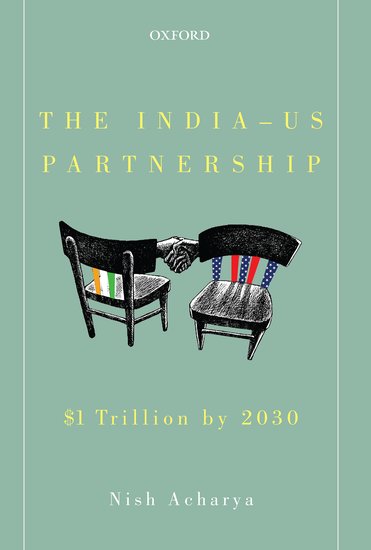
The India-U.S. Partnership: $1 Trillion by 2030

The story of U.S.-India relations is one of unfulfilled potential. Despite their common commitment to democracy, diversity, and free markets, the short- and long-term objectives have not aligned in a way that has enabled the creation of a robust economic and political partnership. These two nations, which will soon be the second and third largest economies in the world, must find ways to increase their economic integration over the next 10 years