US Navy Courtesy: Twitter
24 December 2020

Will 1st Fleet trump Biden’s Asia-Pacific?

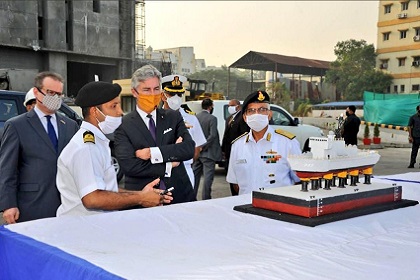
The U.S. Navy Secretary, Kenneth Braithwaite, visited India on 17 Dec 2020. Will this year-end visit culminate in the reactivation of the First Fleet under the U.S. Indo-Pacific Command? The First Fleet, is likely to be an expeditionary fleet - one without a shore-based headquarters and assigned primary responsibility for the Indian Ocean and parts of Pacific Ocean bordering South Asia. Its reactivation will emphasise the strategic importance of this region. It will also relieve the burden of the U.S. Navy's 7th Fleet headquartered in Japan, that is deployed for operations in this vast oceanic space.


amit paper cover Courtesy: Gateway House
21 December 2020

India’s energy investments: A fresh approach

India’s investments in energy thus far have concentrated on buying stakes in oilfields in developing countries often at the risk of political unpredictability. With oil prices, and therefore oil company values, falling – India should revise this strategy and aim for better value and lower risk by making investments in companies in the developed world. This paper recommends investing in oil and gas assets in energy-rich developed countries like the U.S., Canada and Australia, to reduce India's vulnerability to future increases in energy prices. These should be made via a sovereign wealth fund (SWF), not the national oil companies. The SWF will be best served by acting as a financial investor, acquiring, only minority stakes, rather than aiming for management control.

iczMy34b_400x400 Courtesy: Twitter/Arctic Council
3 December 2020

Delhi to the Arctic via Paris

India’s pledge to the Paris Agreement gives it the flexibility to confidently place its climate action policies across various multilaterals. Although an observer of the Arctic Council, India can collaborate with the body's upcoming chair, Russia, to alleviate climate change concerns stemming from the Arctic. It is time for India to use its goodwill with the Arctic Council members to develop a national Arctic policy.

INS_Viraat_front_view Courtesy: Wikipedia
1 October 2020

INS Viraat sails away

Five days before World Maritime Day last week, the former Flag Ship of India’s Western Fleet headquartered in Mumbai – the Aircraft Carrier INS Viraat or R 22 – was towed away to the ship-breaking yard in Alang, Gujarat. This brought down the curtains on Viraat’s glorious career of 58 years at sea. The Indian Navy is awaiting the commissioning of a new aircraft carrier ‘Vikrant’, named after the Indian Navy’s first carrier. Just as it will one day induct another new carrier and name it after the Viraat.

shutterstock_1164513586 Courtesy: Shutterstock
12 May 2020

Artemis Accords propel India’s space ambitions

Under the ‘Artemis Accords’ the U.S. is planning an international coalition to extract natural resources from the Moon. China is concurrently planning an Earth-Moon Special Economic Zone. India’s antiquated endorsement of the 1979 Moon Agreement is shackling its true potential for economics-driven space exploration. India must immediately do away with Cold-War era, vintage whims of global commons.

india sanctions pak Courtesy: Gateway House
30 April 2020

Devising an Indian policy on Sanctions for Pakistan

India must consider new strategies that can be put in place to manage Pakistan's ongoing military aggression and security threat. One policy tool that has been used effectively by many countries but remains unexplored by India is the imposition of sanctions. This paper analyses the feasibility of imposing sanctions on Pakistan and the strategies India should consider to execute this effectively. It makes recommendations on how to establish a legal framework, amend existing laws, include Indian stakeholders with business interests in Pakistan, get government departments to collaborate on implementation, and considers diplomatic measures India can undertake.

shutterstock_1540336541 Courtesy: Shutterstock
9 April 2020

Cybersecurity and privacy in the COVID-19 era

COVID-19 and remote working have resulted in a surge in demand for digital intermediaries, such as Zoom. Most of these are U.S.-based, with some having servers in China, which has aggravated privacy concerns. IT companies have responded quickly by fortifying themselves internally through a range of measures, but it is now time for India’s highly accomplished tech industry to devise secure, scalable platforms with India-based servers