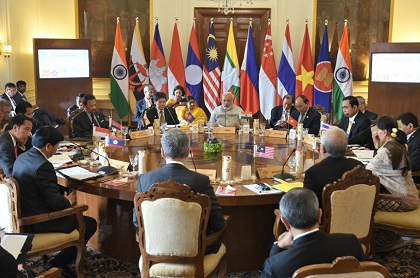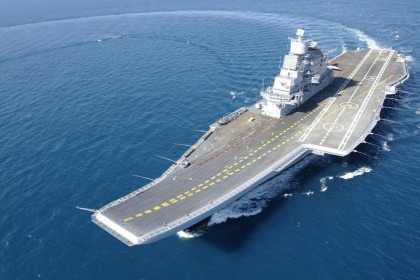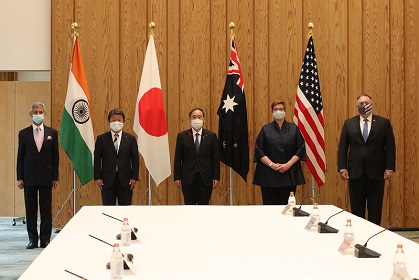
Quad image_ Courtesy: Shutterstock
10 December 2020

To formalize the Quad – or not

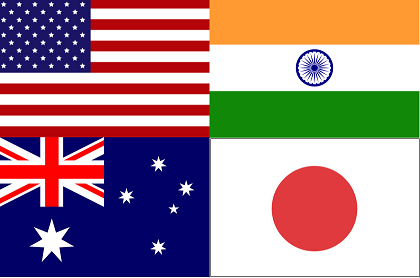
Should the Quad be formalized? It has evolved from a crisis response group in 2004 to a strategic partnership today between the four member-countries – India, the U.S., Australia and Japan. There are benefits and challenges to the institutionalisation of the Quad which require timely analysis, especially as the group has renewed vigour this year with the COVID-19 pandemic and China’s aggression in the Indo-Pacific region.
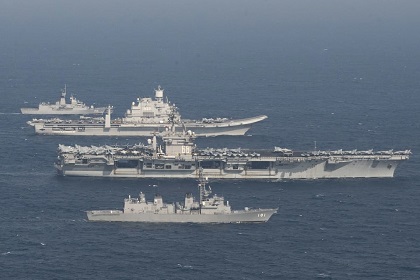
Malabar Excercise Courtesy: US Navy/Twitter
26 November 2020

Malabar Naval Exercise 2020

Australia's much-awaited inclusion at the Malabar Exercise-2020 reflects a hard reset in India's foreign policy that was traditionally accommodative to Chinese concerns on the militarisation of the Quad. In the backdrop of the on-going stand-off with China at the Ladakh border, the Indian Navy has maintained a high operational tempo and deployed the highest numbers of frontline assets during this edition of the Malabar Exercise. India must build on this strategic vision and work towards including France at the next edition of Malabar in 2021.

Edm7TMnUEAEZlk6 Courtesy: Shutterstock
6 August 2020

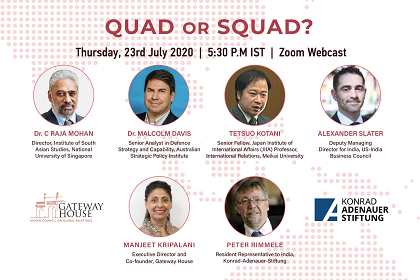
QUAD or SQUAD?

The Quad, a grouping of Indo-Pacific democracies, is more relevant than ever. It must now operationalise not just the military exchanges but also formalise economic and technology partnerships that will undergird a meaningful new multilateral, provide it with resilience and appeal in the Indo-Pacific region. In this Webcast, co-hosted by Gateway House and Konrad-Adenauer-Stiftung, the panelists discuss the need to reform Quad, which hosts the four leading global voices, in order for it to become the magnet that attracts like-minded nations, small and big cutting across continents and oceans to converge on the new world order realities.

QUAD Courtesy: Shutterstock/Gateway House
18 June 2020

Quad, China and the Indo-Pacific churn

China’s escalating actions in the wake of the COVID-19 catastrophe is a calculated strategic diversion and risk. In the Indo-Pacific, tensions between China and the U.S., Australia, India and others are building momentum. As a geopolitical partnership, the relevance of the Quad is now proven. There are clear ways to empower it immediately, and make it a resilient grouping.

shutterstock_1457421710 (1) Courtesy: Shutterstock
26 September 2019

Quad in the Indo-Pacific

The foreign ministers of the Quad countries meet for the first time in New York today even as the Indo-Pacific has turned into a keenly contested geopolitical arena. Some countries are offering to play a mediatory role while other triangular equations are also undergoing change. An analysis of some of the relationships at work here

modi-768x432 Courtesy: CNBC TV18
28 May 2019

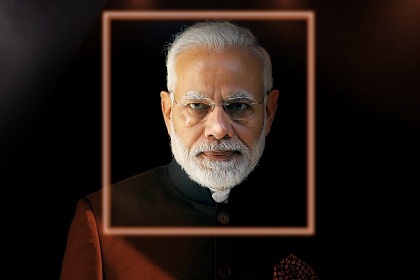
PM Modi’s foreign policy 2.0

India's foreign policy under the second Modi government will take account of a turbulent world in which the old verities are disappearing and domestic political compulsions exert overwhelming influence on external postures

IOC Courtesy: Indian Ocean Conference
21 September 2018

SAGAR and security: leading in Indo-Pacific

If India wants to become a serious Indo-Pacific player, it has to prioritise implementation of the SAGAR initiative, look beyond the Quad to partner with smaller littoral states and provide alternatives to China’s investment strategies. This was the message from the recent Indian Ocean Conference in Hanoi, Vietnam

India-ASEAN Zee News Courtesy: Zee News
26 July 2018

Locating India-ASEAN in the Indo-Pacific

Indonesia and Malaysia appreciate India’s leadership role in the Indo-Pacific, but are also aware of all that keeps it from delivering on its commitments. A policy visit to the two countries enabled a closer look at some key issues, such as ASEAN’s centrality, the Quad and India’s stand on the Regional Comprehensive Economic Partnership

Indo-Pacific Security Quad Courtesy: Indian Navy
3 January 2018

A case for the Quad’s reappearance

A noticeable feature of 2017 was China’s aggressiveness, which it deployed openly to advance its interests in the eastern rim, Southeast Asia, Central Asia and South Asia. This could well be the impetus for the consolidation of a broad front of China-wary nations in 2018

david2 Courtesy: Prachi Bidaye/Gateway House
12 February 2014

India-Australia: Deepening the bilateral

Gateway House interviews David Brewster, Visiting Fellow, Strategic & Defence Studies Centre, Australian National University, and Senior Visiting Fellow, Maritime Studies Programme, Gateway House, on his latest report, ‘The India-Australia Security Engagement: Opportunities and Challenges’