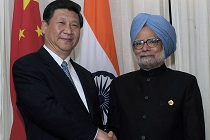
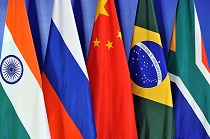
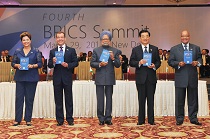
Indian foreign policy has not yet addressed the ramifications of Chinese economic dominance in BRICS. Nor have we matched China’s engagement within the group to ensure that the BRICS vision of a new international order for emerging economies actually works in their favour.
At the 5th BRICS Summit that begins in South Africa today, the heads of state of Brazil, Russia, India, China and South Africa are expected to ratify the creation of the BRICS Bank. After discussion and study for over a year by the respective governments, the bank will be launched with seed money estimated at between $50 billion to $100 billion, and most likely an equal share of voting rights for the management of the bank. What remains
The fifth BRICS summit will take place from 26-27 March with South Africa - a late entrant to the grouping - playing host. Although sceptics have questioned the salience of this bloc, the group is essentially a work in progress. Expectations, therefore, must be modest and pragmatic.
The establishment of a BRICS Development Bank will be among the prime topics of discussion at the BRICS Summit on March 26. Gateway House’s Akshay Mathur interviews former Indian Ambassador and Foreign Secretary, Shyam Saran, on the prospects and viability of alternate financial architectures.
The year 2012 has been a busy one for foreign policy: from escalating disputes in the South China Sea to alternate financial instruments from the emerging world. India’s foreign policy too has its shown strengths and weaknesses. We present our top foreign policy Hotspots, Sweet spots and Blind spots for 2012.
Domestic politics are impacting overall SAARC relations. As the largest SAARC economy, we must strive to minimise differences with our neighbours by understanding how they perceive our policies, and uphold the promise of this regional bloc
The enigmatic former president of Brazil, Luiz Inácio Lula da Silva (or simply Lula), will visit India to receive the Indira Gandhi Prize for Peace, Disarmament and Development. Though India and Brazil share many commonalities, a belief in inclusive growth amidst huge social challenges is perhaps most significant.
Over the past several years, the most talked-about trend in the global economy has been the so-called rise of the rest, which saw the economies of many developing countries swiftly converging with those of their more developed peers. The primary Read more
There’s been much talk about the “the rise of the rest,” with Brazil, Russia, India, and China leading the charge. However, few countries can sustain unusually fast growth for a decade, and even fewer, for more than that. As the boom years begin to end, the international order won’t change as much as expected.
The South African Foreign Policy Initiative republished Gateway House's Hari Seshasayee's interview of Ambassador Deepak Bhojwani. They discussed India’s prospects in Latin America with regard to food and energy security.