Indo-Pacific: New Geostrategic Reality
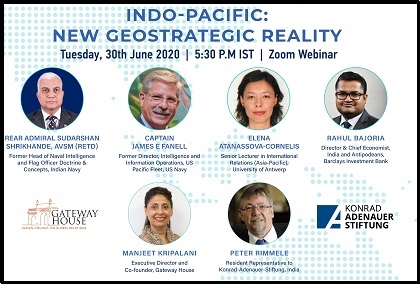
On 30th June, 2020 Gateway House in association with Konrad-Adeneur-Stiftung (KAS) co-hosted a webinar on Indo-Pacific: New Geo strategic reality.

 Courtesy: Gateway House
On 30th June, 2020 Gateway House in association with Konrad-Adeneur-Stiftung (KAS) co-hosted a webinar on Indo-Pacific: New Geo strategic reality.
 Courtesy: MEA/Flickr
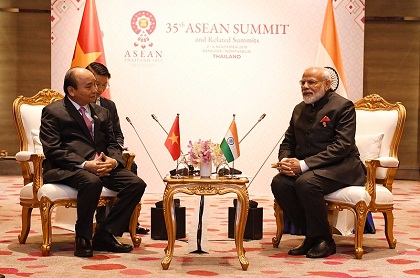
There have been mixed reactions to India’s not signing on to the Regional Comprehensive Economic Partnership. India is often criticised for abstaining from trade agreements and being a protectionist nation, but in fact, the reverse is true. The country’s trade to GDP ratio of 43% is higher than China’s 38% and the U.S.’ 27%. This shows how important trade is for India, particularly if it wants to reach the 2024 goal of being a $5- trillion economy.
 Courtesy: Shutterstock
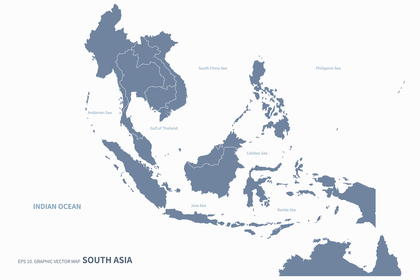
The foreign ministers of the Quad countries meet for the first time in New York today even as the Indo-Pacific has turned into a keenly contested geopolitical arena. Some countries are offering to play a mediatory role while other triangular equations are also undergoing change. An analysis of some of the relationships at work here
 Courtesy: Zee News
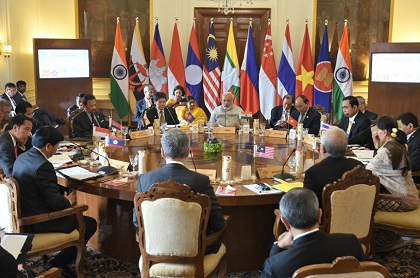
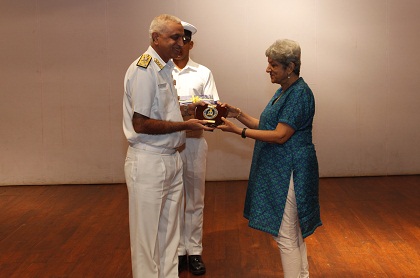
Indonesia and Malaysia appreciate India’s leadership role in the Indo-Pacific, but are also aware of all that keeps it from delivering on its commitments. A policy visit to the two countries enabled a closer look at some key issues, such as ASEAN’s centrality, the Quad and India’s stand on the Regional Comprehensive Economic Partnership
 Courtesy: Western Naval Command
China has expanded its presence in the Indian Ocean Region. President Xi Jinping has abandoned Deng Xiaoping’s conciliatory posture for an aggressive, money-fuelled search for super power status
 Courtesy: Gateway House
The two decade-old Indian Ocean Rim Association holds its first ever summit next week. Maritime safety and security in the region is a paramount concern as also enhanced trade, but will the Blue Economy be included as a priority? Another area of concern is devising modalities for cooperation with dialogue partners, such as the United States, China and Japan
 Courtesy: Ministry of External Affairs, India
In the coming years, India’s greatest strategic challenge in the Indian Ocean region may not be the development of power projection but the quality of the strategic relationships that it can build in the region. The extents to which India will be recognised as a regional leader depend on these relationships.
 Courtesy: Systemman, Erin A. Kirk-Cuomo/Wikimedia Commons
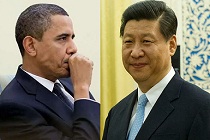
The U.S. government shutdown and President Obama’s absence gave China immense diplomatic and political space at the APEC and East Asia Summit meetings. China’s declaration of a “de-Americanised” world may be premature but the crumbling old order is doing little to dispel this notion
 Courtesy: Gateway House
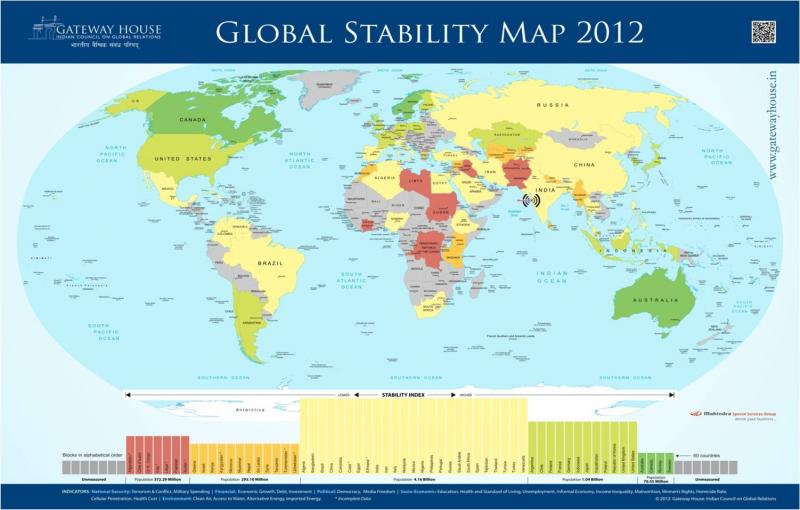
Gateway House prepared a Global Stability Map, using 20 differing indicators, to analyze the stability of 60 countries around the world. Using criteria that are important to the emerging economies of the world, the map provides an Indian perspective of the world today.