Dr. RS Courtesy: Gateway House
18 June 2026

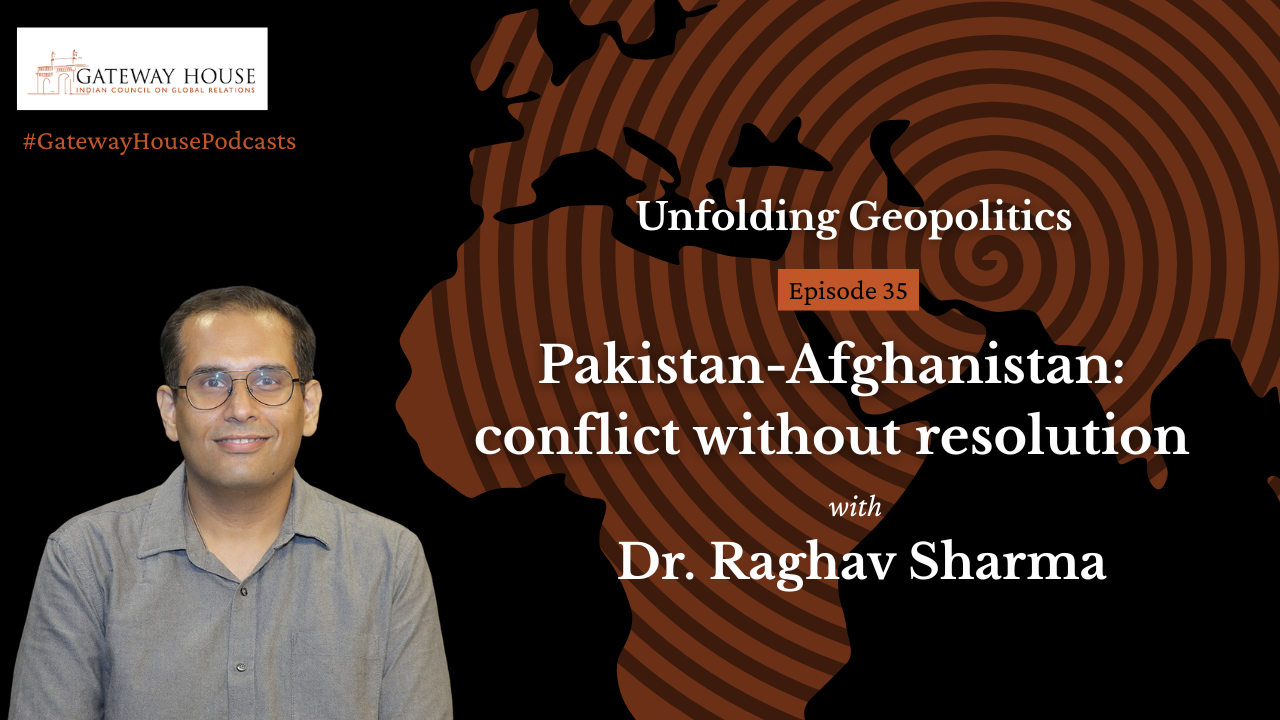
Pakistan-Afghanistan: Conflict Without Resolution

Pakistan and Afghanistan have long shared one of the world's most volatile borders. Pakistan's 2025 airstrikes inside Afghanistan marked a dramatic rupture in a relationship Islamabad had once carefully cultivated. Regional expert Raghav Sharma examines the evolving military balance, China’s mediation efforts, the role of the Gulf states, and how the Iran conflict is reshaping Pakistan’s economy and internal fault lines. The result is a region facing multiple crises, where traditional strategic assumptions no longer offer clear answers.

1 (5) Courtesy: Gateway House
11 June 2026

Decoding India’s Neighbourhood dynamics

Nepal’s ruling party leader, Rabi Lamichhane, visited India from June 1-5, 2026, highlighting Nepal’s evolving political priorities under the leadership of new Prime Minister Balendra Shah. A conversation with Nayanima Basu examines how India is faring under its Neighbourhood First and Act East policies and how New Delhi should navigate an increasingly volatile and sensitive region.

amb HVS (2) Courtesy: Gateway House
7 May 2026

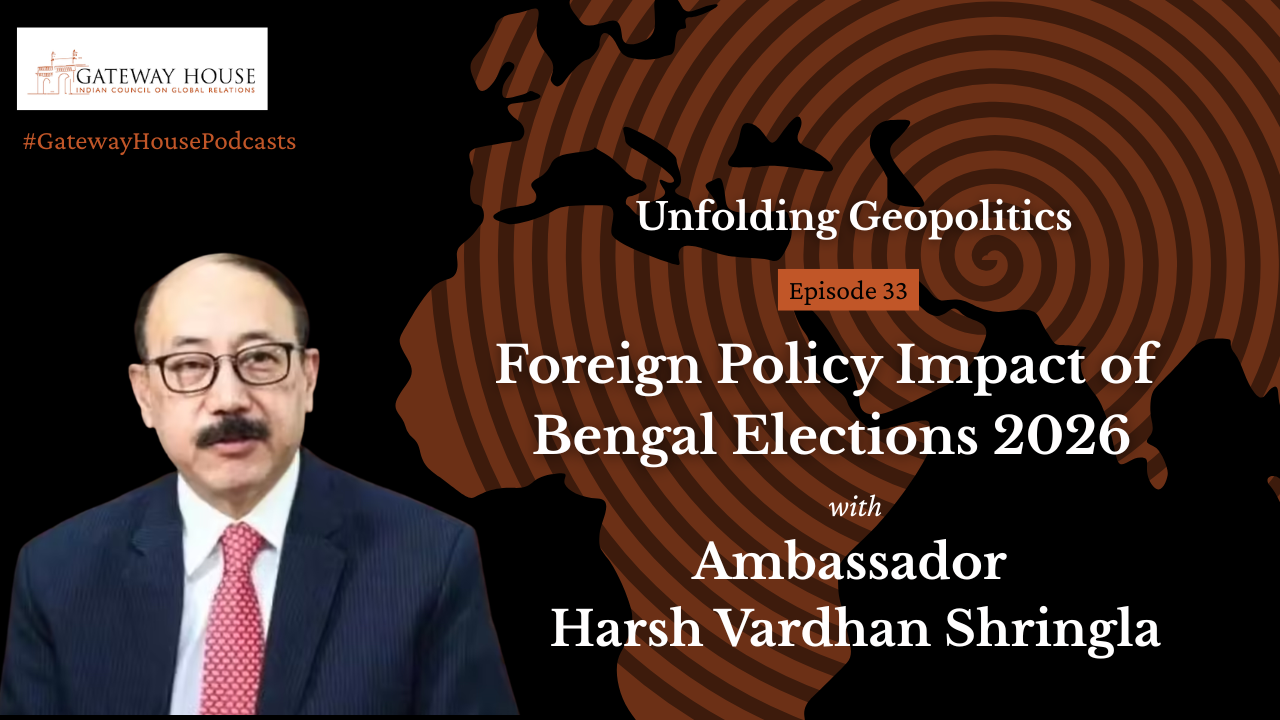
Unfolding Geopolitics Episode 33 |Foreign policy impact of Bengal elections

The state elections in the eastern states of Bengal and Assam have given a massive mandate to the ruling Bharatiya Janata Party. The opportunity for transformation and progress is enormous, especially as both these states are the crucial connectors to India’s Act East Policy. Harsh Shringla, Member of Parliament and former Foreign Secretary of India, says India’s foreign policy will see multiple benefits from these states.

Ivan Courtesy: Gateway House
8 October 2025

Unfolding Geopolitics Episode 23 | India renews engagement with Afghanistan

Afghanistan’s Foreign Minister Amir Khan Muttaqi will visit India on October 10, marking the first high-level Taliban visit since the group took over Kabul in 2021. Nayanima Basu discusses the purpose of this visit and the importance of engagement with Afghanistan. She explains the roles of China, which seeks business; Pakistan, which pursues political interests; and the U.S., which has a renewed interest in Bagram Air Base and its return to the country it abandoned.

Purvi Pod photo Courtesy: Purvi Patel
5 April 2024

Unfolding Geopolitics | Episode 10, Hyper-local, cross-border dialogue benefits

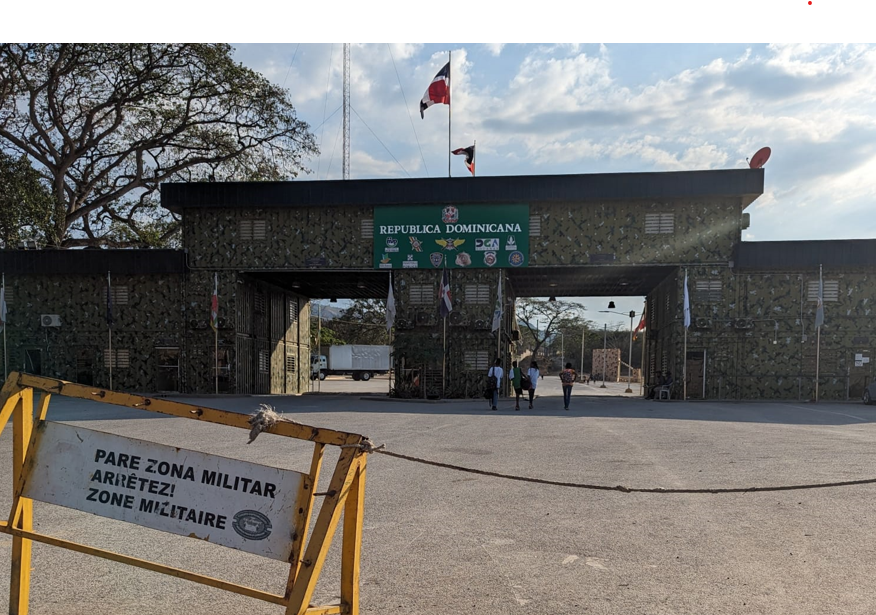
How can hyper-local, cross-border dialogue provide stability in border communities? International Affairs Fellow at the Council on Foreign Relations and Visiting Fellow at Gateway House, Purvi Patel, on a recent visit to Haiti and the Dominican Republic, observed similarities with other complex cases such as the India-Myanmar border and offers lessons for them.

Nepal's role in Asia through SAARC and BIMSTEC Courtesy: Khabarhub
7 October 2021

Nepal’s role in Asia through SAARC and BIMSTEC

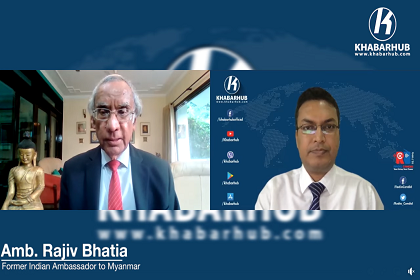
On 6 October 2021, Ambassador Rajiv Bhatia, Distinguished Fellow, Foreign Policy Studies Programme, spoke to Dr. Pramod Jaiswal, Strategic Affairs Editor at Khabarhub on the role of Nepal in BIMSTEC and SAARC, in an analysis of the 17th BIMSTEC ministerial meetings. He also highlighted the role of SAARC and BIMSTEC in countering Chinese influence in the region.

Demystifying Maritime Lawfare Courtesy: Shutterstock
2 September 2021

Demystifying Maritime Lawfare

A new maritime law in China allows it to supervise all foreign vessels which appear in the country's "territorial waters" - many parts of which are internationally disputed. Nationalistic maritime actions such as China’s aggression in the South China Sea and Russia’s actions in the Black Sea, has revived international focus on maritime law. In this podcast, Dr Stefan Talmon, professor and co-director at the Institute of International Law, University of Bonn, interprets maritime law in the two hotly contested seas.

BIMSTEC: Potential and Opportunities Courtesy:
22 February 2021

BIMSTEC: Potential and Opportunities

During the Bay of Bengal Economic Dialogue 2021 on, Post-COVID Challenges in the Bay of Bengal Region, Amb. Rajiv Bhatia, Distinguished Fellow, Foreign Policy Studies, Gateway House addresses the staggered growth of BIMSTEC, whilst also highlighting its potential as a regional grouping. He identifies the lack of political commitment, bureaucratic inertia and insufficient engagement of the Third Space and disregard for the region as a community as the chief obstacles to a successful initiative.

Edm7TMnUEAEZlk6 Courtesy: Shutterstock
6 August 2020

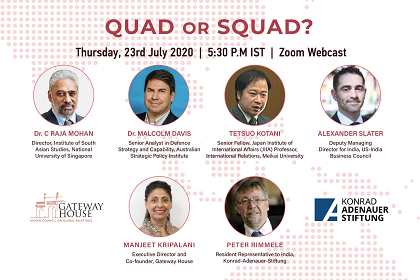
QUAD or SQUAD?

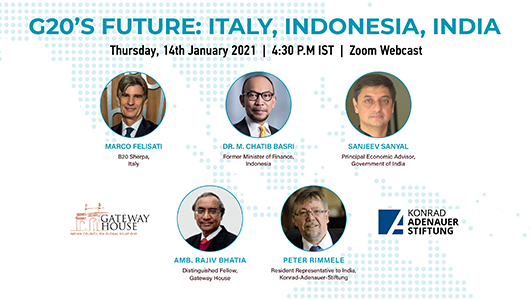
The Quad, a grouping of Indo-Pacific democracies, is more relevant than ever. It must now operationalise not just the military exchanges but also formalise economic and technology partnerships that will undergird a meaningful new multilateral, provide it with resilience and appeal in the Indo-Pacific region. In this Webcast, co-hosted by Gateway House and Konrad-Adenauer-Stiftung, the panelists discuss the need to reform Quad, which hosts the four leading global voices, in order for it to become the magnet that attracts like-minded nations, small and big cutting across continents and oceans to converge on the new world order realities.