

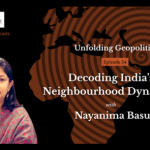
Raveena Shivashankar (RS): Rabi Lamichhane, the chief of Nepal’s ruling party, the Rashtriya Swatantra Party (RSP), was on a five-day visit from June 1 to June 5, 2026. During this visit, he met with the BJP’s chief, Nitin Nabin; the Home Minister, Amit Shah; National Security Advisor, Ajit Doval; External Affairs Minister, Dr Jaishankar; and finally, the Prime Minister, Narendra Modi. What was the reason for this visit, and why now? Is the timing relevant, and what was the outcome of this visit?
Nayanima Basu (NB): India and Nepal share very close ties – historic, cultural, and traditional; and of course, the strongest part of the bilateral relationship is the people-to-people linkage, and we’ve seen Nepal undergoing a lot of political transformation and changes for almost a decade. We saw their constitution coming into effect in 2015, but even then, there was no political stability. There was this communist regime that was there in Nepal for all this time. We now have a very new virgin party, the RSP, which is being led by Prime Minister Balendra Shah.
Now, I think when you have a brand new party in your immediate neighbourhood and you share almost open borders – why, I would say ‘almost’, because, you know, there are certain tensions coming up, but you do have open and porous borders with them. If you remember, our former External Affairs Minister, Ms Sushma Swaraj, used to say, ‘roti beti ka rishta’. Now, whether you agree to that or not, this upsets a lot of Nepali people, but then that has been the reality and the fact that these two countries are very well integrated. So, when you have a brand new party in your immediate neighbourhood, it is always good to have more and more conversations and dialogues.
After the Gen Z revolution that happened last year in September, 2025, a lot of things have been changing in Nepal. To begin with, there was no kind of surety that RSP would have such a landslide victory, because people were thinking no matter what, some seats by the end of the day would go to the Nepali Congress or other political parties, which have been traditionally having a stronghold. So, the coming in of RSP was not just a shock for India; it was also a shock and surprise for the world.
And we’ve seen that probably Prime Minister Balendra Shah has a very different payoff; you know, his governance style has been very different. When he was the mayor of Kathmandu, I’ve heard from several of my friends in Nepal that he’s a taskmaster, he believes in getting things done, and that’s how he has been. I think probably the core Nepali population really wanted Balendra Shah, so they decided and gave him a chance because, in the end of the day, the same kinds of demands people have there are jobs, economic growth, and taking the country to the next level, which has really not been happening under the previous governments.
They also have to look at India as their immediate biggest neighbour, not just neighbour, but also the fact that, you have this integrated economic relationship. So, I think this visit of the RSP’s chief was extremely crucial, and there were certain reports that were also coming out that Foreign Secretary Vikram Misri wanted to go to Nepal, and Balendra Shah said no. While we do not have any confirmation on all of that, we see this visit of the RSP chief coming here, Rabi Lamichhane, as the brain of the party. So, it’s very good that he came here and, you know, met the ruling party here, the Bharatiya Janata Party, and had more of a political dialogue. He met Prime Minister Modi and also met Home Minister Amit Shah, and I really think that is very interesting. That’s probably going to give a very new perspective to the India-Nepal bilateral relations, because you really will not see Home Minister Amit Shah meeting foreign dignitaries so often in such depth.
So, Lamichhane’s meeting with Amit Shah, I think, will augur well for the relationship, but it remains to be seen eventually when Prime Minister Modi and Prime Minister Balendra Shah have their own bilateral dialogue.
We’ve recently seen reports of what Prime Minister Balendra Shah has spoken in their parliament – that, you know, I think he is keeping the border dispute, the unsettled border – that I will not call it a dispute as such, but the tensions are there because that little portion is still unsettled, such as Kalapani, Limpiyadhura and Lipulekh. So, that is their priority, it seems. That has also been one of the sticky parts in the bilateral relationship.
We saw Rabi Lamichhane also writing an op-ed in one of the Indian newspapers, Hindustan Times, talking about the fact that what really came out and what I thought was very important from the op-ed was the fact that he said, ‘To achieve true friendship, you cannot brush core issues under the rug.’ By that he meant settling the border dispute and the border issues, and I think that has to take off. But that also will take off only when the Prime Ministers meet.
RS: The RSP had a landmark victory in Nepal’s national election. The question now is, can they now hold on to their power and sustain themselves? Will the popular young prime minister, Balendra Shah, manage his party and electorate well?
NB: This is their first time, and he has proven his governance style when he was the Mayor of Kathmandu, and I think that is where the people there have given him a chance to rule the entire country. It remains to be seen what he does ahead.
His governance style looks very different. He is not into going out and giving foreign policy or external policy that kind of priority. I think he’s very clearly stated, if you follow the local media reports there, that he wants to now look inside the country and take Nepal into a very different trajectory of growth. He is focusing on job generation, and after all, once that is settled, maybe he will be looking at foreign policy, but that does not mean he will not have any relationship or the country will close; of course not. But his immediate challenge is to bring Nepal back to a positive growth trajectory. If he’s able to do that kind of mandate, I think he will be good enough.
But then again, this being Nepal, you would not know what will really happen. Challenges are many politically, and let us also not forget that there is still a certain section of the Nepali population that is out there that supports the return of the monarchy. The Communist Party would really want to bounce back, and they have tacit support from China. So all those challenges he’ll be facing.
But despite all that, I think if he’s able to have a good GDP and job generation – that’s what Gen Z wants there – and bring back some of the industries, I think he will be there for a long time.
RS: He is focusing more on domestic issues, it seems. Is that the reason why he has not engaged in any foreign visits as of now? And let’s say that he does have any foreign visits, would he consider coming to India first or China?
NB: If you really follow Nepal closely and the media reports there, it seems that he has no plans to go anywhere now. His first trip would probably be to the U.S. for the United Nations General Assembly, which happens every year in September. Maybe he’ll do that first and break the typical protocol of either going to China or India. We saw what Prime Minister KP Oli, the former Prime Minister of Nepal, did, choosing China over India. But I think that does not define the foreign policy of a country. It depends on scheduling issues also sometimes.
But of course, if Balendra Shah finally decides to go to China first and not to India, then it is a concern for India. We are hearing from Bangladesh Prime Minister Tarique Rahman that he might be going to China first and not India.
So I guess when India talks about the Neighbourhood First policy, we need to also ensure that our neighbours, the leaders, should first come to India. But frankly speaking, that really is just good for optics for argument’s purposes. It really depends on what the main outcome of that visit is.
RS: Looking at the broader South Asian neighbourhood, there have been a series of visits from South Asian leaders. The first was from Bangladesh’s foreign minister, and the recent visit of the RSP’s chief. As you now mentioned, Bangladesh’s prime minister is considering going to China first rather than India. So, how are the South Asian leaders managing their relationship with India in the current geopolitical context?
NB: It’s not just about what India is doing, but also within our neighbourhood, things are changing, dynamics are changing. You have this whole new young generation coming up. In Bangladesh, the fact is that with the new generation, several new demands and new aspirations come up and that is something India should be very much aware of.
The fact that, let’s say, the Bangladesh Prime Minister Tariq Rahman really decides to go to China first, we need to sit and analyse whether the population in Banggladesh also wanted it or they wanted him to come to India first.
But then, again, coming back to your question, changes are happening in South Asia. India needs to be very much aware of it. India needs to focus, I think, much more seriously on its neighbourhood because there are several changes happening and happening very rapidly.
Gone are the days when India really could say that or maybe act like they were taken by surprise. You can’t be surprised anymore. This is your immediate neighbourhood, which is very much under the Chinese radar. So you need to be very firm in managing your neighbours and be serious and also understand what it is that they want from you.
We can build a railway network, let’s say for Bangladesh, connecting the Northeast and Bangladesh. But we also need to understand whether they want it or not, whether it is for their benefit or ours. Because that’s what our neighbours have started to question.
RS: We have seen anti-India sentiments in Bangladesh; do we get the same feelings in Nepal as well?
NB: I think the anti-India sentiment is kind of catching up fast in our neighbourhood, and there are several reasons for it. India is aware of that, and that is also because a lot of changes are happening, and the new generation is not really aware of the historical aspect of this kind of bilateral relationship. Like for Bangladesh, when I was there for the elections in February, I realised the youth, the student youth leaders, while they are very much aware of the 1971 history, the India-Bangladesh and the Pakistan war that they had in 1971 that got them independence, they are aware of the history, but then they don’t want to be defined only by that aspect of the history. They want to have their own identity. I think that’s where the tension is coming from. India should not refuse to acknowledge that and look the other way.
So, anti-India sentiment is there and will always be there. That is also because we are a big country; we have our own domestic political issues, which sometimes reflect very poorly in our neighbourhood. Some of the comments that we are seeing coming from some of our ministers during this recent election campaign against Bangladeshis and immigration have not gone down well in Dhaka. And that again gives rise to a lot of anti-India sentiments.
But I think that is also the responsibility of that particular country to keep that in check because, at the end of the day, they need to also educate their own population on why India is also important, and this anti-India sentiment can give them a few headlines, but it cannot be the mainstay.
RS: Speaking on the South Asian neighbourhood, Min Aung Hlaing was also on a five-day visit to India, and that was a pretty notable visit. What came out of it, and what does it mean for India-Myanmar bilateral?
NB: It’s very important for us to understand the history of Myanmar, which has its own dynamics, its own history, and its own kind of place within Southeast Asia and South Asia. The military rule and everything else that they have had came from the democracy under Aung San Suu Kyi, who is believed to be now under house arrest. Some reports say that she’s no longer under detention. She’s been released.
But these tensions go on, and the current president, Min Aung Hlaing, who was in India for his maiden visit abroad after becoming the president, has been the main architect of the coup that took place there in February 2021. But we’ve seen India historically has engaged with the junta there, the military that is the Tatmadaw, and which is why Min Aung Hlaing is not new to India.
So, this visit was important. India must play an effective and responsible role in talking about democracy there because we’ve seen not just the Western world but even some countries in ASEAN have also stated that the elections in Myanmar had been a sham. They have questioned the outcome. They’ve questioned the way the elections have happened there. But he has become the president. We also need to see that he is now the leader of that country, we need to engage again because Myanmar is sensitive. You have your Northeast, which is totally vulnerable and exposed to them. There are several insurgent groups, and this was what the prime minister had also discussed with President Min Aung Hlaing when they both met. The external affairs minister has also stated that Prime Minister Modi spoke about Aung San Suu Kyi on what is happening to her and the democratic forces out there. India follows a certain kind of two-track policy. India follows a peace process there.
But then this is also true that India has to engage with the junta but also see to it that India should not be on the wrong side of history. That’s also very important.
RS: Do you think India can bring peace to Myanmar?
NB: I don’t think India should be doing that. As a big neighbour and a friendly partner country to Myanmar, we can at least tell them what they need to do. But beyond that, I don’t think India needs to get involved or bring peace there. We can see civil war happening there in several pockets of the country; several territories have gone away from the hands of the junta.
There are anti-junta regimes that have come up. So they’re having their own issues, and I think they need to sort it out themselves. Of course, when such big visits take place, that’s when India needs to tell them what it has to tell them.
But beyond the point, if you start giving them lectures on how to bring peace, then, of course, there’s a population there as well who will say that India is getting involved in their internal matters, and that has become a very sensitive topic in today’s geopolitics. There is a certain section that expects India to play a role. It should be the largest democracy in the world. But beyond the point, you cannot play any role.
You can always stand on the right side of history and assert your principles to your partners.
RS: How is India faring in its Neighbourhood First and Act East Policies? Does India need to do more? How can it gain trust again and make its neighbours its strongest allies? How can it compete with China?
NB: India needs to be very, very serious with the neighbourhood. If you really want to have, to become, this global leader, such as having a permanent seat at the United Nations, you are being watched as to how you are handling your immediate neighbourhood. The condition in the immediate neighbourhood as of now is really not that positive, also because of their own internal issues and the things that India has done.
In the last couple of years, we’ve seen what has happened between India and Bangladesh, which was our biggest supporter and friendly country, but India failed to see what was happening there underneath. While it had the support of the Sheikh Hasina government, India did not engage with other stakeholders.
And I think that is extremely important for India to manage the neighbourhood and make it a strong point. Be it Sri Lanka, Nepal, Bhutan, Bangladesh. Pakistan and Afghanistan have very different dynamics; it is very important to have dialogue with all the stakeholders, at least wherever there is a democratically elected government.
We see that in the neighbourhood now, either have the Taliban or the Tatmadaw as good friends – is what I generally say these days, but that’s not how it should be. I mean, yes, you need to engage the Taliban. You also need to engage the Tatmadaw of Myanmar, but you need to also have a very good relationship with Bangladesh, with Sri Lanka, and, of course, with other countries, like Nepal, because with them you have people-to-people linkages, very strong linkages.
With Bangladesh, I think the challenges are increasing every single day. We are going to have, the India-Bangladesh border talks, which are going to happen and will be the first high-level border talks that we have had after the Bangladesh Nationalist Party came in there. Then there is the Ganga water treaty coming up for renewal in December. So these little things, if you really sort them out well and let them not linger within your bilateral relationship, there will be some kind of reset. The Teesta River water issue sharing – that dispute is also going to come up soon because the Chinese have offered a different kind of innovative technology in the Teesta River, and if they really start doing that, it will become a big problem for India.
So India should sort that problem and address the immediate issues and the issues that our neighbours are telling to address. If you do that, then I think it will become your strong point.
Nayanima Basu is a journalist who writes on issues of foreign policy and is the author of “The Fall of Kabul: Despatches from Chaos”.
Raveena Shivashankar is the digital media associate at Gateway House.
This podcast was exclusively recorded for Gateway House: Indian Council on Global Relations. You can explore more exclusive content here.
Support our work here.
For permission to republish, please contact outreach@gatewayhouse.in
©Copyright 2026 Gateway House: Indian Council on Global Relations. All rights reserved. Any unauthorised copying or reproduction is strictly prohibited.