Gateway House launches first Quad Economy and Technology Task Force
The Task Force led by Gateway House will study economic and technological cooperation between the four like-minded democracies in the Indo-Pacific.

 Courtesy: Gateway House
The Task Force led by Gateway House will study economic and technological cooperation between the four like-minded democracies in the Indo-Pacific.
 Courtesy: Shutterstock
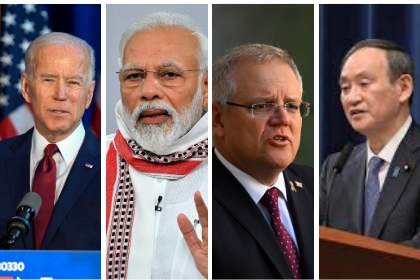
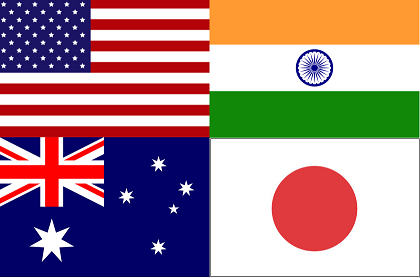
In its recent itineration, the Quad (or the Quadrilateral Security Dialogue) has been toiling since 2017, through deliberations among mid-level and senior officials, to develop a common vision for the challenges facing the Indo-Pacific region, challenges caused by China's menacing rise and aggressive behaviour.
 Courtesy: US Navy/Twitter
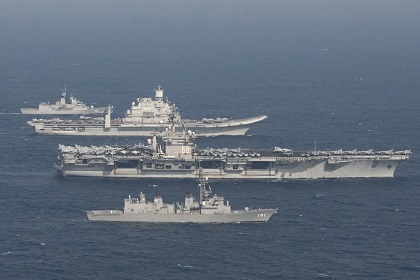
Australia's much-awaited inclusion at the Malabar Exercise-2020 reflects a hard reset in India's foreign policy that was traditionally accommodative to Chinese concerns on the militarisation of the Quad. In the backdrop of the on-going stand-off with China at the Ladakh border, the Indian Navy has maintained a high operational tempo and deployed the highest numbers of frontline assets during this edition of the Malabar Exercise. India must build on this strategic vision and work towards including France at the next edition of Malabar in 2021.
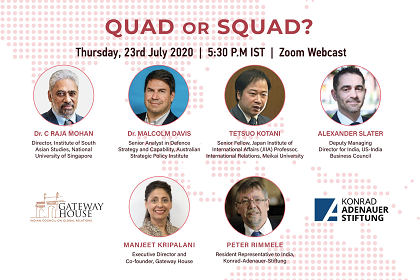
The Quad, a grouping of Indo-Pacific democracies, is more relevant than ever. It must now operationalise not just the military exchanges but also formalise economic and technology partnerships that will undergird a meaningful new multilateral, provide it with resilience and appeal in the Indo-Pacific region. In this Webcast, co-hosted by Gateway House and Konrad-Adenauer-Stiftung, the panelists discuss the need to reform Quad, which hosts the four leading global voices, in order for it to become the magnet that attracts like-minded nations, small and big cutting across continents and oceans to converge on the new world order realities.
 Courtesy: Gateway House
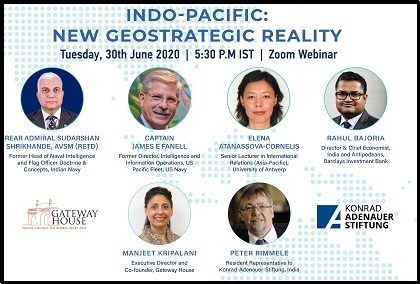
On 30th June, 2020 Gateway House in association with Konrad-Adeneur-Stiftung (KAS) co-hosted a webinar on Indo-Pacific: New Geo strategic reality.
 Courtesy: Shutterstock/Gateway House
China’s escalating actions in the wake of the COVID-19 catastrophe is a calculated strategic diversion and risk. In the Indo-Pacific, tensions between China and the U.S., Australia, India and others are building momentum. As a geopolitical partnership, the relevance of the Quad is now proven. There are clear ways to empower it immediately, and make it a resilient grouping.
 Courtesy: MEA/Flickr
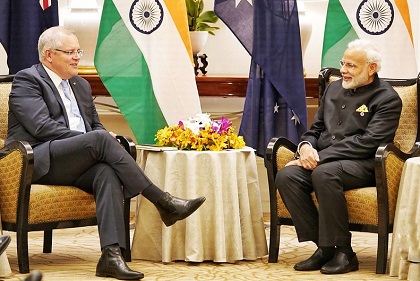
At the 4 June, India-Australia, virtual summit, one of the most critical, among several agreements signed, was the Mutual Logistics Support Agreement (MLSA). India has logistics support agreements with many countries. How is the MLSA with Australia any different? Given the geo-strategic maritime competition with China, this agreement is uniquely significant and could be especially beneficial for the Indian Navy.
Manjeet Kriplani, Executive Director, Gateway House, in discussion with Prof. Rory Medcalf, Head, National Security College, Australian National University, and author of Indo-Pacific Empire: China, America and the Contest for the World's Pivotal Region; and Cleo Paskal, Associate Fellow, Energy, Environment and Resources, and Asia-Pacific, Chatham House; on the possibility of an Indo-Pacific Charter for the region.
 Courtesy: Shutterstock
The foreign ministers of the Quad countries meet for the first time in New York today even as the Indo-Pacific has turned into a keenly contested geopolitical arena. Some countries are offering to play a mediatory role while other triangular equations are also undergoing change. An analysis of some of the relationships at work here
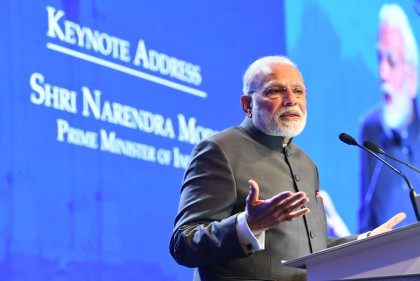 Courtesy: MEA Flickr
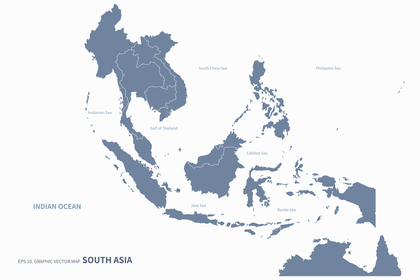
The key global powers are redefining their roles in the Indo-Pacific to promote national interest. China’s rise and increased activism in South Asia and the Indian Ocean region is an uncontested reality even as Asian countries worry about the new cold war in which the U.S. and China are locked. The Quadrilateral Dialogue has reemerged to prevent a unipolar Asia — these are some of the trends unfolding in this arena