


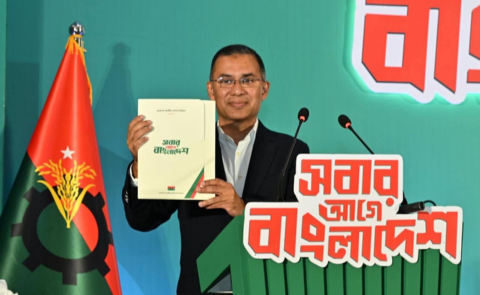
Prime Minister Tarique Rahman-led Bangladesh Nationalist Party (BNP) will soon complete 60 days in power, and the journey so far has been more difficult than expected. For one, the ruling party’s relationship with the opposition Jamaat-e-Islami has become bitter particularly over the issue of introducing Constitutional reforms through a referendum since Rahman took the oath of office at the South Plaza of the Jatiya Sangsad Bhaban in Dhaka on February 17, 2026. Second, it has become quite clear to Bangladeshis that in the past two months that Rahman will not follow in the footsteps of his mother and former Prime Minister of Bangladesh Begum Khaleda Zia’s footsteps but will walk the path of a strongman governance style of his father and ex-President Zia-ur-Rahman, the military dictator who seized power in 1977.
Rahman, the 11th Prime Minister of Bangladesh, has initiated several measures focused on economic stability, governance reform, and normalising foreign relations. Rahman formed a 59-member cabinet, comprising 25 ministers and 23 ministers of state. He has emphasised that accountability will apply to everyone, stating that “not even the prime minister” will be able to abuse power with impunity.
“I want to build a Bangladesh that will stand high in the world’s court, not the dominance of anyone,” Rahman recently stated.
His priority is to boost the country’s economic growth, which has been decelerating after the previous Awami League government was ousted in 2024. The BNP’s ambitious election manifesto declares its intention to more than double the economy by 2034, from $450 billion to $1 trillion – that’s an ambitious 9% growth rate.
Bangladesh’s economic growth has taken a massive hit post the ousting of the Awami League government led by former Prime Minister Sheikh Hasina, who continues to reside in hiding in India. In 2023-24, Bangladesh’s foreign exchange reserves plummeted by nearly half, to $26.7 billion from $46 billion in 2020-2021. Foreign Direct Investment (FDI) fell to $554 million in 2024-25 from $667.56 million in 2023-24, which was already a low number. [1]
Like his father, Rahman identified anti-corruption measures as a top goal for his government. In his inaugural speech, he stressed that maintaining peace and order “at any cost” is a core objective, declaring that chaos will not be tolerated. When Rahman came back to Bangladesh in December 2025 after spending 17 years in the United Kingdom under a self-imposed exile, the first commitment he made to a people who were then under the rule of Muhammad Yunus’s interim government, was that that he would chart a new path for the country under his infamous slogan, “I have a plan.”
Rahman’s plan is now being slowly unveiled in the form of a nationwide anti-corruption drive. He has directed the country’s intelligence agencies to strictly monitor MPs and ministers in order to ensure transparency and accountability at all levels of the administration, as part of his 180-day reform plan to recover assets smuggled abroad, target money laundering and financial crimes. The government has pledged to ensure that the Anti-Corruption Commission (ACC), judiciary, and law enforcement agencies operate without political interference.
In an effort to overcome the political polarisation amongst the supporters of the BNP, Awami League and the Jamaat-e-Islami, Rahman had promised some far-reaching reforms such as a top-down, no-tolerance approach to corruption, ensuring accountability for government officials and ending the culture of revenge. He vowed to rebuild the state institutions and implement large-scale economic and social reforms.
However, so far the BNP has not taken any such steps that prove that it is serious about bringing about reforms in the country, which it had promised by way of addressing some of the crucial reform ordinances. These ordinances were introduced by the caretaker government after seeking the public’s views and opinions on how to bring about a transformation in the country. They were drawn from the July Charter that was drawn up to accommodate the aspirations of Bangladeshis post the 2024 ouster of Hasina. But earlier this month, the Parliament passed only 97 out of the 133 ordinances that were laid down there. The ones that the government allowed to relapse were meant to bring in judicial independence, prevent enforced disappearances, and strengthen institutions such as the Anti-Corruption Commission and the Human Rights Commission.
Analysts and experts within Bangladesh have been critical of the government’s lackadaisical approach toward these reforms and the expiry of ordinances, which should already have become law. Despite the referendum receiving nearly 70% ‘Yes’ for the above changes, the BNP had been reluctant to act on the measures. The July Charter[2] forms the basis of the referendum. It was drafted by a National Consensus Commission under the interim government led by former chief advisor Yunus, it aims to rebuild democratic institutions, which they felt had been abused and misused by the Awami League government, and prevent future authoritarian rule where a prime minister can be allowed to rule for multiple terms.
Nahid Islam of the National Citizen Party (NCP), who is in the opposition as an ally of the BJI, has come down heavily on the government stating that it has “broken its promise to the nation” which had agreed to take up the reforms laid out in the referendum as soon as it took the reins of government.
In its external relations and steering of its foreign policy, Bangladesh is prioritising its own national interests under a ‘Bangladesh First’ policy while cautiously rebuilding ties with India amid tensions over the extradition of former PM Hasina. Both nations are engaging to manage security, economic, and energy needs.
With India, Dhaka has sought to address some of the fundamental challenges ailing two-way ties, which were visible even during Hasina’s era. Recently, Bangladesh Foreign Minister Khalilur Rahman undertook his first foreign visit, and his maiden visit to India since taking charge, accompanied by Humayun Kabir, the Adviser on Foreign Affairs to the Prime Minister of Bangladesh. Rahman, who was previously the National Security Advisor (NSA) for Bangladesh, and his advisor Kabir, met External Affairs Minister S. Jaishankar, NSA Ajit Doval, Minister of Petroleum Hardeep Singh Puri and Commerce Minister Piyush Goyal.
The main issues discussed between both sides revolved around security, especially in the border areas, sharing of river waters; and reviving robust people-to-people ties. It was a good first step, but the war in Iran has forced Dhaka to look at critical issues of food and fuel, and it has been unable to chalk out a solid roadmap for its foreign policy. In the wake of a major energy crisis, Dhaka has reached out to India for a supply of diesel, and India has provided 5,000 metric tonnes of diesel via the India-Bangladesh Friendship Pipeline, over and above the 10,000 metric tonnes that are usually sent to them.[3]
The bonhomie with India has worked alongside the BNP government’s stated goal of safeguarding the national interest under the nomenclature Bangladesh First. In this, Rahman brought up the issue of effective yet humane border management especially with regard to killing of civilians who cross over the border, and of fair water-sharing as a fundamental concern. Rahman reiterated that renewing the Ganges Water Treaty, which expires in December 2026, and decisively addressing the equitable sharing of vital rivers like the Teesta are imperative steps that would transform public perceptions and foster closer ties between the nations.
The journey ahead is daunting for the BNP both domestically and externally. At home, the government must address the internal challenges of bringing stability and undertake a plethora of difficult reforms. Externally, Rahman will have to walk a tightrope in the near term: reset ties with India but also balance it when dealing with China, a large investor in Bangladesh. It’s an unenviable position, but one that he is determined to manage well.
Nayanima Basu is the Adjunct Fellow at Gateway House and an author.
This interview was exclusively recorded for Gateway House: Indian Council on Global Relations. You can read more exclusive content here.
For permission to republish, please contact outreach@gatewayhouse.in.
Support our work here.
© Copyright 2026 Gateway House: Indian Council on Global Relations. All rights reserved. Any unauthorised copying or reproduction is strictly prohibited.
References:
[1] Bangladesh Economy Spirals Downwards.” Gateway House: Indian Council on Global Relations. https://www.gatewayhouse.in/bangladesh-economy-spirals-downwards/
[2] International Institute for Strategic Studies. “Bangladesh: Rahman Wins but Faces Challenges.” IISS Online Analysis, February 2026. https://www.iiss.org/online-analysis/online-analysis/2026/02/bangladesh-rahman-wins-but-faces-challenges/
[3] The latter is sourced from the Numaligarh Refinery in Assam and is part of a regular, long-standing energy trade agreement designed to help Bangladesh combat fuel shortages. India has been supplying diesel from the Numaligarh refinery to Bangladesh since 2017 through various modes, which include waterways and rail and later through the India-Bangladesh friendship pipeline.