

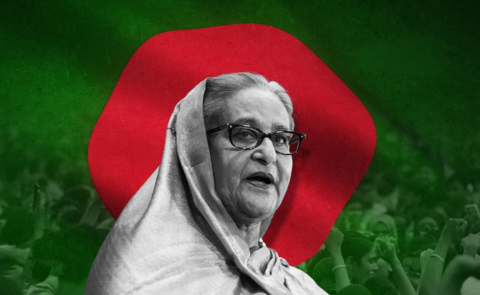
Bangladesh elected a new government in February this year after former long-time Prime Minister Sheikh Hasina was ousted from power in a violent mass protest on August 5, 2024. Her party, the Bangladesh Awami League, was banned from participating in this year’s election, which saw the return of the rival Bangladesh Nationalist Party (BNP) under Prime Minister Tarique Rahman. Hasina has been living in India since then and talks about her plans to return to Bangladesh and revive her party’s activities there. She spoke exclusively to Nayanima Basu.
Nayanima Basu (NB): You have said you will return to Bangladesh soon. When will that be, and why have you decided to return now?
Sheikh Hasina (SH): My return is not tied to a specific date. We are working to establish a democratic environment, uphold freedom of expression, restore political rights, and reinforce the rule of law. These efforts are crucial for my return and the nation’s independence and welfare. My goal and my party’s goal are to unite the people of Bangladesh like before. My absence does not mean silence. I am continuing to fight for my country and working to bring light to the darkness we face. We are engaging diplomatically, utilising international legal frameworks, and leveraging global media to expose the conspiracy behind the removal of the Awami League government.
But to simply answer your question, I will return to Bangladesh soon. Bangladeshis know that it was me who brought democracy there.
NB: In which capacity do you plan to return? There is a ban on the Bangladesh Awami League currently, and what do you expect the current Bangladesh Nationalist Party (BNP) will do with you?
SH: I always have worked for the welfare of people in Bangladesh, whether in government or in opposition. When we were in power, we only focused on the country’s development and the well-being of its people. Today Bangladesh is reaping the benefits of the work that I and my party did. And the people of Bangladesh can now clearly see the work we have done. Let me remind you that in 1971, the then Pakistani government also banned the Awami League. If bans could really silence the Awami League, Bangladesh would never have come into existence.
NB: Is the Awami League undergoing a leadership change? There are speculations that you may be soon stepping down as the chief of the party.
SH: The Awami League has always upheld democratic values, maintaining its core ideologies despite changes over time. As the largest political party in Bangladesh, we face both allegations as well as rumours, but our dedicated supporters—true Awami League workers—are essential to our strength.
Since August 5, 2024, state repression against our leaders and activists has escalated under the illegal interim government led by Muhammad Yunus, resulting in unprecedented attacks on our party. Despite these challenges, Awami League workers remain committed to the party, and their sacrifices will be recognised. Those abroad must also earn their place through contributions and work.
Bangladesh is currently facing a critical situation, with political and democratic rights being restricted and the judiciary misused for repression. The economy is in crisis, and the law and order situation has deteriorated, leading to rising crime and vulnerability among women, children, and minorities. As extremism resurfaces, the spirit of the Liberation War is being undermined.
This situation is not just a national issue but relates closely to global human rights and democracy. If democracy fails in Bangladesh, it will impact regional and global security. I urge democratic nations and organisations to recognise the seriousness of the situation and to support the fight for human rights and the rule of law.
To the people of Bangladesh: Keep hope alive. The Awami League is committed to restoring democracy and good governance. We will continue to fight for a prosperous, inclusive future, undeterred by oppression or false judgements. Together, we will make Bangladesh stand tall again.
No amount of threat has ever deterred me. I have always kept my head held high. The Awami League cannot be suppressed. This party lives in the hearts of the people and survives through their love. In the interest of the country and its people, the return of the Awami League is inevitable — it is only a matter of time.
NB: The current BNP government is increasingly seen to be getting close to China and Pakistan even as anti-India sentiments are rising. How do you see this?
SH: Our relationship with India is steeped in history and significance. Not only is India our neighbouring country, but its vital support in our great Liberation War is an undeniable facet of our shared past. Despite this, a troubling trend has emerged within our nation, where anti-India rhetoric has become a prominent tool wielded by anti-liberation factions and ideologically stagnant groups. These entities have exploited this narrative as one of their main political instruments, seeking to further their own agendas at the expense of national unity.
For their own petty political gains, they relentlessly propagate anti-India sentiment, creating an atmosphere of discord and misunderstanding. The illegitimate interim government led by Dr Yunus has unfortunately continued this harmful practice, perpetuating a divisive narrative rather than fostering cooperation.
Our political opponents have consistently levelled accusations against the Awami League, claiming that we are “selling the country” to India and signing agreements that undermine national interests. However, throughout the past 18 months of the interim government and under the current administration, these critics have been unable to substantiate their claims with even a single example of an agreement that could be considered detrimental to our nation. The people of Bangladesh are observant and aware, watching closely as these narratives unfold, well aware of what truly serves the interests of our country.
NB: Which are the particular agreements you are referring to?
SH: When the Awami League came to power in 1996, we signed the Indo-Bangladesh Ganga Water Treaty, which is coming up for renewal this year in December. In 2014, we added nearly 20,000 square kilometres of maritime territory to Bangladesh’s map through the resolution of maritime boundary disputes with India. Then came the historic Land Boundary Agreement in 2015, under which we permanently resolved the enclave issue between the two countries.
The India-Bangladesh Friendship Pipeline that we established is now serving as one of the key lifelines of Bangladesh’s energy sector amid the global energy crisis that has emerged due to the tensions in West Asia.
Throughout its history, the Awami League has maintained a transparent approach to foreign relations, steadfastly protecting the nation’s interests. The party has never compromised national sovereignty by entering into agreements that serve personal or foreign interests at the expense of the country’s well-being.
NB: What about apprehensions of a rise in militancy in Bangladesh?
SH: This is not only a threat to Bangladesh but also one of the greatest threats to regional and global security. Surely you remember that during the BNP-Jamaat alliance government from 2001 to 2006, Bangladesh became a safe haven for militancy.
Simultaneous bomb attacks were carried out in 63 districts of the country, and a grenade attack was launched against me. Several Awami League leaders were killed in militant attacks; judges were murdered; cultural institutions and religious places of worship were attacked. The then British High Commissioner Anwar Choudhury was also targeted in a militant attack. Under state patronage, incidents such as the import of ten truckloads of illegal weapons took place.
After coming to power, we declared zero tolerance against militancy and used all our strength to free the country from extremism. Through the modernisation of law enforcement agencies, the formation of specialised anti-terror cells, and proper surveillance, we were able to control militancy.
NB: But what about the Holey Artisan Bakery attack of 2016?
SH: I acknowledge the painful reality of tragic incidents like the Holey Artisan attack that occurred during our administration. These events were rooted in intricate global conspiracies. However, we took decisive action by identifying the perpetrators, holding them accountable under the law, and ensuring that justice was served. As a result, Bangladesh transformed into a safer country, witnessing a significant reduction in the threat of militancy.
Unfortunately, after August 5, 2024, a troubling shift unfolded. Convicted top militants, previously imprisoned, were released without any substantial measures taken to apprehend those who had escaped. From the outset of the interim government, extremism began to creep back into various facets of society. Banned organisations, which once operated in the shadows, started to conduct their activities openly, brazenly challenging the rule of law. Disturbingly, many individuals previously convicted for their involvement in militancy and terrorism managed to infiltrate parliament, posing as public representatives through dubious electoral processes.
This alarming trend suggests that the dark days of 2001–2006 are looming once again, with the ominous shadow of militancy re-emerging across the country. The threat has even seeped into the ranks of our armed forces and law enforcement agencies, creating a precarious situation for national security.
Equally disconcerting is the treatment of those within law enforcement and intelligence agencies who played crucial roles in the fight against militancy. Many have been unjustly dismissed from their positions, subjected to false accusations, and continually harassed. While those once connected to militant activities are walking free and resuming their operations, the dedicated members of our security forces, who have tirelessly worked to combat these threats, are becoming targets of state-sponsored harassment. This stark contrast illustrates a disturbing reality: since August 2024, extremism has not only resurfaced but also appears to be spreading with the direct support of the state.
NB: How do you assess the current economic situation in Bangladesh under the BNP?
SH: The interim government led by Dr Yunus has drastically harmed the economy through violence and mismanagement, resulting in millions unemployed and a historic drop in foreign investment. In just one and a half years, they borrowed 373 thousand crore Taka ($30.38 billion USD), crippling the banking sector and halting development projects. The current government under Tarique Rahman continues this trend, borrowing nearly 100 thousand crore Taka ($8.1 billion USD) in just three months. Today, the economy is in dire straits, with shortages of electricity, fuel, and essential goods, causing widespread hardship.
In contrast, when the Awami League formed the government in 2009, we faced a severe economic crisis and successfully navigated it, including during the COVID pandemic as well as the challenges that came out of the Russia-Ukraine war. Our focus has always been the welfare of the people, while Yunus and Tarique Rahman have acted in their own interests, leading to the current tragic state of the country.
Nayanima Basu is the Adjunct Fellow at Gateway House and an author.
This interview was exclusively recorded for Gateway House: Indian Council on Global Relations. You can read more exclusive content here.
For permission to republish, please contact outreach@gatewayhouse.in.
Support our work here.
© Copyright 2026 Gateway House: Indian Council on Global Relations. All rights reserved. Any unauthorised copying or reproduction is strictly prohibited.