BIMSTEC, bridge between South & South East Asia?
TIMES NOW featured our Distinguished Fellow in Foreign Policy Studies, Amb. Rajiv Bhatia on their show to discuss the fourth BIMSTEC Summit. Watch the full episode here.
Courtesy:
TIMES NOW featured our Distinguished Fellow in Foreign Policy Studies, Amb. Rajiv Bhatia on their show to discuss the fourth BIMSTEC Summit. Watch the full episode here.
Economist Surjit S. Bhalla, who sits on the Prime Minister’s Economic Advisory Council, says all currencies, not just the rupee, have fallen against the U.S. dollar. Speaking to Gateway House’s Manjeet Kripalani, he elaborates on some diplomatic and domestic tools to stem the fall, even in an election year
Courtesy: Legal Entity Identifier
Ten years after the global financial crisis, some reform has come about. To further transparency, the Legal Entity Identifier (LEI), proposed by the G20, is a code used to identify the parties that participate in financial transactions around the world. While its benefits and applications are abundant and will reduce systemic vulnerability, its global implementation is complex and slow. This primer shows why – and also why the LEI should be urgently and widely adopted
Courtesy: MEA/ Flickr
India and Brunei have a 34-year-old diplomatic relationship; but as yet no Indian president or prime minister has paid the country a bilateral visit to strengthen these ties. The strategically-located nation is rich in its history, with a unique political system. Its foreign policy approach is non-controversial, yet noticeably pragmatic.
Courtesy: Foreign Policy
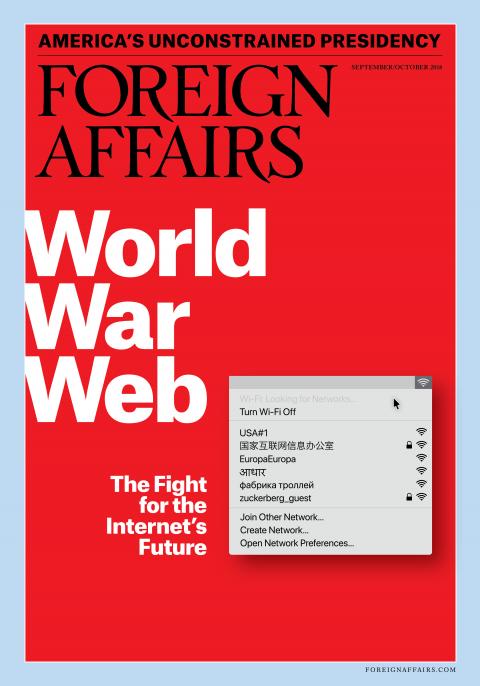
Should the conduct of diplomacy lay emphasis on values over national self-interest? This is an undying subject of debate and calls for wisdom to be drawn from both camps for the world is not strictly black-and-white
Courtesy: Wikipedia
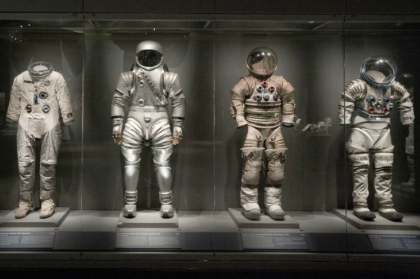
India’s human spaceflight programme calls for a strong symbiosis between the country’s private sector, defence, and civilian agencies. The focus should be on indigenous development to preserve strategic autonomy
This paper is an analysis of the impact the U.S. sanctions on Russia are having on India, especially in defence and energy. As India and the U.S. prepare for the first 2+2 Dialogue on September 6, this paper recommends ways in which India can balance its long-standing strategic ties with Russia and growing proximity to the U.S.
Courtesy: Gateway House
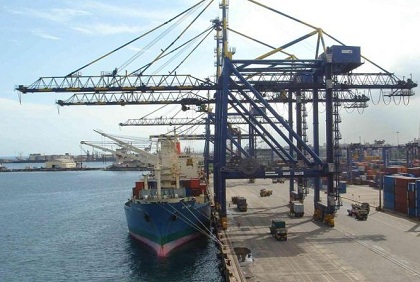
America is increasingly using sanctions as a geopolitical tool against its rivals, Russia, Iran and Venezuela. These countries are important partners for India, which needs to find ways around unilateral American sanctions.
Courtesy: MEA Flickr
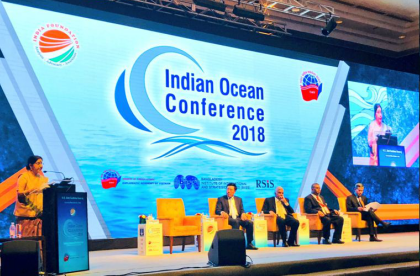
The Indian Ocean has served as a keystone of global politics, economics and culture for centuries. In modern times, after World War II, it emerged as a focal point for great power competition and subsequently, of global commerce as the pivot of economic growth shifted from Europe to the Asia Pacific, a feature which has since remained constant.
Courtesy: MEA Flickr
The fourth summit of the Bay of Bengal Initiative for Multi-Sectoral Technical and Economic Cooperation (BIMSTEC) has many implications for the countries involved. The agreements signed at the summit can only be implemented through a concerted effort by all parties.