India in a changing global order
This speech was delivered at ‘Industry Meet 2018’, organised by the Indian Institute of Management, Indore, in collaboration with the Ministry of External Affairs, Government of India, on 7 July 2018

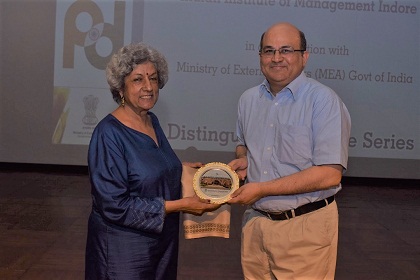 Courtesy: IIM, Indore
This speech was delivered at ‘Industry Meet 2018’, organised by the Indian Institute of Management, Indore, in collaboration with the Ministry of External Affairs, Government of India, on 7 July 2018
 Courtesy:
Our Director, Amb. Neelam Deo’s lecture at IIM Indore’s Industry Meet 2018 was featured in a local Hindi paper, Patrika. Read the full article here.
 Courtesy:
Our Director, Amb. Neelam Deo, delivered the guest lecture at IIM Indore’s 2018 Industry Meet. The Free Press Journal carried a short write-up, available here.
 Courtesy:
Our Director, Amb. Neelam Deo’s speech at IIM Indore, was featured in the Times of India’s Indore city edition. Read the full article below:
 Courtesy:
Our Director, Amb. Neelam Deo’s lecture at IIM Indore’s Industry Meet 2018 was featured in Dainik Bhaskar. Read the full piece below:
 Courtesy:
Sputnik News spoke to three experts: Arvind Virmani, Former Chief Economic Advisor to the Government of India and former Indian representative to the International Monetary Fund, Narendra Taneja, a leading energy expert, and Amit Bhandari, our energy specialist, on how India’s signals should be Read more
 Courtesy: MEA/ Flickr
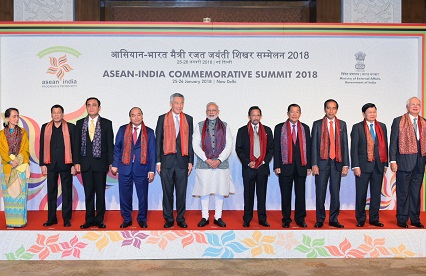
Change and uncertainty have marked geopolitical equations in the East Asian segment of the Indo-Pacific in the last six months. India-China relations changed visibly for the better while the U.S.-China trade war became more polarised. The Quad remained inert as did negotiations on the proposed Code of Conduct for the South China Sea. An analysis of some of the major trends
 Courtesy: Narendra Modi/ Twitter
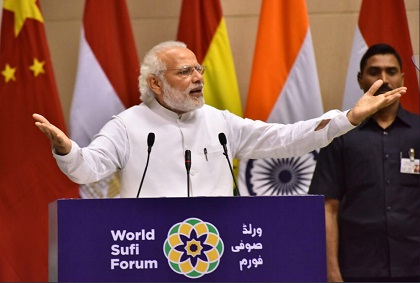
Religion is an important component of the soft power countries use in their foreign policy. Yet, no Indian government has given Islam adequate prominence, especially in its interactions with South-East Asia, where the majority of people are Muslim
 Courtesy:
Ambassador Neelam Deo, Director, Gateway House, was interviewed by BloombergQuint reacting to the news of postponed India-U.S. 2+2 talks between the Ministers of Defense and External Affairs. Watch the interview and read the accompanying article, here.
 Courtesy: Gateway House
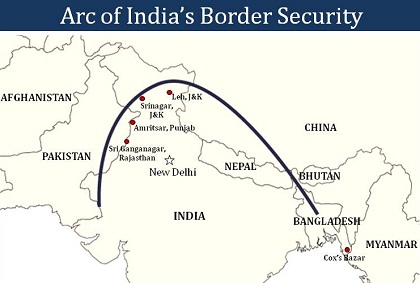
Border regions and communities, some of them far from the heartland, constitute India’s first line of defence, a critical link in its national security. India’s 15,000-km borders touch seven neighbouring countries: Afghanistan (abutting Gilgit), Pakistan, Nepal, Bhutan, China, Bangladesh, Myanmar. Border regions have their own local dynamics, often shaped by subnational and religious identities that do not necessarily align neatly with political borders. Some also serve as flourishing corridors for illegal smuggling of goods and humans. Technology plays an important role in better protecting borders, but in some cases it has made borders obsolete. Despite their importance, border regions do not receive the full attention of the Indian mainstream, except when border tensions arise.