



Over the past decade, India has developed a large-scale digital public infrastructure ecosystem built around interoperable digital systems and shared digital infrastructure. The ecosystem encompasses foundational and sectoral infrastructures across areas including identity, payments, data exchange and public services and has increasingly been discussed as a model of population-scale digital infrastructure.[1]
The relationship between this infrastructure and artificial intelligence has become increasingly relevant to India’s technology policy. Recent scholarship has conceptualised this relationship in two broad directions: “AI for DPI”, in which AI is used to improve public digital infrastructure and services, and “DPI for AI”, in which digital public infrastructure may contribute to the conditions for AI development.[2] India’s policy environment increasingly reflects the importance of infrastructure and data to domestic AI capability. Recent government policy discussions have also highlighted the role of digital public infrastructure and open digital networks in supporting the deployment of AI applications across sectors such as healthcare, agriculture and public services.[3]
This growing policy importance, however, also raises questions about whether and under what conditions data associated with public digital systems can be responsibly used for AI development. The existence of large-scale DPI does not by itself make data generated or processed through such systems publicly available or open for AI development. Where such data constitutes personal data, its processing must have a lawful basis under the applicable data-protection framework, including consent or a recognised legitimate use under the Digital Personal Data Protection Act, 2023.[4] The relevance and availability of DPI-associated data for AI development must therefore be assessed in relation to the nature of the dataset, the legal basis for its processing, and the particular purpose for which its use is proposed.
The central question is which governance concerns arise when data associated with India’s Digital Public Infrastructure is considered for indigenous AI development, and how can these concerns be addressed? DPI can certainly contribute to indigenous AI development, but doing so requires governance frameworks capable of addressing the risks that arise when data generated through public digital systems acquire new technological and economic uses.
India’s policy initiatives increasingly recognise the importance of data and digital infrastructure to the country’s AI ambitions. The IndiaAI Mission, approved by the Union Cabinet in March 2024 with an outlay of $1 billion (₹10,371.92 crore) over five years, includes initiatives relating to datasets and the development of indigenous AI capabilities. [5] AIKosh, the IndiaAI datasets platform, provides access to datasets, models, toolkits and other AI resources, including assessments relating to the AI-readiness of datasets.[6]
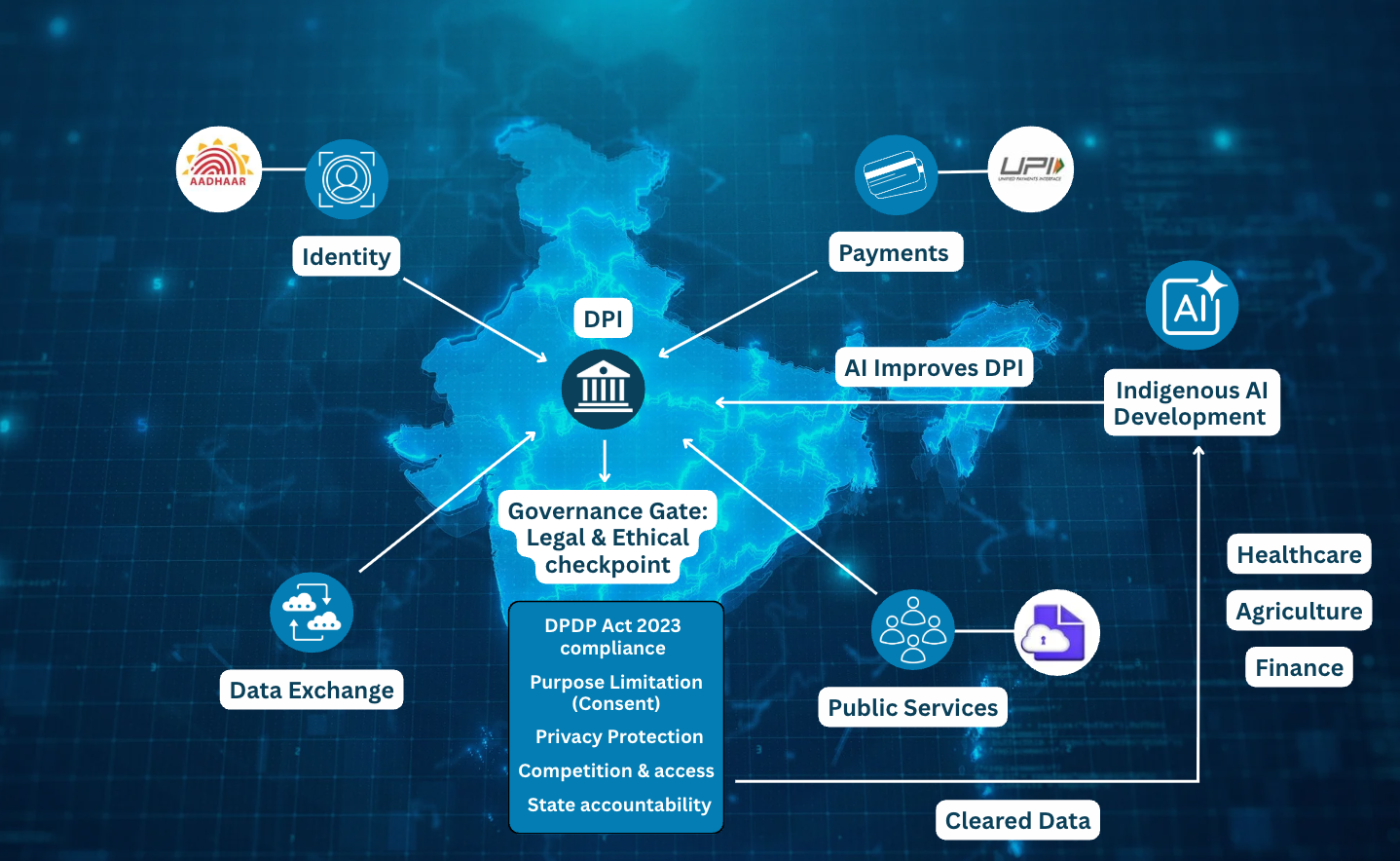
Image Credits: Gateway House
These initiatives build on India’s existing digital public infrastructure ecosystem, which has developed to support a range of governance, welfare and service-delivery functions. The emerging AI policy agenda adds a further dimension by considering how such infrastructure and appropriately governed data can contribute to domestic AI capacity. Digital public infrastructure and open digital networks can provide the interoperable systems through which data is generated, standardised and exchanged across sectors. This is particularly relevant to AI applications in areas such as healthcare, agriculture and public services, where locally generated and contextually relevant data may contribute to the development of systems better suited to Indian conditions. [7]
India’s emerging AI governance framework similarly identifies improved data availability and sharing, locally relevant datasets, enhanced data governance and the integration of AI with digital public infrastructure as important components of the country’s AI ecosystem. The significance of DPI, therefore, lies not merely in the volume of data it generates but in the possibility of transforming appropriately governed DPI-associated data into a resource for indigenous AI research and development.
This transition, however, changes the governance question. Data generated through DPI was not necessarily collected or structured with AI training and research as its original purpose. As such data acquires new uses and value, the conditions governing access to it become increasingly important.
What, then, are the conditions for responsible DPI-to-AI integration? The transition from DPI-associated data to AI development cannot be governed by data availability alone. It raises distinct but interconnected questions concerning the subsequent use of personal data, access to resources necessary for AI development, and the implications of expanded state analytical capacity.
Three concerns are particularly relevant: privacy, competition and access, and state accountability.
Privacy and secondary use:
The integration of DPI-associated data into AI development raises a fundamental question on whether data processed for one specified purpose can subsequently be used as an input for AI development without adequate safeguards governing that new use. The Digital Personal Data Protection Act, 2023, makes the purpose of processing legally significant. Where processing is based on consent, section 6 requires that consent relate to a specified purpose and that the personal data processed be limited to what is necessary for that purpose.[8] The India AI Governance Guidelines similarly identify unresolved questions concerning the application of data-protection principles to AI development, including the treatment of publicly available personal data, the compatibility of collection and purpose limitation with modern AI systems, and the scope of research and “legitimate use” exceptions.[9]
The issue, therefore, is not whether DPI-associated data should be categorically unavailable for AI development. Rather, its movement from public digital systems into AI development requires a legal basis and safeguards appropriate to the purpose for which it is subsequently used. The India AI Governance Guidelines accordingly recommend measures including privacy-enhancing technologies, machine unlearning and algorithmic auditing as potential approaches to mitigating AI-related risks.[10] The objective should thus not be simply to maximise the volume of data available for AI training but to enable its responsible use while preserving the privacy and accountability conditions governing its processing.
On competition and access:
The use of DPI-associated data for indigenous AI also raises a question of access. If data generated or accumulated through public digital systems becomes an input into AI development, the terms on which such data is made available may affect who is able to participate in developing AI systems. This does not mean that DPI-associated data should automatically be treated as an open resource. Personal data, confidential information and other legally protected material must remain subject to restrictions on access and use.
The competition question instead arises where data can legitimately be made available for AI development: whether its institutional design permits meaningful access to a sufficiently broad range of actors rather than creating unnecessary barriers to participation.
The issue is not confined to data. India’s Standing Committee on Communications and Information Technology identified inadequate datasets and limited computing facilities among the fundamental barriers to deploying AI at scale in India.[11] In parallel, the IndiaAI Mission has developed shared compute infrastructure. More than 38,000 GPUs have been onboarded through 14 empanelled service providers, with access made available to start-ups, researchers, academic institutions and government organisations.[12] This provides an example of policy intervention aimed at widening access to computational resources needed for AI development.
For DPI-to-AI integration, therefore, the relevant competition concern is not universal access to every DPI dataset, but the design of access to resources that can lawfully and appropriately contribute to AI development. Where DPI-associated data is suitable for such use, questions of accessibility, interoperability and the terms of access become part of the governance framework surrounding its transition into an AI resource. The objective should be to ensure that public digital infrastructure can contribute to indigenous AI development without unnecessarily restricting participation in the ecosystem that it is intended to support.
Regarding state surveillance and accountability:
The integration of DPI with AI also raises questions about expanding state analytical capacity. DPI should not be characterised as an AI-enabled surveillance system merely because it facilitates the collection and exchange of digital information. However, increasingly capable AI systems may allow public authorities to analyse and draw inferences from such information at a greater scale, making corresponding safeguards necessary.
The Supreme Court’s privacy jurisprudence provides an important framework. In Justice K.S. Puttaswamy (Retd.) v Union of India, the Court recognised that an infringement of privacy must satisfy requirements of legality, a legitimate state aim and proportionality.[13] These principles are relevant to AI-enabled uses of DPI because technological capability alone cannot justify a particular use of personal information. For the DPI-to-AI transition, expanded analytical capacity must therefore be accompanied by defined purposes, lawful authority, proportionality and institutional oversight. AI governance mechanisms may supplement these safeguards but should not replace the constitutional constraints governing state action.
India’s transition from Digital Public Infrastructure to indigenous AI should not be understood simply as an effort to make more data available for AI development. The more important question is how data associated with public digital systems can be brought into new technological uses without weakening the legal and institutional safeguards that govern its collection, access and use.
The objective, therefore, should not be to maximise the conversion of DPI-associated data into AI resources. It should be to establish conditions under which such data can be used where legally and appropriately justified, with access structured responsibly and the exercise of state power remaining subject to meaningful safeguards. If India can develop this balance, DPI can contribute to indigenous AI not merely through the data and infrastructure it makes available but through a governance framework capable of sustaining innovation alongside privacy, participation and public accountability. This model will resonate with other countries which are seeking DPI with AI for their own systems.
Ashish Bharadwaj is Pro Vice Chancellor of WPU Goa and Distinguished Fellow for Law and Education at Gateway House.
Nada Shawl is a student at BITS Law School.
This article was exclusively written for Gateway House: Indian Council on Global Relations. You can read more exclusive content here.
Support our work here.
For permission to republish, please contact outreach@gatewayhouse.in
© Copyright 2026 Gateway House: Indian Council on Global Relations. All rights reserved. Any unauthorised copying or reproduction is strictly prohibited.
References:
[1] “Center for Digital Public Goods, Indian Institute of Management Bangalore, Report on the State of Digital Public Infrastructure in India 2025, Bangalore: CDPG, IIMB, 2025. https://www.iimb.ac.in/cdpg/pdf/State-India-DPI_Report.pdf.
[2] Sengupta, Amrita, Alexandre Costa Barbosa, and Mila T. Samdub. “Understanding Interrelationships between AI and Digital Public Infrastructure (DPI) in India and Brazil,” The African Journal of Information and Communication (AJIC), no. 35 (2025): 1–11.
[3] Press Information Bureau, “India AI Governance Guidelines: Enabling Safe and Trusted AI Innovation.” Government of India, February 15, 2026. https://www.pib.gov.in/PressReleaseDetail.aspx?PRID=2228315®=48&lang=2.
[4] Digital Personal Data Protection Act 2023, s 4.
[5] Press Information Bureau, “Cabinet Approves Ambitious IndiaAI Mission to Strengthen the AI Innovation Ecosystem,” Government of India, March 7, 2024. https://www.pib.gov.in/PressReleasePage.aspx?PRID=2012355®=48&lang=2.
[6] Press Information Bureau, “MeitY launches AIKosha,” Ministry of Electronics and Information Technology, Government of India, March 6, 2025, https://www.pib.gov.in/PressReleaseIframePage.aspx?PRID=2108961®=48&lang=2.
[7] Press Information Bureau, “India AI Governance Guidelines: Enabling Safe and Trusted AI Innovation,” Government of India, February 15, 2026. https://www.pib.gov.in/PressReleaseDetail.aspx?PRID=2228315®=48&lang=2.
[8] Digital Personal Data Protection Act 2023, s 6(1).
[9] Ministry of Electronics and Information Technology. India AI Governance Guidelines: Enabling Safe and Trusted AI Innovation. New Delhi: Government of India, November 2025. https://static.pib.gov.in/WriteReadData/specificdocs/documents/2025/nov/doc2025115685601.pdf.
[10] Ibid.
[11] PRS Legislative Research, “Impact of Emergence of AI and Related Issues,” Standing Committee Report Summary, New Delhi: PRS Legislative Research, 2026. https://prsindia.org/policy/report-summaries/impact-of-emergence-of-ai-and-related-issues.
[12] Press Information Bureau, “AI Models Developed under IndiaAI Mission Represent Important Progress in Building India’s Own AI Capabilities Tailored to Local Languages and Use-Cases,” Ministry of Electronics and Information Technology, Government of India, March 13, 2026. https://www.pib.gov.in/PressReleasePage.aspx?PRID=2239614®=1&lang=1.
[13] Justice K. S. Puttaswamy (Retd.) v. Union of India, (2019) 1 SCC 1 (India). https://api.sci.gov.in/supremecourt/2012/35071/35071_2012_Judgement_26-Sep-2018.pdf.