

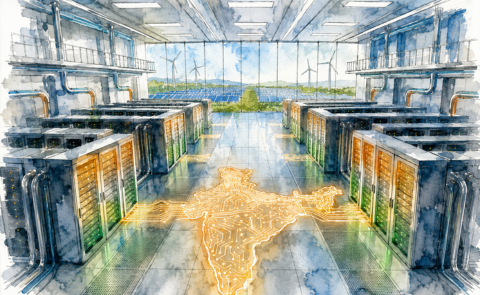
“Sovereign AI” has gone from a phrase coined by chipmakers to a working assumption in national policy. France backs Mistral, Saudi Arabia is building HUMAIN, and India has its India AI Mission. Across these efforts, the prevailing definition of sovereignty rests on a now-familiar checklist: own your chips, own your compute, own your data, and own your models, with talent as the connective tissue running through all four. [1]
Energy barely registers in this checklist, usually a footnote for utilities to resolve once policy and capital are in place. This article argues the ordering may be backwards. As the electricity bill for AI climbs into the hundreds of terawatt-hours worldwide, the ability to generate and reliably deliver power is becoming a hard constraint on what any country can do with AI. The question is not whether a country needs more electricity for its AI ambitions, but whether energy security deserves treatment as a core pillar of sovereign AI, rather than infrastructure beneath it.
The scale of AI’s electricity appetite is no longer speculative. Global data centre electricity use rose 17 per cent in 2025, and AI-focused facilities grew three times faster, against a 3 per cent rise in overall electricity demand. [2] The IEA projects data-centre electricity demand will more than double by 2030, reaching around 945 terawatt-hours, slightly more than Japan consumes today. [3] Five large technology companies directed over $400 billion in 2025 capital spending, projected to rise 75 per cent further in 2026, overwhelmingly toward compute and power. [4]
Training frontier models and serving inference at scale requires power that is concentrated, continuous and largely non-negotiable: a single large AI campus can draw as much electricity as a mid-sized city. The Center for Strategic and International Studies estimates the United States alone may need 40 to 90 additional gigawatts by 2030 for its AI build-out. [5] A country can hold the chips, the models and the data and still be unable to run AI at scale without power behind it.
This checklist was popularised in large part by Nvidia, whose business depends on governments believing they need exactly this. [6] It says almost nothing about the electricity that makes any of the five operable. Brookings Institution analysis this year argues full-stack AI sovereignty is out of reach for almost any country, since AI depends on a transnational web of inputs, minerals, chips, networks, data, talent and energy concentrated among a handful of suppliers. [7] Energy belongs on that list not as infrastructure beneath the “real” stack but as a resource a country must secure before exercising autonomy over the rest.
Washington has begun acting on this logic, if not in name: a July 2025 executive order fast-tracked federal permitting for AI-linked data centres, treating power access as core AI infrastructure policy. [8]
The United Kingdom has formalised the link institutionally through its AI Energy Council, co-chaired by the technology and energy secretaries since April 2025, ensuring the UK’s energy system is ready for AI infrastructure. [9] Its AI Growth Zones require candidate sites to demonstrate access to at least 500 megawatts of power. [10]
China’s experience is the most instructive, though not one India should simply replicate. For more than two decades, Beijing treated energy generation, hydropower, solar and wind manufacturing, and nuclear capacity as a strategic industrial capability rather than a supplementary layer, years before AI created any demand for it. By the time generative AI began consuming power at scale, China already possessed abundant, low-cost electricity in its resource-rich western provinces. The “Eastern Data, Western Computing” programme launched in 2022, backed by over 200 billion yuan (roughly $27 billion), relocated data-centre capacity west rather than building that abundance from scratch. [11] The 2025 plan binding data-centre approvals to electricity-supply planning reads as a second stage of a strategy laid down earlier. [12] The lesson generalises well beyond China’s model: a country’s capacity to scale AI a decade from now may already be fixed by decisions it makes, or fails to make, today.
AI’s energy efficiency is improving at a genuinely impressive rate; the IEA notes a single text query today can use less electricity than a television running for the same few seconds.2 But aggregate demand is growing faster than efficiency gains can offset, as AI workloads multiply. Progress and consumption are pulling in opposite directions, and consumption is winning.
Renewables are expected to meet roughly half of the additional electricity data centres will need by 2030 in the IEA’s base case, but dispatchable power, generation available regardless of weather, remains essential where interruption cannot be tolerated, and nuclear, geothermal and storage-backed solar have deployment timelines longer than typical AI investment cycles. [13] None of this makes AI leadership and climate goals incompatible, but reconciling both depends on deliberate, early planning.
India’s own sovereign AI programme illustrates the problem precisely. The IndiaAI Mission, backed by roughly Rs 10,372 crore ($1.25 billion), has built a national shared compute pool that crossed 34,000 GPUs by mid-2025, targeting 100,000 by end-2026, alongside pillars for models, data, safety and talent. [14]
Its energy foundation has not kept pace. Data centre capacity is projected to grow from roughly 1.2 GW today to between 4.5 and 10 GW by 2030, with annual electricity demand reaching 40 to 57 terawatt-hours, on top of overall demand the IEA expects to grow 6.4 per cent a year through 2030, among the world’s fastest. [15] [16] This growth is geographically concentrated: Mumbai and Chennai account for roughly three-fifths of operational capacity, straining grids least able to absorb new load. [17] Renewable capacity often cannot reach where needed either: IEEFA estimates over 50 gigawatts stood stranded as of mid-2025 for want of transmission, with FY25 additions running 42 per cent behind target. [18] [19]
India does hold real advantages, having crossed its COP26 target of 50 per cent installed capacity from non-fossil sources roughly five years early, in 2025. [20] [21] But headline renewable capacity is not the same as the firm, round-the-clock electricity AI infrastructure requires, and China’s experience suggests that closing that gap is what sustained, early planning is for, not a case for copying Beijing’s playbook wholesale. Some of that planning has begun: the Central Electricity Authority’s national resource adequacy plan for 2026-27 to 2035-36 has, for the first time, folded data-centre demand into the assumptions behind the country’s generation and storage build-out, alongside electric vehicles and green hydrogen. [22] That is a start, not yet a solution.
India is not alone in this bind. China keeps adding coal capacity even as it scales renewables and nuclear, commissioning 78 GW of new coal power in 2025, its highest annual total in a decade. [23] Europe leans on similar firm power as AI-driven demand rises, with the IEA expecting EU electricity consumption to grow through 2030 on a mix that includes gas-fired generation and a nuclear sector regaining policy support across advanced economies. [24] None of this argues for India to lean further on fossil fuels or to copy Beijing’s model. It is a reminder that AI readiness needs reliable, dispatchable electricity alongside, not instead of, a longer decarbonisation path.
Energy security deserves formal recognition as a core pillar of India’s sovereign AI strategy, integrated into the IndiaAI Mission itself rather than left as a separate infrastructure matter. AI demand should also be tracked as its own category in electricity planning, with IndiaAI Mission targets and the National Electricity Plan drawn into closer alignment. Transmission deserves the same priority as compute, given how much renewable capacity already sits stranded for want of it. [25] Dispatchable power needs a realistic mix rather than a single bet: the nuclear sector’s opening to private participation under the SHANTI Act, aiming for 100 gigawatts by 2047, was framed explicitly around supporting AI alongside storage and renewables. [26] New AI clusters could also be sited partly on power availability rather than the reverse. [27] A standing mechanism bringing MeitY, the Ministry of Power, the CEA, NITI Aayog and the IndiaAI Mission together, echoing the UK’s technology-energy council, could help close that gap.
Sovereign AI has typically been understood as a contest over chips, compute, data and foundation models. That framing captures what is most visible and easily funded, but not what is most decisive. As electricity rather than silicon increasingly sets the pace of AI at a national scale, energy security looks less like supporting infrastructure and more like a precondition for technological sovereignty, and Washington, London and Beijing already treat it that way in practice.
For India, the lesson from China is not to replicate a state-led model built for different conditions but to recognise that Beijing’s advantage was decades in the making, laid down before AI created the demand now exploiting it. The choices India makes on transmission, dispatchable capacity and institutional coordination over the next few years will likely decide how much of its AI ambition its grid can carry a decade out. The next race in artificial intelligence may not be won solely by the countries that build the best models but by those that build the energy systems capable of sustaining them.
Ashish Bharadwaj is the Distinguished Fellow for Law and Education, Gateway House.
Sairah Zahoor is a student at BITS Law School.
This article was exclusively written for Gateway House: Indian Council on Global Relations. You can read more exclusive content here.
Support our work here.
For permission to republish, please contact outreach@gatewayhouse.in
© Copyright 2026 Gateway House: Indian Council on Global Relations. All rights reserved. Any unauthorised copying or reproduction is strictly prohibited.
References:
[1] Center for a New American Security (2026): “CNAS Sovereign AI Index.” Maps the compute/data/talent/capital framing of sovereign AI used by governments worldwide. (https://interactives.cnas.org/reports/sovereign-ai-index/)
[2] International Energy Agency (April 2026): “Key Questions on Energy and AI.” Source for global data-centre electricity-demand figures and the AI-efficiency comparison cited in Sections II and IV. (https://www.iea.org/reports/key-questions-on-energy-and-ai)
[3] International Energy Agency (2025): “Energy and AI Report.” (https://www.iea.org/reports/energy-and-ai/executive-summary)
[4] International Energy Agency (April 2026): “Key Questions on Energy and AI.” Source for global data-centre electricity-demand figures and the AI-efficiency comparison cited in Sections II and IV. (https://www.iea.org/reports/key-questions-on-energy-and-ai)
[5] Center for Strategic and International Studies (April 2025): “Securing Full Stack U.S. Leadership in AI.” Source of the 40–90 GW additional U.S. energy-demand estimate. (https://www.csis.org/analysis/securing-full-stack-us-leadership-ai
[6] NVIDIA Corporation (2025): “What Is Sovereign AI?” Note: Nvidia has a direct commercial interest in government adoption of this framing. (https://blogs.nvidia.com/blog/what-is-sovereign-ai/)
[7]Brookings Institution (February 2026): “Is AI Sovereignty Possible? Balancing Autonomy and Interdependence.” (https://www.brookings.edu/articles/is-ai-sovereignty-possible-balancing-autonomy-and-interdependence/).
[8] The White House (23 July 2025): “Accelerating Federal Permitting of Data Center Infrastructure” (Executive Order). (https://www.whitehouse.gov/presidential-actions/2025/07/accelerating-federal-permitting-of-data-center-infrastructure/)
[9] UK Government, Department for Science, Innovation and Technology (8 April 2025): “Technology and Energy Secretaries chair first meeting of AI Energy Council.” (https://www.gov.uk/government/news/technology-and-energy-secretaries-chair-first-meeting-of-ai-energy-council)
[10] UK Government, Department for Science, Innovation and Technology: “Delivering AI Growth Zones” (https://www.gov.uk/government/publications/delivering-ai-growth-zones/delivering-ai-growth-zones)
[11] Jamestown Foundation (2026): “Energy and AI Coordination in the ‘Eastern Data Western Computing’ Plan.” (https://jamestown.org/energy-and-ai-coordination-in-the-eastern-data-western-computing-plan/)
[12] State Council, People’s Republic of China (September 2025): “China unveils plan on AI-energy integration to drive green transition.” (https://english.www.gov.cn/news/202509/08/content_WS68be8c3ec6d0868f4e8f566d.html)
[13] International Energy Agency (April 2025): “Energy and AI – Energy Supply for AI.” (https://www.iea.org/reports/energy-and-ai/energy-supply-for-ai)
[14] Press Information Bureau, Ministry of Electronics and Information Technology, Government of India (May 2025): “India’s Common Compute Capacity Crosses 34,000 GPUs.” (https://indiaai.gov.in| https://www.pib.gov.in/PressReleasePage.aspx?PRID=2132817)
[15] International Energy Agency (January 2026): “Electricity 2026 – Demand.” (https://www.iea.org/reports/electricity-2026/demand)
[16] Deloitte India and S&P Global Commodity Insights, as reported in Outlook Business (January 2026) (https://www.outlookbusiness.com/planet/industry/india-ai-data-centre-energy-sustainability-2030)
[17] Business Standard (October 2025) “India’s Data Centre Capacity to Double by 2027, Rise 5x by 2030: Macquarie” (https://www.business-standard.com/industry/news/india-s-data-centre-capacity-to-double-by-2027-rise-5x-by-2030-macquarie-125102801409_1.html)
[18] Institute for Energy Economics and Financial Analysis (IEEFA) and JMK Research & Analytics (October 2025): “Green power transmission: The invisible barrier in India’s clean energy growth.” (https://ieefa.org/resources/green-power-transmission-invisible-barrier-indias-clean-energy-growth)
[19] IEEFA (September 2025): “Transmission expansion trails renewable energy growth in India.” (https://ieefa.org/articles/transmission-expansion-trails-renewable-energy-growth-india)
[20] Ministry of Power, Government of India, Press Information Bureau (September 2025). (https://www.pib.gov.in/PressReleasePage.aspx?PRID=2223720)
[21] Enerdata (October 2025): “India hits 500 GW in installed power, over 50% from non-fossil sources,” (https://www.enerdata.net/publications/daily-energy-news/india-hits-500-gw-installed-power-over-50-non-fossil-sources.html)
[22] Central Electricity Authority, Ministry of Power, Government of India (March 2026): “National Generation Adequacy Plan (2026-27 to 2035-36).” (https://jmkresearch.com/wp-content/uploads/2026/03/Generation-Adequacy-Plan-2035-36.pdf)
[23] OilPrice.com (February 2026): “China Hits Renewable Milestone, But Coal Isn’t Going Anywhere.”(https://oilprice.com/Energy/Coal/China-Hits-Renewable-Milestone-But-Coal-Isnt-Going-Anywhere.html)
[24] International Energy Agency (January 2026): “Electricity 2026 – Supply.” (https://www.iea.org/reports/electricity-2026/supply)
[25] Institute for Energy Economics and Financial Analysis (IEEFA) and JMK Research & Analytics (October 2025): “Green power transmission: The invisible barrier in India’s clean energy growth.” (https://ieefa.org/resources/green-power-transmission-invisible-barrier-indias-clean-energy-growth)
[26] Press Information Bureau, Government of India (December 2025): “The Sustainable Harnessing and Advancement of Nuclear Energy for Transforming India (SHANTI) Bill, 2025.” (https://www.pib.gov.in/PressReleasePage.aspx?PRID=2206598®=3&lang=1)
[27] Business Standard (October 2025) “India’s Data Centre Capacity to Double by 2027, Rise 5x by 2030: Macquarie” (https://www.business-standard.com/industry/news/india-s-data-centre-capacity-to-double-by-2027-rise-5x-by-2030-macquarie-125102801409_1.html).