Ambassador Rajiv Bhatia is Distinguished Fellow, Foreign Studies Programme at Gateway House. He is a member of CII’s International Advisory Council, Trade Policy Council and Africa Committee. He is theChair of FICCI’s Task Force on Blue Economy, and served as Chair of Core Group of Experts on BIMSTEC. He is a founding member of the Kalinga International Foundation and a member of the governing council of Asian Confluence. As Director General of the Indian Council of World Affairs (ICWA) from 2012-15, he played a key role in strengthening India's Track-II research and outreach activities. During a 37-year innings in the Indian Foreign Service (IFS), he served as Ambassador to Myanmar and Mexico and as High Commissioner to Kenya, South Africa and Lesotho. He dealt with a part of South Asia, while posted as Joint Secretary in the Ministry of External Affairs. A prolific columnist, he is also a regular speaker on foreign policy and diplomacy in India and abroad. He was Senior Visiting Research Fellow during 2011-13 at the Institute of South East Asian Studies (ISEAS), Singapore. He holds a master’s degree in political science from Allahabad University.His first book India in Global Affairs: Perspectives from Sapru House(KW Publishers, 2015) presented a sober and insightful view of India’s contemporary foreign policy. His second book, India-Myanmar Relations: Changing contours(Routledge 2016) received critical acclaim. His third book, India-Africa Relations: Changing Horizons (Routledge 2022) has also been receiving positive reviews.
Expertise
Foreign Policy, Quad & Indo-Pacific, South & South-East Asia, Africa, Blue Economy
The G20’s current cycle is unique, with four Global South nations presiding consecutively: Indonesia, India, Brazil, and now South Africa. Brazil’s 2023-24 presidency exhibited both achievements and struggles, prioritising social inclusion, hunger, energy transition, and governance reform. The handover to South Africa marks a significant milestone in G20 history. Will the momentum be followed by the U.S., the next G20 president but also a G20 sceptic?
There was much at stake for the U.S.-Russia summit at Alaska – more than just the future of Ukraine. It will put the world back on economic track, and ease East-West relations, under stress for an on-going tariff war. For now, diplomacy has played a successful hand.
The India-Maldives bilateral, so fraught till recently, has seen a positive reset. This was evident in Prime Minister Narendra Modi’s July 25-26 visit to Male. Using patience, quiet diplomacy and a consultative process with the Maldivians, India is now on the path to achieving its bilateral and regional goals in tandem with its strategically critical neighbour in the Indian Ocean.
PM Modi's five-nation tour highlights that despite geopolitical conflicts, New Delhi remains confident in its ability to balance relationships with the North and South.
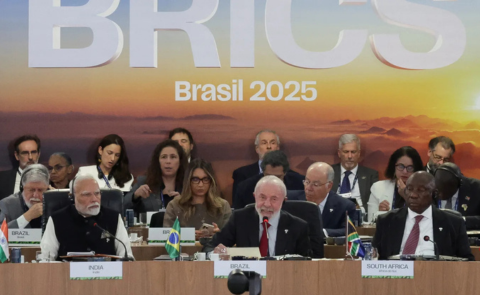
While BRICS does have a wise agenda, backed by considerable unity, it is not in a strong position to garner the world’s support for it. The fissures within the G7, the tensions between the U.S. and Europe, and the unilateralism of Washington leave little room for BRICS to develop an international consensus on the issues agreed at the recent Rio Summit.
BRICS is undergoing a major transformation—expanding its membership, redefining its global role, and navigating geopolitical tensions. As the group prepares for the Rio Summit in July 2025, key challenges include integrating new members, reforming multilateral institutions, and balancing economic ambitions with strategic unity. With India set to chair in 2026, the bloc’s evolving identity will shape its global influence.
PM Modi's multi-country visit from 15-19 June to Cyprus, Canada, and Croatia demonstrated India's expertise in nurturing ties with great powers, middle powers and state powers. The common thread was twofold: to represent India at the still-important summit of the Group of Seven in Alberta, and to push India’s strategic partnership with the EU, by forging closer ties with the countries of eastern and central Europe.
Most multilateral and plurilateral institutions have lost their significance and ability to shape the trajectory of international relations today. The G7 is no exception. It is impacted by the shift of power from the Atlantic to the Pacific, and an intra-Atlantic rift. The G7 discussions reflected this. More positive were the sideline discussions on repairing the India-Canada bilateral.
Canadian Prime Minister Carney can use the upcoming G7 summit he is hosting to advance the North-South dialogue and cooperation and also to discuss the strained bilateral with India. India can articulate the viewpoint of the Global South, stressing its conviction that the G7 is better served by constructively working with developing and emerging economies.
Studying the reaction of key stakeholders to the India-Pakistan conflict, and how India’s diplomatic machine coped with it, is revealing. Some of the major powers like the U.S., raised the temperature, China expectedly stood by Pakistan while Russia once again proved a dependable friend. Unsurprisingly, South Asia had a consistently neutral stance toward the conflict.